YouTube Is the New NBC. TikTok Is the New MTV.
The distribution layer of modern television is controlled by two companies headquartered in Mountain View and Los Angeles. Neither sends a representative to the Television Academy gala. The data is unambiguous. The industry just refuses to state it plainly.
Once social feeds are accepted as the new linear, the question of who owns the new broadcast networks becomes trivially easy to answer. The data is unambiguous. The industry refuses to state it plainly because saying it out loud means accepting that two companies — neither of which courts the Television Academy — now control the distribution layer of modern television.
YouTube Is the New NBC
This isn't a metaphor. It's a straight read of the financials and the viewership data.
YouTube commands 12.7% of all U.S. television viewing — more than any single traditional media conglomerate (Nielsen February 2026 Gauge). Its 2025 revenue across ads and subscriptions exceeded $60 billion (Alphabet Q4 2025 earnings) — larger than the entire annual revenue of most legacy broadcasters, and larger than Netflix's $45 billion. Its connected-TV ad revenue alone is projected to hit $9.21 billion in 2026, accounting for nearly 12% of all U.S. CTV ad spending (eMarketer/Insider Intelligence, 2025).
The dominance isn't just measured in dollars. On BCG's consumer satisfaction index, YouTube scores 7.8 — above every paid SVOD service except Netflix, and significantly above traditional FAST platforms at 6.8 (BCG GIFTs Survey, 2025). When Gen Z respondents are asked why they use YouTube, "Creators" ranks first at 22% — ahead of "Free" at 18% (BCG GIFTs Survey, 2025). The moat isn't price. The moat is programming. YouTube has out-programmed HBO in the eyes of a generation that will pay a $15-a-month premium for Netflix but spends most of their actual viewing hours on a platform that costs them nothing.
The arrival of YouTube Stations closes the loop. The backend feature will ultimately allow any channel convert a VOD playlist into a 24/7 linear stream with a single click — eliminating the last technical moat separating legacy FAST platforms from creator-driven linear. Thousands of creators can now operate channels that function identically to cable networks, without licensing deals, without carriage fights, without an EPG grid. A generation of new linear inventory is about to flood the CTV ecosystem, and legacy FAST isn't structurally equipped to compete with it on discovery.
TikTok Is the New MTV
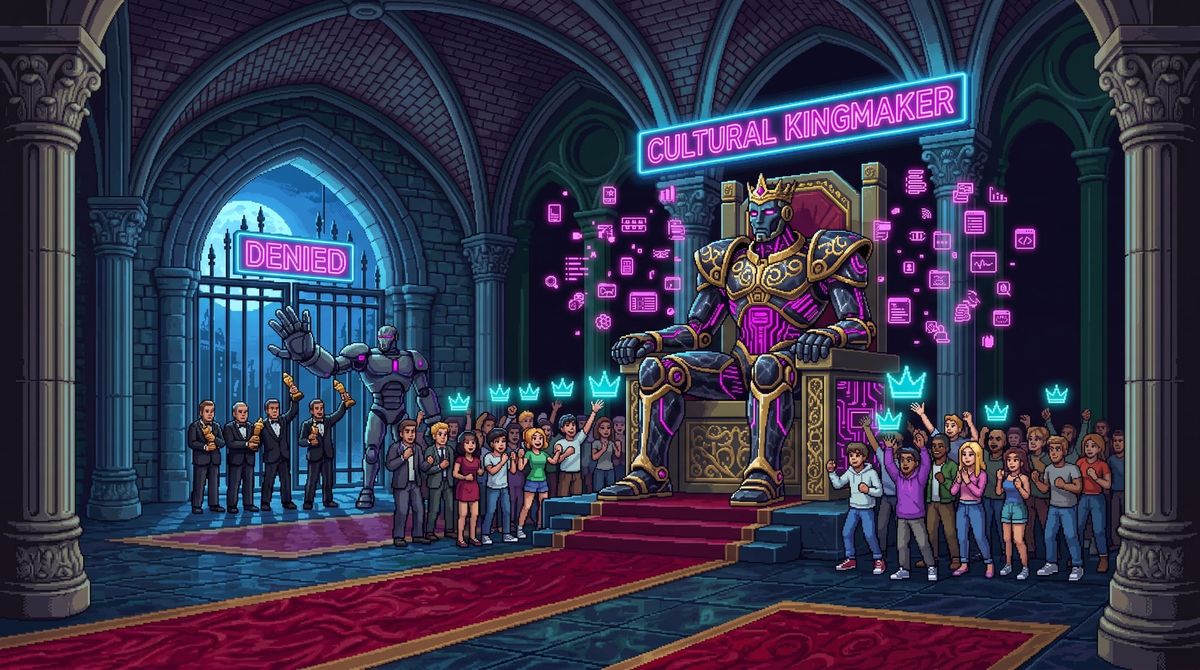
Not because it plays music videos — though it effectively does — but in the deeper sense MTV occupied for Gen X: the Cultural Kingmaker. The platform that decides what's relevant, what's over, what's worth wearing, what's worth watching, what counts as cool this week. MTV did this through VJs and music-video rotation schedules. TikTok does it through a recommendation algorithm that processes billions of signals a day. The mechanism is different. The function is identical.
The migration data confirms the cultural transfer. 43% of Gen Z now name YouTube or social video as their most preferred video consumption platform — versus 37% for paid streaming, 12% for traditional TV, and 8% for free streaming (Activate Technology & Media Outlook 2026, via Variety). The preference compounds across cohorts: Millennials at 36%, Gen X at 31%, Boomers still hold the line at 19%. Each younger cohort hands more programming control to the algorithm.
The directional forecast is starker. Across all U.S. adults, daily streaming time (which includes YouTube) is projected to grow from 3 hrs & 12 minutes in 2025 to 4 hours and 8 minutes by 2029. Daily traditional TV time falls from 1:56 to 1:17 in the same window — a 10% annual decline (Activate Technology & Media Outlook 2026, via Variety). The share of daily attention legacy media controls shrinks every year. Gen Z's preferences are tomorrow's averages.
The deeper signal: 38% of Gen Z watch absolutely no live traditional television — a generation of cord-nevers who were never on the grid and are not coming (Attest Gen Z Media Consumption 2026). 56% of Gen Z and 43% of Millennials say social-media content is more relevant to them than traditional TV shows and movies (Deloitte Digital Media Trends, 2025).
BCG's consumer data captures the cultural flip with the sharpest precision: general TV enjoyment has declined 0.4 points since 2022, while enjoyment of social video has surged 0.4 points in the same period — officially crossing the line (BCG GIFTs Survey, 2025). Consumers are simply having more fun on algorithmic feeds. Given a free Tuesday evening, more of them now choose TikTok over HBO. That isn't a demographic subtrend. That's the central fact of modern television. How long until we see the TikTok VMAs?
The Personalized Grid
The programming works exactly like the old network schedule — just personalized.
In 1995, the viewer wanting something light and funny at 8 PM turned on NBC. No specific episode chosen. No plot synopsis evaluated. The viewer trusted the network to fill the slot with something that matched the cultural mood of "Thursday night, 8 PM, couch." NBC's programming team earned their multi-million-dollar salaries by correctly predicting that mood across sixty million living rooms simultaneously.
Today, that same 8 PM slot is filled by an algorithmic feed that predicts the mood for each individual viewer. Not for sixty million living rooms in aggregate — for one living room, refined in real time based on the previous seven days of viewing data. The programming is more accurate than it has ever been in the history of the medium. The network is programmed by a model instead of a human. The schedule is rebuilt every six seconds.
This is the single point legacy media cannot get past. They keep looking for the grid. The grid isn't gone — it's been broken into a billion Personalized Grids, one per viewer, rebuilt continuously. Anyone waiting for the grid to "come back" is waiting for a version of television that could only exist when broadcast bandwidth was a scarce resource.
It isn't coming back. Stop waiting. Part IV names the new gatekeepers — the people and algorithms now running the schedule.
An audit of who actually owns Gen Z's living room.
Part I — Gen Z Didn't Kill Linear TV. They Switched Networks.
Part II — Linear Was Never the Cable Box
Part III — YouTube Is The New NBC. TikTok Is The New MTV. (you are here)
Part IV — Creators Replaced the Talent. Algorithms Replaced the Programmers.
Part V — The Three Delusions Legacy Media Won't Abandon (5/15)
Conclusion — Gen Z Didn't Kill TV. Legacy Media Stopped Owning It. (5/19)