Creators Replaced the Talent. Algorithms Replaced the Programmers.
A broadcast network was never just a distribution channel — it was a gatekeeping apparatus. The Control Layer's gatekeeping function has migrated to two new classes of operators. Neither one works for legacy media.
A broadcast network was never just a distribution channel. It was a gatekeeping apparatus. The real power of NBC in 1995 wasn't that it owned the 8 PM Thursday slot — it was that NBC's executives decided who got to fill it. Jerry Seinfeld didn't become Jerry Seinfeld because he was funny. Plenty of comedians were funny. He became Jerry Seinfeld because somebody at NBC decided he got the slot, and fifty million people would be watching.
The Control Layer's gatekeeping function has migrated from network executives to two new classes of operators: creators and algorithms. Together they now perform the exact function that network programming departments performed for seventy years — deciding what gets made, what gets seen, and what survives long enough to matter.
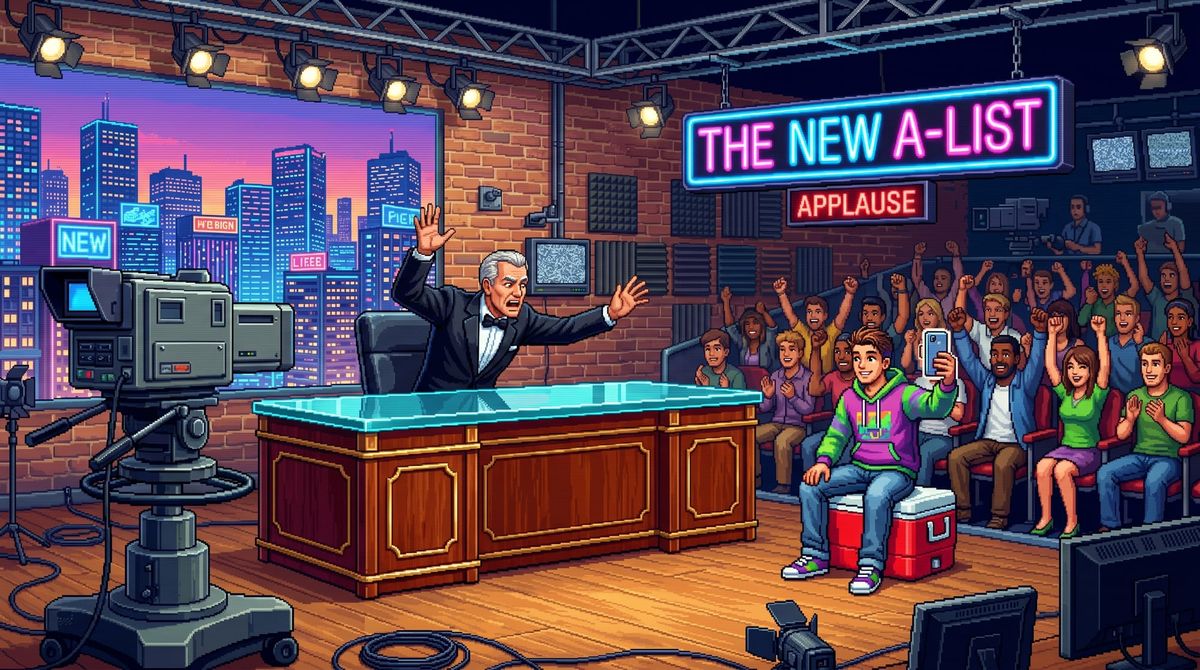
Creators Are the New A-List
Not the new independent voices. Not the new alternative layer. The new A-list, full stop.
MrBeast is the new Johnny Carson. He draws the largest consistent global audience of any entertainer on the planet, and his audience is more valuable to advertisers, per viewer, than any linear late-night show on any broadcast network. Kai Cenat is the new late-night. His live streams draw tens of thousands of concurrent viewers without a writing staff, without a production crew, without a script. A loud, funny friend on the couch — simulating the social ritual that late-night talk shows used to occupy. Hot Ones is the new Tonight Show celebrity interview. Smosh is the new SNL for a generation that finds SNL embarrassing.
The audience reception confirms the lineage. Tubi's Stream 2026 report found that 67% of adult streamers say digital creator content feels "more original" than most traditional TV and movies. 63% say watching it feels no different from streaming a traditional TV show (Tubi Stream 2026).
This isn't Gen Z dismissing premium television. It's a broader adult audience — including cohorts over 45 — actively treating creator content as premium television. When a 55-year-old watches a YouTube carpenter build a deck for three hours on their living room TV, they aren't consuming "user-generated content." They're watching This Old House with better production values, no commercial breaks, and a host whose endorsement carries weight.
Algorithms Are the New Programming Directors
And unlike NBC's programming team, they are right more often.
49% of Gen Z viewers say they watch premium TV shows on SVOD services only after hearing about them from online creators first (Deloitte Digital Media Trends, 2024). 60% explicitly prefer user-generated social content over traditional streaming because they don't have to spend time searching (Deloitte Digital Media Trends, 2024). 63% of young viewers discover premium TV shows and movies for the first time via fragmented clips on social platforms (Hub Entertainment Research, Video Redefined 2025). 73% of younger demographics explicitly prefer recommendations surfaced by organic social-media algorithms over official streaming-app homepages or studio marketing campaigns (S&P Global Market Intelligence, 2025).
Every one of these statistics says the same thing: the algorithm now decides what legacy media's own premium content gets promoted to whom. A billion-dollar HBO drama that doesn't get picked up by the TikTok algorithm is, from a discovery standpoint, invisible to Gen Z. An ignored Paramount+ catalog show that catches algorithmic momentum becomes Suits — 57.7 billion viewing minutes, a career resurrection for its cast, and a retroactive cultural phenomenon (Nielsen Streaming Unwrapped, 2024).
Suits LA is the inverse receipt. NBC ran the same TikTok playbook on the spinoff but locked it to NBC linear and Peacock. The algorithm couldn't send traffic to a walled garden. It was cancelled in a season (Variety, May 2025). The algorithm is the new network greenlight committee. It just runs on engagement data instead of executive intuition — and the show only succeeds if the access surface is open.
The 8-Second Pitch Meeting
The new gatekeeping rules are simpler than the old ones. And crueler.
The 8-Second Evaluation Filter has replaced the 15-minute pilot episode. The opening moment of every piece of content is now the pitch meeting. No development cycle. No focus group. No upfront presentation. The algorithm runs the pitch in real time, millions of times per hour, and drops whatever fails the filter. What survives gets served to the next viewer. What doesn't, disappears.
This is Darwinian Programming. Faster and more accurate than anything legacy media has ever had access to — which is precisely why legacy media finds it so disorienting to compete with.
Stop competing with the algorithm. Hand it the asset and let it program. Part V names the three legacy delusions still keeping operators from doing exactly that.
An audit of who actually owns Gen Z's living room.
Part I — Gen Z Didn't Kill Linear TV. They Switched Networks.
Part II — Linear Was Never the Cable Box
Part III — YouTube Is The New NBC. TikTok Is The New MTV.
Part IV — Creators Replaced the Talent. Algorithms Replaced the Programmers. (you are here)
Part V — The Three Delusions Legacy Media Won't Abandon (5/15)
Conclusion — Gen Z Didn't Kill TV. Legacy Media Stopped Owning It. (5/19)