The Era Split: Seven Outcome Curves of Cultural-Asset Acquisitions
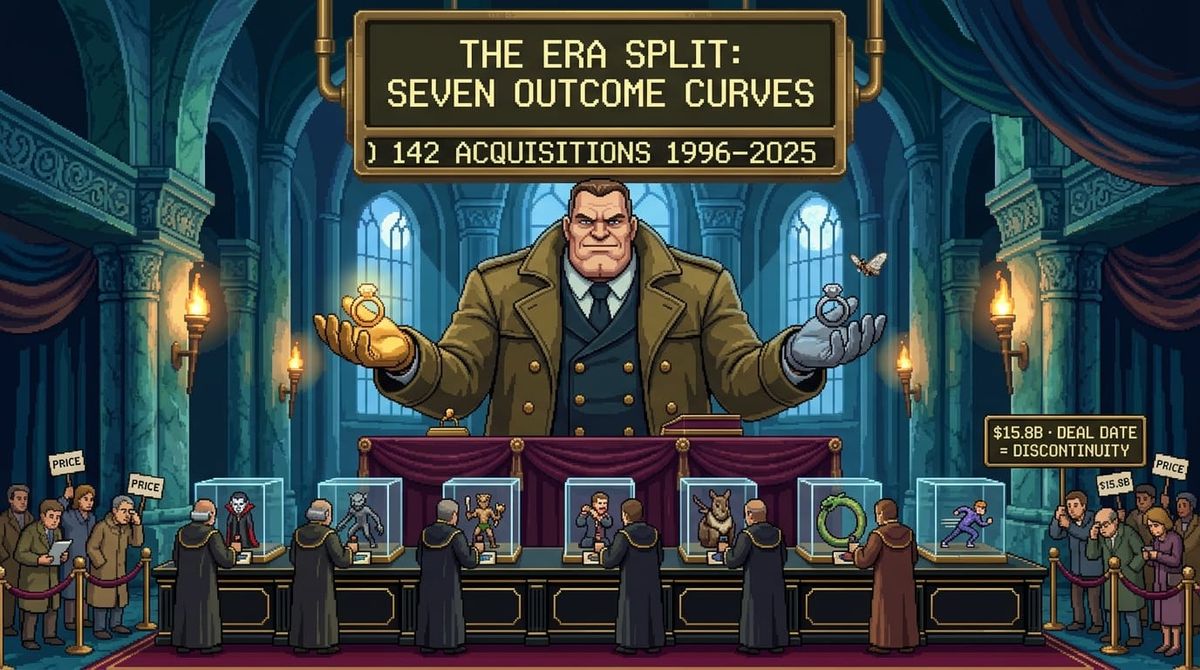
Vampire, Skinwalker, Trophy Hunter, Strangler, Taxidermist, Ouroboros, Speedrunner. Seven curves catalogued from 142 documented acquisitions 1996–2025.

A Tiffany engagement ring purchased in 2019 and a Tiffany engagement ring purchased in 2024 are not the same asset.
This is not metaphor. On the secondary market — at estate consignors, on 1stdibs, at vintage-jewelry specialists — Tiffany pieces produced before LVMH's $15.8 billion acquisition (closed January 2021) carry a measurable premium over pieces produced under LVMH ownership. The setting standards have not formally changed. The marks are nominally the same. But buyers behave as if a discontinuity occurred at the deal date, and they are not wrong — Tiffany's positioning, product development cadence, and category mix have all shifted under the new ownership. The market is pricing the founder-era and the corporate-era as two different products.
This pattern is not unique to Tiffany. It is the dominant pattern in cultural-asset acquisitions. We catalogued seven outcome curves the pattern produces — seven distinct ways an acquired brand's catalog bifurcates by era, with seven distinct market consequences.
We catalogued them by accident. Over three weeks we built a procedural simulator of cultural-asset markets that had to model what happens when one brand buys another. The simulator's mechanic — that on acquisition, the acquired brand's catalog splits by era, with pre-deal inventory appreciating and post-deal inventory depreciating — kept reproducing the same seven shapes across thousands of runs. The shapes correspond, with strong fidelity, to observed real-world acquisitions across luxury, tech, streetwear, footwear, food, and media.
The findings travel.
The era split
Every acquisition of one brand by another produces a forced split in the acquired brand's catalog.
Pre-deal inventory becomes the "real era" — the founder-era, the independent-era, the era before corporate strategy attached itself to the product. This inventory appreciates on the secondary market. The appreciation curve varies by outcome; the direction is consistent.
Post-deal inventory becomes "the new product." The new product depreciates relative to the pre-deal inventory, even when objectively comparable, because buyers read it as carrying corporate compromise — choices made under the acquirer's strategy rather than under the founder's hand.
This split happens regardless of whether the new product is actually worse. It happens at the price-discovery layer, not the product layer. Markets reprice categorical authenticity, and the deal date is what marks the categorical break.
The split unfolds across four phases. Whisper: the rumor period before announcement; finance-trading cities front-run the deal. Announce: the deal drops, the catalog re-prices the whole inventory. The Tell: over the following weeks and months, signals reveal which outcome shape the deal is following. Settle: vintage finds its appreciation floor, new product finds its depreciation floor, and the relative spread becomes the steady-state.
What determines which shape a deal follows? Mostly the cluster pairing of acquirer and target — but the seven shapes themselves are stable. Once you can read a deal's shape, you can predict its trajectory.
The seven outcomes
Pick an outcome shape and a named acquisition to see the side-by-side — engine cascade × real-world deal. Every bolded acquisition in the case descriptions below deep-links into this preview at the matching scenario.
1. Vampire — slow bleed; vintage is the grail
The acquirer keeps the acquired brand running roughly as before but quietly extracts value. New product gradually loses its edge — manufacturing relocations, material downgrades, design conservatism — without any single visible inflection. Vintage pieces from the pre-deal era appreciate slowly and durably as the new product becomes legibly diluted.
Brooks Brothers under Authentic Brands Group (acquired out of bankruptcy August 2020 for $325 million, via SPARC Group, an ABG/Simon Property Group joint venture) is the canonical Vampire of the 2020s. The Madison-Avenue-era suits — pre-2010 No. 1 sack-cut sport coats, the Brooks 346 tweed three-twos — appreciate on Grailed and at estate consignors. The new product, manufactured to a price-tier requirement, has lost its old reputation as the cheapest path into respectable American tailoring. The vintage moons. The new bleeds. Slowly.
2. Skinwalker — spike then erode; founder-era wins
The acquirer maintains the brand's public posture, but the creative direction shifts. There is usually a marketing spike at announcement (a campaign, a celebrity face-of-house, a refreshed flagship) that drives short-term sales. Over the following eighteen to thirty-six months, the founder-era identity erodes as the new ownership's aesthetic preferences accumulate. The founder-era inventory becomes legibly different and appreciates.
Tiffany under LVMH is the contemporary Skinwalker. The August 2021 Beyoncé and JAY-Z "About Love" campaign was the announce-phase spike. The subsequent four years have brought the Lock collection, the redesigned Fifth Avenue Landmark store, and a stylistic drift toward LVMH-house aesthetics. Pre-2021 Tiffany pieces — particularly the Elsa Peretti and Paloma Picasso ranges — appreciate on consignment as Tiffany under LVMH legibly departs from Tiffany before LVMH.
3. Trophy Hunter — spike then forgotten; ends in writedown
The acquirer paid premium prices in a competitive process, generated a brief celebration spike at announcement, then quietly let the brand atrophy as integration synergies failed to materialize. Years later: a writedown that priced the deal as a loss.
Yahoo × Tumblr is the textbook Trophy Hunter. Acquired May 2013 for $1.1 billion under Marissa Mayer's "millennial relevance" thesis; sold August 2019 to Automattic for approximately $3 million, less than 0.3% of the purchase price. Tumblr's user base did not migrate to Yahoo properties; content-moderation politics drove away the remaining audience; the brand was eventually offloaded for what amounts to a rounding error on the original deal. Pre-Yahoo Tumblr (2007–2013) is remembered as a cultural moment; post-Yahoo Tumblr is remembered as a cautionary tale. HP × Autonomy ($11.1 billion in 2011; $8.8 billion writedown in 2012) and News Corp × MySpace ($580 million in 2005; sold to Specific Media for $35 million in 2011) are the older Trophy Hunters. The shape is older than the acquisitions; it just keeps repeating.
4. Strangler — acquired brand dies; the acquirer's rival line wins
The acquirer kills the acquired brand to clear the way for its own competing line. The acquired brand's catalog enters scarcity; both the acquired brand's farewell inventory and the acquirer's competing line appreciate.
Quaker × Snapple is the case study every M&A textbook teaches. Acquired November 1994 for $1.7 billion; sold March 1997 to Triarc for approximately $300 million — a 27-month round trip that destroyed roughly $1.4 billion in shareholder value. Quaker tried to integrate Snapple's distribution into Gatorade's channels, alienated Snapple's existing distributor network, mismanaged the brand's anti-corporate identity, and effectively killed it within two years. Quaker's own Gatorade thrived in the absence of Snapple's competitive pressure. The 1994-era Snapple bottles — particularly the hand-illustrated "Wendy" flavor variants — appreciate on collector forums as artifacts of a brand strangled in three years.
5. Taxidermist — brand becomes a licensing vehicle; original vintage moons
The acquirer recognizes the brand has value but the operating business is unsustainable. The solution is to convert the brand into a licensing operation. The brand name appears on increasingly distant categories. Original-era inventory becomes scarce and appreciates dramatically.
Off-White under LVMH is the contemporary Taxidermist. LVMH acquired a 60% majority stake in Off-White in 2021. Virgil Abloh died in November 2021. Post-Virgil, Off-White has functioned increasingly as a licensing operation — collaborations with diverse partners, expanded category presence, but no central designer voice. Virgil-era pieces (especially the early Pyrex Vision work and the 2013–2018 mainline Off-White) have appreciated on Grailed and via auction houses as fundamentally different products from post-Virgil Off-White.
Pierre Cardin is the historical Taxidermist — Cardin licensed his name across categories from cookware to leisure suits to pens, and original-era Cardin haute couture is now worth more than entire categories of contemporary Pierre Cardin SKUs by orders of magnitude. The taxidermist outcome has been operating in fashion since the 1970s.
6. Ouroboros — rebrand churn; every retired logo appreciates
The brand (or its post-acquisition leadership) responds to identity uncertainty with serial rebrands. Each retired logo, packaging system, and aesthetic regime becomes appreciative inventory in its own right. The brand effectively eats its own past and resells it.
Burberry's logo and identity churn since the late 1990s is the contemporary Ouroboros. The 1901 equestrian-knight logo (in use through 1999) was retired by Christopher Bailey; restored partially under Riccardo Tisci's TB monogram (2018); replaced again under Daniel Lee (2022). Each retired identity-era has its own collector market on vintage resale platforms — pre-1999 trenches, 2001–2017 Bailey-era, 2018–2022 Tisci TB-monogram. The brand has, intentionally or otherwise, manufactured its own vintage tiers.
7. Speedrunner — founder-exit cliff; founder-era moons
The brand's market value is anchored to a single founder's identity. The founder exits — through termination, departure, or visible step-back — and the brand cliffs. Founder-era inventory appreciates dramatically and durably.
Yeezy after Adidas is the cleanest Speedrunner of the decade. The Adidas partnership was terminated on October 25, 2022, following Kanye West's antisemitic comments. Pre-termination Yeezys (especially the 2015–2018 Boost 350 V1s and the 2020 Foam Runners) appreciated thirty to eighty percent on StockX in the six months following the termination. Adidas managed approximately $1.3 billion in unsold post-termination inventory through controlled Yeezy drops in 2023–2024, recovering most of the inventory value while directing a portion of proceeds to anti-hate charitable commitments. The founder-era Yeezys are now distinct collector assets from the post-Kanye Adidas-branded successors.
Supreme after Jebbia's step-back is the slower-burning Speedrunner. James Jebbia remained creative director through the 2020 VF Corporation acquisition, but operational decisions migrated upward. By 2024 — when VF announced the sale to EssilorLuxottica — pre-2020 box-logo hoodies and early-era Supreme accessories had become a separately tracked collector tier on Grailed.
Eight deals, seven outcome curves. Test the framework before moving on — each session pulls a fresh eight from a pool of sixteen.
What the taxonomy is for
For brand acquirers, the taxonomy is a diligence framework. Before signing a deal, walk through which outcome the cluster pairing implies, and price the acquisition accordingly. Status-cluster acquirers buying Heritage-cluster targets reliably produce Skinwalker outcomes. Platform-cluster acquirers buying Status-cluster targets reliably produce Strangler outcomes. Conglomerate-cluster acquirers paying premium prices in competitive processes reliably produce Trophy Hunters. The model predicts these, and in the simulator's run, seven of eight named historical acquisitions land in the predicted cell.
For acquisition targets, the taxonomy is a price-floor argument. If your sale will plausibly produce a Taxidermist outcome, your archived inventory and your founder-era output retain value independent of the going-forward operating business. That value belongs on the balance sheet — separately from the operating business — and the seller should price accordingly.
For collectors and resale operators, the taxonomy is a tier-discovery framework. The era split happens whether or not the secondary market has organized around it. When it has not yet — early days of an acquisition, or during a quiet Vampire bleed — there is a window for buying founder-era inventory at pre-split prices.
The seven shapes are not currently in any MBA curriculum. They were not in ours. We catalogued them by trying to build a simulator that produced acquisition cascades the player would believe — and the shapes that work in the simulator are, with surprising fidelity, the shapes that have been operating on every major brand acquisition in the public record.
What makes a Tiffany ring from 2019 a different asset from one purchased in 2024 is the same thing that makes a pre-VF box-logo hoodie a different asset from a post-VF one, and the same thing that made a 1994 Snapple bottle worth more than a 1996 Snapple bottle. The discontinuity is real, and it is pricing the deal in the secondary market in real time. The taxonomy just lets you name the shape before you have finished watching it run.
🎮 Play this article in the game · Deck: Finance · Seed: Tiffany Skinwalker → dripdriphype.xyz/play?deck=finance&seed=acq_skinwalker_tiffany&piece=W04