The Colorado River legally owes more water than it carries, and the deal sharing it expires in 2026. Farms, chip plants, and data centers all need a piece — and the lawsuits are just starting.
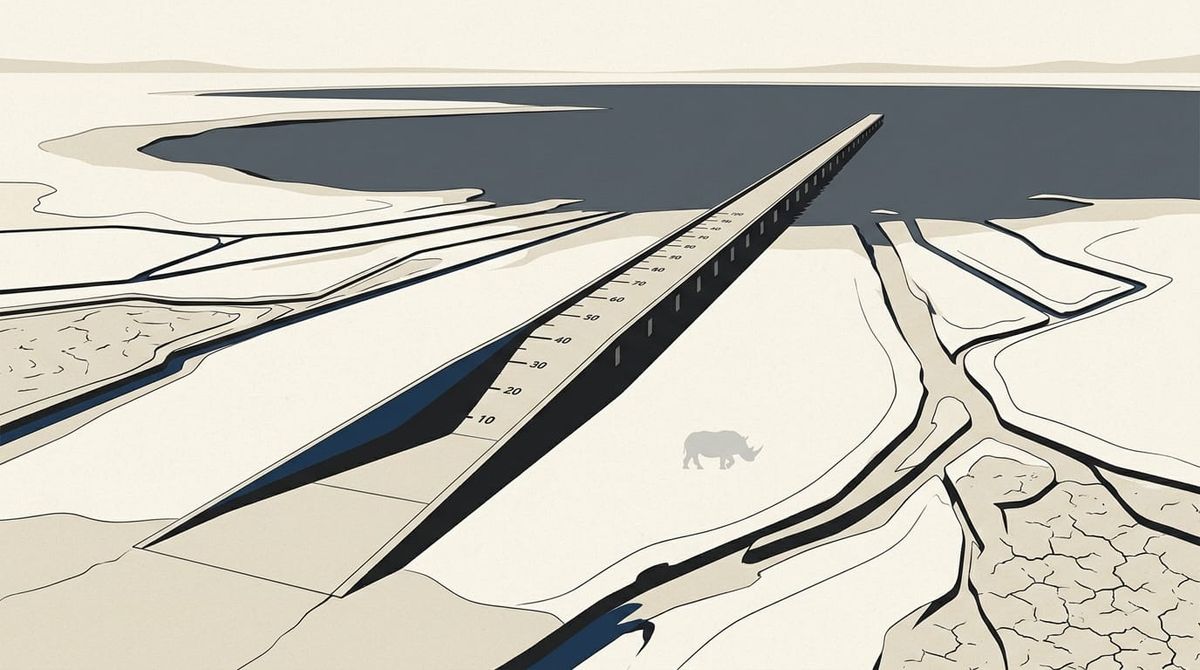
The Colorado River was carved up in 1922 on the promise of 12 million acre-feet a year. Since 2000 it has carried about 10 million — a 17% shortfall written into every state's water right. The rules dividing that water expire in 2026, with no agreed referee and lawsuits already filed by Arizona, Nevada, and California. Lake Mead hit 27% full in 2022, triggering cuts of up to 40%.
The market treats this as a distant drought story. It is a fixed legal deadline. Farms use 80% of the water, so they are first in line for cuts — and they feed a $1.7 trillion food chain. Meanwhile, factories that never existed in 1922 now demand their share.
Taiwan Semiconductor Manufacturing and Intel both run thirsty chip plants in Arizona and named water as a risk. Microsoft runs water-hungry data centers in the region. Archer-Daniels-Midland depends on the farm output the river sustains. Limoneira, a California citrus grower, sits directly on contested water rights. Each loses if cuts land hard.
Why this matters. The Colorado River legally owes more water than it carries, and the deal dividing it runs out in 2026 with no agreed way to settle fights. Farms, chip plants, and data centers will battle over a shrinking supply, and the losers face forced cuts and lawsuits. Lenders, operators, and investors with money tied to Southwest farming, food, or new factories should treat this as a fixed deadline, not a distant worry.
Blindside · US Macro Risk
The River Runs Out
The Colorado River promises more water than it holds, and the deal expires in 2026
Building
82
Blindside index
What drives it — drag to test
each slider starts at our cited estimate — drag to see the range
Share of the regional economy hit by water cuts11%
Sourced — Farms use 80% of the water; cutting 15–30% of that ripples through to roughly 8–14% of regional output.
Odds the 2026 water talks fail to stop damage55%
Sourced — No agreed way to settle disputes after 2026; Arizona, Nevada, and California are already suing each other.
Extra drag on chip plant and data center spending+12%
Our judgment — Chip plants and data centers named water as a risk in filings; no published dollar figure yet.
Time to impact
3–5 yearsBuilding
now3 yrs7+ yrs
When the financial hit begins to land, on our read.
How to read this. Drag any slider to test your own number — the chart and index update live. The likelihood and the locked facts stay put.
Yearly economic output at risk
$55.3bn7.38% of sector
Dark line = most likely · faint lines = low–high (8 in 10 outcomes land between) · shaded band = what outside analysts expect
Our estimate lands within what outside analysts expect ✓
Chance this is a permanent shift, not a blip
62%
Average of five independent reads (range 50–70%):
The track record65%
The water shortfall has been known since the 1980s; the 2026 deadline is a fixed date, not a maybe.
How it works70%
Water rights are property. Moving them needs a sale, a federal order, or a court — all slow and bitterly contested.
The skeptic's case50%
Wet years refilled reservoirs in 2023, drip irrigation cuts demand, and a deal could buy time past 2030.
What investors show65%
Chip plants and data centers now name water limits in site documents and earnings calls — this is new and real.
What regulators signal60%
A 2024 federal rule set up Washington to override state water rights in a shortage, guaranteeing lawsuits whatever happens.
Fixed — the sliders change the size of the hit, not the odds it's permanent.
Why this matters
The Colorado River legally owes more water than it carries, and the deal dividing it runs out in 2026 with no agreed way to settle fights. Farms, chip plants, and data centers will battle over a shrinking supply, and the losers face forced cuts and lawsuits. Lenders, operators, and investors with money tied to Southwest farming, food, or new factories should treat this as a fixed deadline, not a distant worry.
The 1922 Colorado River agreement promised 12 million acre-feet a year, but the river has averaged only 10 million since 2000 — a 17% shortfall baked into every state's water right.
Bureau of Reclamation — Colorado River Basin Water Supply and Demand Study (2012, updated 2023)
−40%
Lake Mead fell to 27% full in 2022, its lowest ever, forcing official shortage declarations that cut Arizona and Nevada water by up to 30–40%.
Bureau of Reclamation — Lower Colorado River Operations (2022–23)
80%
Farms use about 80% of the water actually consumed from the Colorado River, making agriculture the first target for cuts.
USDA Economic Research Service — Colorado River Basin Agriculture (2023)
2026
The current rules for sharing the river expire in 2026, and states and the federal government must rewrite them with no agreed referee and lawsuits already filed.
Bureau of Reclamation — Colorado River Post-2026 Framework (2024)
$1.7T
The US Agriculture Department estimates the Colorado River supports about $1.7 trillion in farm and food output across the country each year.
USDA Economic Research Service — Economic Contribution of Colorado River Water Use (2023)
58%
The Ogallala Aquifer, which waters 30% of all US groundwater-irrigated land, has lost an average of 58% of its volume in the hardest-hit areas since farming began.
USGS — Groundwater Depletion in the United States (updated 2023)
Attention stays flat and low while the impact builds. the gap stays open.
Our rough estimate puts Southwest economic output at risk from forced water cuts at about $55.5 billion a year (range $43.4–$70.5 billion), roughly 7.4% of the $750 billion regional base. This fits the US Agriculture Department's figure that the river supports $1.7 trillion in downstream output. The 2026 expiration is a contractual deadline, not a planning guess, and the Ogallala Aquifer's 58% depletion adds a second physical clock.