AI is demanding power faster than the grid can deliver. New power lines take 13 years; 19 of 25 regions already face reliability risk. The likely bill: $17-19 billion a year.
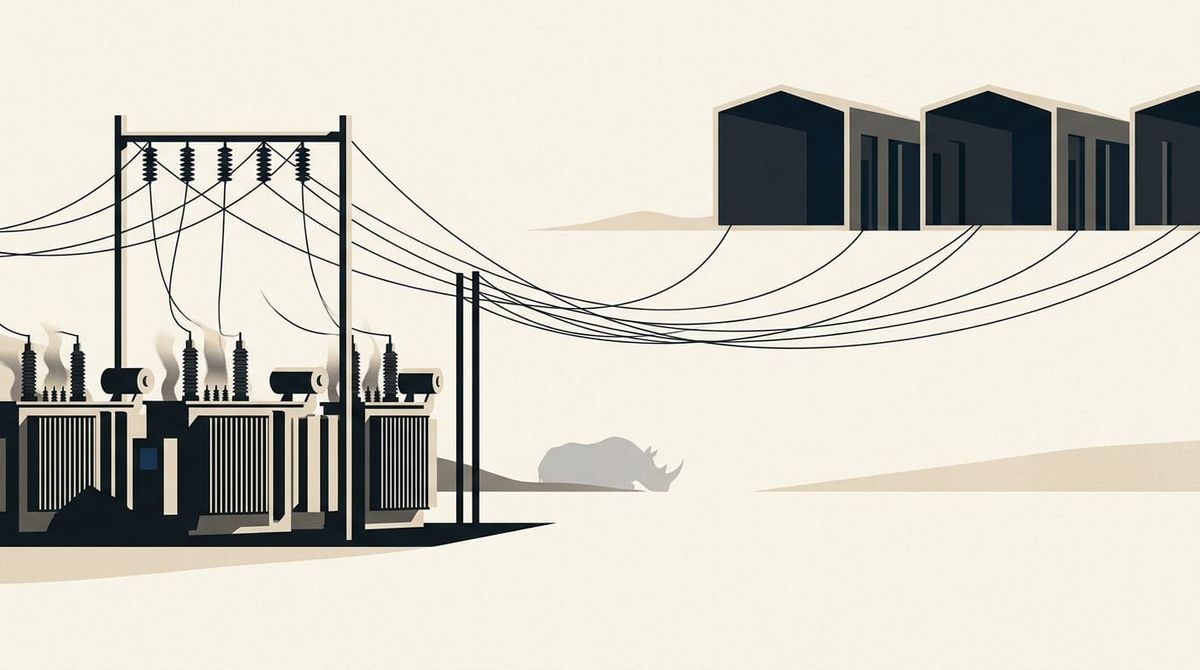
Artificial intelligence is forcing data centers to demand electricity faster than the grid can supply it. Their share of US power use is set to climb from about 4% in 2023 to 9.1% by 2030, while the average new power line takes about 13 years to build. Grid operators have already flagged 19 of 25 North American regions as facing heightened reliability risk. Our middle estimate of the yearly cost is $17-19 billion, within a range of $11-36 billion.
The market treats this as a tech story, not a power story, so it underprices the slow squeeze of higher prices and forced cutbacks. The companies most exposed sit at both ends. Power producers Constellation Energy, Vistra, and NRG Energy stand to sell scarce electricity into rising prices but face mounting build costs. Data-center landlords Equinix and Digital Realty face the opposite risk: their tenants need power that may not arrive on time, threatening expansion plans and margins on every new site.
Why this matters. Data centers for artificial intelligence are demanding electricity far faster than the grid can add supply, and new power lines take about 13 years to build. The result is higher power prices, forced cutbacks, and unplanned spending across the country. Any lender, operator, or investor tied to energy-hungry businesses faces a steady, rising cost that few have budgeted for.
Blindside · US Macro Risk
The Power Grid Can't Keep Up
Data center demand is doubling faster than the grid can grow
Building
71
Blindside index
What drives it — drag to test
each slider starts at our cited estimate — drag to see the range
Extra data-center power demand above normal, 2025-287%
Sourced — research shows data centers grow from 4% to 9.1% of US electricity use by 2030; demand up 160%.
Share of new demand the grid can't supply in time38%
Sourced — grid operators flag 19 of 25 regions at risk; a new power line takes 13 years to build.
How high power prices jump during shortages+18%
Our judgment — Texas saw a 10,000% spike in 2021; smaller spikes expected in crowded eastern and midwestern grids.
Time to impact
2–4 yearsBuilding
now3 yrs7+ yrs
When the financial hit begins to land, on our read.
How to read this. Drag any slider to test your own number — the chart and index update live. The likelihood and the locked facts stay put.
Likely yearly cost of grid strain
$16.5bn3.44% of sector
Dark line = most likely · faint lines = low–high (8 in 10 outcomes land between) · shaded band = what outside analysts expect
Our estimate lands within what outside analysts expect ✓
Chance this is a permanent shift, not a blip
64%
Average of five independent reads (range 50–72%):
The track record68%
When power lines lag demand by over 5 years, reliability problems follow; today's backlog is already 13 years.
How it works72%
Big transformers take 2-4 years to make, permits add 2-7 years, but data centers need power now.
The skeptic's case50%
Tech giants are buying nuclear and building private grids; efficiency and small reactors could close the gap.
What grid operators say70%
The grid's own 2024 stress test flagged 19 of 25 regions at risk; this is no advocacy group.
What the market shows62%
Power-producer stocks have jumped and long-term capacity contracts trade at five-year highs, signaling expected scarcity.
Fixed — the sliders change the size of the hit, not the odds it's permanent.
Why this matters
Data centers for artificial intelligence are demanding electricity far faster than the grid can add supply, and new power lines take about 13 years to build. The result is higher power prices, forced cutbacks, and unplanned spending across the country. Any lender, operator, or investor tied to energy-hungry businesses faces a steady, rising cost that few have budgeted for.
Most exposed companies
Constellation Energy CEG · Vistra VST · NRG Energy NRG · Equinix EQIX · Digital Realty DLR
🔒
The facts — locked
measured, not editable
4% → 9.1%
Data centers used about 4% of US electricity in 2023; that climbs to 9.1% by 2030.
EPRI — Powering Intelligence: Analyzing AI Demand (2024)
13 years
The average new power line takes about 13 years from proposal to switch-on.
Lawrence Berkeley National Laboratory — Queued Up 2023 Report
19 of 25
Grid operators rate 19 of 25 North American regions at heightened reliability risk over the next decade.
Goldman Sachs sees data-center power demand rising 160% by 2030, needing about 47 gigawatts of new generation.
Goldman Sachs Equity Research — AI Power Demand (April 2024)
$50bn
Goldman Sachs estimates an extra $50 billion of power-sector spending is needed every year through 2030.
Goldman Sachs — Generative AI: Too Much Spend, Too Little Benefit? (2024)
770GW
The queue of waiting power projects holds about 770 gigawatts, but 93% will never get built at today's permitting speed.
Lawrence Berkeley National Laboratory — Queued Up 2023
Attention is falling while the impact compounds. the blind spot is widening, not closing.
Our rough calculation puts the yearly cost of grid strain at roughly $17-19 billion in the middle case, within a range of $11-36 billion—in line with McKinsey's reliability-cost work. Grid operators flagged 19 of 25 regions at risk in 2024, the average new power line takes 13 years, and data-center demand is set to double its share of the grid by 2030. The damage comes through price spikes, forced cutbacks, and unbudgeted spending—not a blackout, but a steady reliability tax on every power-hungry business in the country.