Vintage Media: How a Rediscovery Cascade Lifts an Entire Era
Kate Bush at #1 in 2022. The Beatles back in vinyl-stockist rotation. Pokémon Base Set at $5M. A five-phase cascade pattern moves whole eras at once.

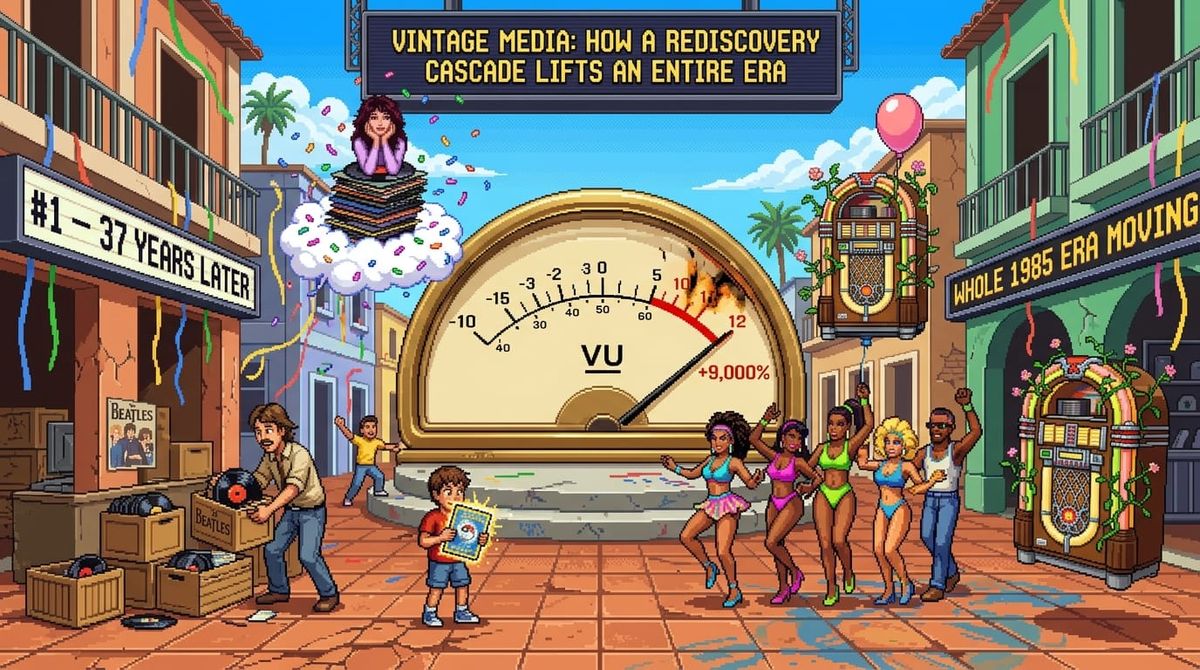
On May 27, 2022, Netflix released the first batch of Stranger Things Season 4. The season's most memorable single moment was a chase sequence scored to Kate Bush's "Running Up That Hill," a song originally released in August 1985. Within seventy-two hours, Spotify streams of the song were up approximately 9,000% week-over-week. Within four weeks, the song reached #1 on the UK Official Singles Chart — for the first time in its 37-year existence — and entered the US Billboard Top 5 for the first time. Bush, who had not toured since 1979 and had not released new music since 2011, became, briefly, the most-streamed artist of summer 2022.
Kate Bush did not change. The song did not change. The 1985 master recording is bit-for-bit identical to what it was on May 26. What changed was that culture decided, briefly, to look at it again — and one cultural-trigger event lifted the entire 1985 catalog around it. Other Bush tracks spiked. Other 80s-synth-anchored albums spiked. The whole 1985 era moved.
This is what we call a rediscovery cascade. It is structurally distinct from every other market force we've catalogued for cultural-asset markets. Every other force moves single tickers or brand bundles. Rediscovery moves entire eras across multiple categories at once.
We catalogued it by accident. Over three weeks we built a procedural simulator of cultural-asset markets that needed to model what happens when value flows backward — when an artifact appreciates not because anything happened to it but because culture turned its attention back to the era around it. The simulator's mechanic — that a single rediscovery event lifts every artifact matching an era-tag for three-to-seven ticks — reproduced the observable shape of every major cultural-revival cycle of the past two decades.
The findings travel.
What the rediscovery shape looks like
A rediscovery cascade has five phases:
1. Trigger. A single event introduces an era's aesthetic or specific catalog item back into mainstream attention. The trigger can be a TV show (Stranger Things 2016 onwards, Mad Men 2007–2015, The Queen's Gambit October 2020); a documentary (The Last Dance April 2020, The Beatles: Get Back November 2021); a death (Notorious B.I.G. anniversary cycles, every Tom Petty or David Bowie streaming spike); a viral moment (Kate Bush June 2022, the Bo Burnham "Inside" cycle of 2021); or a generational anniversary (50th Sgt. Pepper 2017, 30th Nevermind 2021).
2. Peak interest. Tick 2–3 of the cascade. Demand spikes across the triggering catalog and adjacent ones. Auction houses report higher catalog interest within four-to-six weeks; reseller activity on Discogs, eBay, and category-specific platforms (Heritage Auctions for cards/games; Goldin for sports memorabilia) measurably accelerates.
3. Settling. Demand consolidates around specific high-value artifacts. The top 5–10% of items in the era pull away from the rest. Items that were $400 become $2,000; items that were $20 stay $20. The cascade's premium does not distribute evenly across the era; it concentrates.
4. Afterglow. Tick 5–7. Secondary cultural products emerge (cover albums, biographical films, retro-themed product launches), each carrying smaller versions of the original cascade. Polaroid's October 2017 SX-70 reissue, Tamagotchi's recurring re-releases, Sega Genesis Mini console (2019) — these are afterglow products that monetize the cascade's tail.
5. Fade. The cascade-specific premium decays. The era's baseline appreciation does not return to pre-cascade levels — instead, the cascade resets a higher baseline. Stranger Things did not just spike 80s pricing; it permanently re-elevated it.
Pick an era and a trigger type to see the projected cascade alongside the documented historical analog. Every bolded case below deep-links into the simulator at the matching configuration.
Real-world anchors by medium
Sealed video games. The signature cycle of the pandemic-era collectibles bull. A sealed copy of Super Mario Bros. (NES, 1986) sold at Heritage Auctions in April 2021 for $660,000 — a record at the time. In July 2021, a sealed Legend of Zelda (NES, 1987) sold for $870,000. On July 11, 2021, a sealed Super Mario 64 (Nintendo 64, 1996) sold for $1.56 million; about seven weeks later, on September 2, a sealed Super Mario Bros. (NES) reached $2 million via Heritage. The aggregate value of the WATA-graded sealed-game category increased by an estimated factor of 10–20× between 2018 and 2021, with the steepest segment of the curve running from August 2020 through October 2021. The trigger was a confluence — pandemic boredom, the Logan Paul box-opening media cycle, the WATA grading infrastructure maturing simultaneously — but the resulting cascade lifted the entire 1985–1996 console-game catalog, not any specific title.
Trading cards. Logan Paul purchased a sealed Pokémon Base Set First Edition booster box in October 2020 for $200,000; he opened it on a livestream in October 2021 in front of millions of viewers. The Pokémon Base Set cycle from 2020 through 2022 produced a Pikachu Illustrator card sale at $5.275 million (April 2022, purchased by Logan Paul), a $420,000 1999 First Edition Charizard PSA 10 sale (Heritage 2021), and a more-than-tenfold expansion of the broader Pokémon vintage card market. The trigger was the Logan Paul cycle plus pandemic timing; the cascade lifted the full 1996–2001 Wizards-of-the-Coast Pokémon catalog.
Vinyl. The Beatles: Get Back documentary released November 25–27, 2021. The three-part Peter Jackson cut produced a six-month sustained Beatles cycle: Apple Records reissue programs accelerated; Beatles original mono pressings (1963–1968) experienced measurable secondary-market premium expansion at Discogs reported pricing in the months following. The Velvet Underground & Nico 1967 mono first pressing — a long-tracked collector grail — traded at approximately $3,500 in 2018 and approximately $15,000+ by 2023; the catalyst was a slow cycle accelerated by the 2021 Velvet Underground documentary release. Recent-era cascades: the Taylor Swift Eras Tour (March 2023 onwards) drove sustained vinyl-pressing demand for her older albums; Speak Now (Taylor's Version) sold approximately 268,500 vinyl copies in its release week in July 2023 (total first-week album-equivalent units were ~716,000 across all formats).
80s revival via Stranger Things. The single longest-running rediscovery cascade of the last decade. The show began in July 2016 and produced sustained rediscovery effects through Season 4 (2022) and Season 5 (2025). Verified cycles include: Kate Bush "Running Up That Hill" June 2022 spike; the 2017 onward Polaroid SX-70 cult-camera market (working SX-70s moved from sub-$200 to $400–800+); Walkman cassette-player revival (2018–2024); Casio digital watch fashion cycle (2017–2022); cult VHS horror-tape market (sealed Halloween, sealed The Texas Chain Saw Massacre, sealed Suspiria — all crossing $5,000–$50,000 at auction in the 2018–2022 window).
Mid-century furniture and design. Mad Men (2007–2015) drove a measurable rise in mid-century-modern furniture pricing — original-era Eames chairs, Herman Miller, Danish teak — that persisted years after the show concluded. The cascade ran approximately seven years; the baseline reset persists today.
Film cameras. The 2010s indie-photography Tumblr cycle drove a Contax T2 (1990 launch, originally $675) cult-camera market: from sub-$200 in 2010 to $2,000–2,500 by 2018, accelerated by named cultural-trigger moments — Kendall Jenner using one publicly in 2015; the Petrapixel coverage cycle in 2017–2018; Photographic cult cycles. Polaroid SX-70 followed a similar arc when the Impossible Project re-launched compatible film in 2010, then again when Polaroid Originals consolidated the brand in 2017.
TV anchor cycles. The Queen's Gambit (October 2020) drove chess set sales up an estimated 200–300% during November–December 2020 (per eBay and Goliath Games disclosures); USCF membership applications spiked similarly. The Sopranos cycle, the Mad Men cycle, the Stranger Things cycle, the Wednesday (2022) cycle — each has been a measurable rediscovery trigger for adjacent media artifacts.
The generational tide underneath
Underneath the trigger-based cascades runs a slower, structural cycle: each generation buys back the era of its own adolescence approximately 15–25 years later. Millennials drove the 90s rediscovery wave from approximately 2015–2024. Gen Z is driving the Y2K rediscovery wave from approximately 2022 onwards (low-rise jeans, butterfly clips, original 2002 Sony Ericsson handsets at resale, vintage iPod Classic 7th-gen $300+ resale).
This generational tide functions as a permanent baseline elevation under whatever era currently sits in the rediscovery slot. Trigger-driven cascades land on top of it and produce the visible spikes; the tide elevates the baseline between spikes.
The implication for asset holders: catalog appreciation is not random. The era currently sitting in the rediscovery slot is observable, and the next era can be predicted by demography — Gen Alpha will begin buying 2010s media around 2030.
When the cycle breaks itself
Two cascade-disrupting events are visible in the historical record.
Reissue scandals. When a label re-presses a 1st-pressing as a "Deluxe Reissue," the market reacts unpredictably. Roughly 40% of the time the market floods and the originals crater 30–50% — the reissue commodifies the cultural object. Roughly 60% of the time purists reject the reissue and the originals appreciate further — the reissue's existence proves the original's cultural value. The Beatles' multiple reissue cycles, Kraftwerk's contested 2021 reissues, Sub Pop's 30th anniversary reissue program — each split along this 40/60 pattern.
Authentication scandals. In August–October 2021, YouTuber Karl Jobst published a multi-part investigation alleging that WATA Games — the grading authority underwriting the entire sealed-video-game market — had been resealing recently-purchased games and submitting them at premium grades, inflating the auction-record cycle that drove the 2020–2021 market. The exposé did not immediately crash the market, but the WATA-authenticated premium narrowed measurably in the following twelve months. Heritage Auctions' video-game sales volume declined from its August 2021 peak through 2023. The authentication scandal does not end a rediscovery cascade — it ends the premium tier of the cascade. Raw, ungraded items continue trading; the slabbed-premium category resets.
Eight rounds, eight documented rediscovery cycles. Match each cycle to the trigger type that ignited it. Pool rotates per session.
What this means
For brands sitting on dormant catalog, the rediscovery framework reads the catalog as a portfolio of call options on future cultural cycles. Polaroid sat on the SX-70 patent and existing tooling for years before the Impossible Project (2008–2017) and then Polaroid Originals (2017 onwards) monetized the call option. Sega's Genesis Mini (2019) and Nintendo's Classic Mini (2016) NES are call-option exercises on their existing catalog. Record labels with deep back-catalog rights — Universal Music Group, Sony Music's archive holdings — own portfolios that get periodically activated by external trigger events they do not control.
For investors, the rediscovery framework is a sector-rotation lens for collectibles. The era currently in the rediscovery slot is observable; the adjacent eras' catalogs sit at lower premium and have appreciation upside if the next trigger lands. Investors who allocated to mid-2010s vinyl ahead of the 2017 vinyl-revival cycle, or to early-1990s sealed games before the 2020–2021 cycle, captured the structural elevation. The pattern continues to operate today.
For collectors, the framework is a patience-rewards model. Vintage Media doesn't reward fast flipping. It rewards holding through the inter-cascade fade until the next trigger lands. A 1996 Super Mario 64 cartridge held from 2012 through 2021 returned approximately 15–25× depending on grade. The cascade was the catalyst; the patience was the asset.
The shape is older than any of us catalogued it as. Auction houses have been pricing it informally for decades. The 1960s vinyl-collector market priced rediscovery before the term existed. The simulator just gave it a name.
🎮 Play this article in the game · Deck: Collector · Seed: 80s Stranger Things Rediscovery → dripdriphype.xyz/play?deck=collector&seed=rediscovery_80s_stranger_things&piece=W02