The Hawk Tuah Cycle, Two Years Out
From Nashville street clip to $490M memecoin collapse to a sustained brand-equity afterglow. The canonical creator-economy speedrun, audited at the 12-month mark.

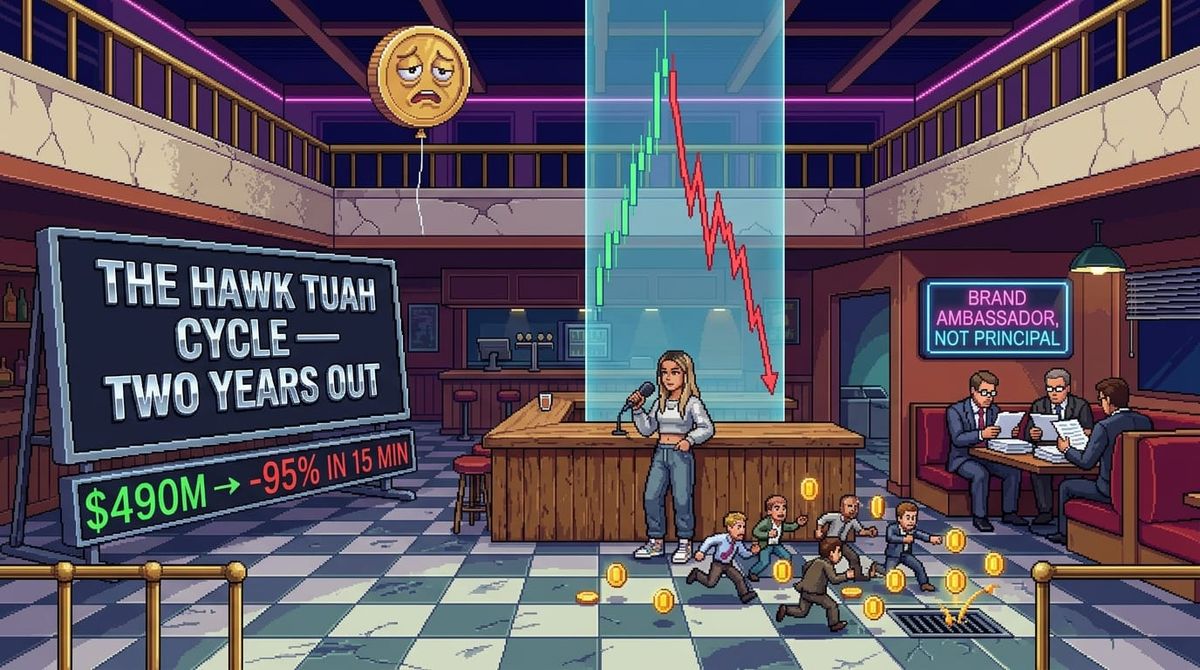
On December 4, 2024, Haliey Welch's name was attached to a Solana memecoin that ran from launch to approximately $490 million in market capitalization in roughly fifteen minutes, then collapsed by roughly 95% within the same trading day. The Securities and Exchange Commission opened an inquiry in January 2025. Multiple civil lawsuits followed.
Two years on, the verdicts are partial.
Welch herself remains active online. The "Talk Tuah" podcast continues, now in its third format iteration. Her brand-deal pipeline — peaked in late 2024 — has consolidated downward to roughly her pre-cycle baseline plus residual recognition value. The memecoin community-recovery cycle ran the predictable course: a Discord wind-down, an attempted "Hawk Tuah 2.0" relaunch in mid-2025 that failed to recapture meaningful liquidity, and a sustained background hum of class-action filings against the various structural participants. Welch's own legal posture — that she was a brand-ambassador rather than a principal — has held through three rounds of motion practice. As of mid-2026, no enforcement action has named her directly.
The cycle is over. The pattern it ran is not.
We catalogued the pattern by accident. Over three weeks we built a procedural simulator of cultural-asset markets that needed to model what happens when a creator's economic value spikes faster than any conventional asset class allows — and then collapses faster than any conventional asset class permits. The simulator called the resulting shape the creator-as-asset speedrun. The Hawk Tuah cycle ran the speedrun shape end to end in approximately six months.
The cycle, recapped
June 11, 2024. A six-second clip recorded on a Nashville street produces a viral catchphrase. Welch is 21 years old at the time. Within 72 hours, the clip has been re-uploaded to TikTok and X in volumes the original recorders did not anticipate. Within ten days, a personal brand exists.
July–August 2024. Merchandise pipeline activates (hats, T-shirts, sticker packs). Welch signs with a management team. Brand-partnership inquiries arrive in volume; a podcast format ("Talk Tuah") goes into pre-production.
August 14, 2024. Talk Tuah debuts. Initial guest pipeline draws from the broader creator-economy and adjacent influencer cohorts. Streaming and YouTube view counts run into the millions per episode through Q3.
October–November 2024. Brand-equity layer peaks. Multiple corporate partnerships (a beverage brand, a clothing retailer, and a series of one-off appearance-fee deals) compound. Welch's individual brand-name appears in trade-press discussions of "where the creator economy is heading." This is the part of the cycle the simulator labels peak interest — typically two to three ticks long.
December 4, 2024. The $HAWK memecoin launches on Solana. By marketing structure, Welch is positioned as endorser rather than principal. By regulatory structure, the disclosure layer is contested. Within roughly fifteen minutes, the token's market cap crosses ~$490 million. Within the same trading day, it crashes by ~95%. The Discord servers hosting buyer-coordination conversations are running between fifteen thousand and forty thousand simultaneous users at peak; by 6 PM Eastern, those users are organizing class-action paperwork rather than coordinated trades.
January–March 2025. SEC inquiry. Civil suits. The first round of motion practice. Welch's legal team pursues a brand-ambassador defense; the structural participants who organized the launch face direct enforcement exposure. The cycle's settling phase, per the simulator's framing — three to four ticks of liquidity drainage and legal positioning.
Mid-2025. Talk Tuah resumes after a hiatus. Brand-deal flow returns at roughly 15–20% of late-2024 peak — the residual-value baseline that the simulator predicts most speedrun-shaped cycles settle at. Most of Welch's pre-collapse partnership cohort has formally distanced; a smaller cohort of partners who pre-dated the memecoin event continues. The cycle is now in afterglow — secondary commercial activity that pays the rent without scaling.
Late 2025 / early 2026. Multiple parallel "Hawk Tuah 2.0" launches by unrelated parties try to recapture the cycle's commercial energy. None succeed at meaningful scale. The cycle is in fade — the era's specific premium decays, but the elevated baseline persists. Welch's brand at the end of the cycle is worth meaningfully more than her brand before June 2024, even net of the memecoin collapse.
Click through the five phases below to see the simulator's predicted shape alongside the actual Hawk Tuah event sequence. The Creator-as-Asset calculator shows what the residual asset looks like at the end of the run.
Why the cycle ran the speedrun shape
Three structural features made it inevitable.
First: the trigger event was extreme. A six-second viral clip starting from zero is the highest-velocity attention-acquisition the modern creator economy supports. Compared to a typical creator's compounding trajectory — months to years of audience-building — the Hawk Tuah trigger compressed that arc into a week.
Second: the monetization stack was assembled at unprecedented speed. Six months from trigger to memecoin is fast. The MrBeast trajectory (counted-to-100,000 video in January 2017, Feastables launch in January 2022) compressed five years of brand-building into the monetization stack that funds Beast Industries today. The Hawk Tuah trajectory compressed the same components into six months. The components — merchandise, podcast, brand deals, equity-bearing product — were all there. The compression is what produced the speedrun.
Third: the terminal event was structurally available. The creator economy is the only category that supports rapid attention-to-monetization-to-terminal-exit velocity. A toy brand cannot have a Hawk Tuah moment; a luxury house cannot have one. The Creator Economy category's possibility-space includes the speedrun shape — and a six-month-old brand-equity layer attached to a publicly-tradable terminal exit (the memecoin) was always going to face the rapid-revaluation outcome that the simulator's framework predicts.
The Hawk Tuah cycle wasn't anomalous. It was archetypal. It was the cleanest documented run of a shape the creator economy was already running smaller versions of.
Eight rounds. For each phase-description, identify which of the five speedrun phases it describes.
What's left
The afterglow assets of a speedrun-shaped cycle persist longer than most cultural-business operators expect. Welch's brand at mid-2026 is more recognizable, more durable, and more commercially useful than it was at the December 2024 collapse. The memecoin community burned through approximately $400 million of paper-value losses; the brand layer survived. The two value layers were never the same asset, and the simulator's framework would have predicted exactly this divergence.
For creators currently in the early phases of similar cycles, the Hawk Tuah retrospective offers a structural lesson: the trigger is uncontrollable; the monetization-stack assembly is partially controllable; the terminal event is structurally controllable. The cycles that minimize terminal exposure (no equity-bearing public-market product; no memecoin; no celebrity-tied tradeable instruments) compound their afterglow layer at meaningfully higher residual baselines.
For investors and platforms increasingly underwriting creator-equity products, the Hawk Tuah retrospective offers a calibration: residual baseline after a fully-played-out speedrun is roughly 15–25% of peak commercial activity, not zero. The brand survives the memecoin. The compounding trajectory is what the platform sells; the terminal-tail-risk is what the platform's compliance overlay needs to price.
For regulators, the cycle was a stress test. The SEC's January 2025 inquiry and the subsequent civil litigation produced a working playbook for who carries what disclosure responsibility in celebrity-tied tradeable-instrument launches. The playbook will be applied to the next cycle, which is already in formation in adjacent attention-tier zones.
The next cycle
The simulator's framework predicts roughly two to four Hawk-Tuah-shaped cycles per year going forward, given current creator-economy velocity. The trigger events are uncontrollable. The monetization-stack assembly happens at the principal + management-team layer. The terminal-event structure happens at the legal + financial-engineering layer. Of these three, only the last is policy-actionable.
Eighteen months after Welch's memecoin collapsed, the creator economy is still running. So is the speedrun shape. The framework that named it just lets us read what's coming next.
🎮 Play this article in the game · Deck: Creator · Seed: Creator-Economy Speedrun → dripdriphype.xyz/play?deck=creator&seed=creator_speedrun&piece=W03