Interest on the national debt now costs more than the military—$951 billion in 2025, heading to $1.7 trillion by 2034. There is almost nothing left in the budget to cut.
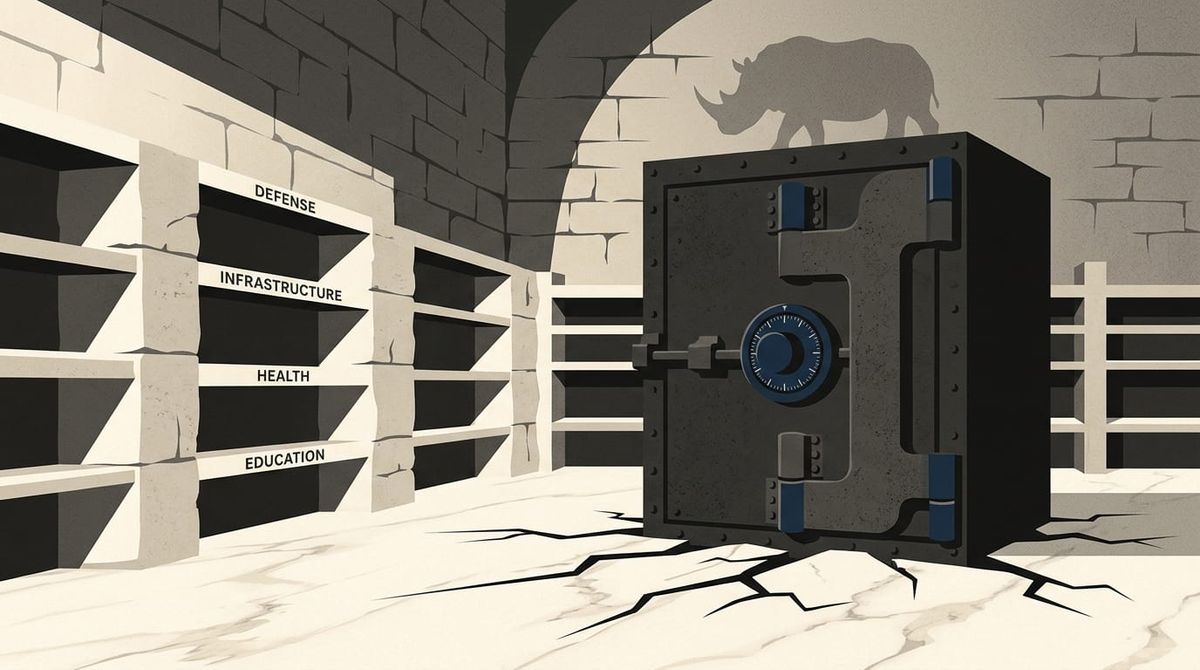
The US government now spends more paying interest on its debt than it spends on its military. Interest hit $951 billion in 2025—$56 billion above defense spending of $895bn—and the Budget Office projects $1.7 trillion a year by 2034. With $36.2 trillion of debt owed to the public and roughly $9 trillion coming due in 2025–26, much of that debt is being refinanced at 4–5%, locking in high costs for years.
The market treats this as a known fact, but underprices what comes next: every fresh dollar of spending needs a tax rise or new borrowing that pushes rates higher still. Our estimate puts the yearly budget squeeze near $1,098 billion by 2027.
This hits anyone tied to long-term government debt and rates. The iShares 20+ Year Treasury Bond ETF (TLT) loses value as rates climb. BlackRock (BLK) and Charles Schwab (SCHW) hold and manage huge bond portfolios. MarketAxess (MKTX) depends on bond-trading volumes that can seize up. Moody's (MCO) faces scrutiny over how it rates US government debt.
Why this matters. The government now spends more on interest than on its military, and that bill is set to nearly double by 2034. Every extra dollar of interest is a dollar that can't fund anything else—or that forces tax hikes or more borrowing. Lenders, businesses, and investors all face a future where the government competes harder for money and has less room to support the economy in a downturn.
Blindside · US Macro Risk
Debt Interest Eats The Budget
Interest on the national debt now costs more than the military
Imminent
97
Blindside index
What drives it — drag to test
each slider starts at our cited estimate — drag to see the range
Interest versus everyday non-military spending by 202780%
Sourced — Budget Office projects interest hits $951bn in 2025, above defense ($895bn); rising to $1.7T by 2034.
Share of expiring debt refinanced above 4.5%65%
Sourced — Average US debt lasts about 6 years; roughly $9T expires in 2025-26, per Treasury.
Extra economic drag from crowded-out investment+10%
Our judgment — Studies suggest spending cuts shave 0.5–1.0% off output; direct crowd-out drag is unmeasured.
Time to impact
2–4 yearsImminent
now3 yrs7+ yrs
When the financial hit begins to land, on our read.
How to read this. Drag any slider to test your own number — the chart and index update live. The likelihood and the locked facts stay put.
Yearly squeeze on the rest of the budget
$1.10tn60.96% of sector
Dark line = most likely · faint lines = low–high (8 in 10 outcomes land between) · shaded band = what outside analysts expect
Our estimate lands within what outside analysts expect ✓
Chance this is a permanent shift, not a blip
75%
Average of five independent reads (range 60–85%):
The arithmetic82%
$36T of debt at 4–5% equals $1T+ in yearly interest. The projection is simple math, not a guess.
How it works85%
Treasury must roll over $9T in 2025–26; even at 4.5% that locks in high costs for 5–10 years.
The skeptic's case60%
Fast growth could shrink the ratio, a budget deal could shift course, and global demand for dollars helps.
The track record78%
After World War II the US carried huge debt and grew out of it—but today's rates and aging population differ.
What the market shows70%
10-year Treasury at ~4.3% reflects some worry, and default insurance has widened, but no real break yet.
Fixed — the sliders change the size of the hit, not the odds it's permanent.
Why this matters
The government now spends more on interest than on its military, and that bill is set to nearly double by 2034. Every extra dollar of interest is a dollar that can't fund anything else—or that forces tax hikes or more borrowing. Lenders, businesses, and investors all face a future where the government competes harder for money and has less room to support the economy in a downturn.
Most exposed companies
iShares 20+ Year Treasury Bond ETF TLT · BlackRock BLK · Charles Schwab SCHW · MarketAxess MKTX · Moody's MCO
🔒
The facts — locked
measured, not editable
$951bn
Federal interest payments reached $951 billion in 2025—more than national defense ($895bn) and Medicaid ($624bn).
Congressional Budget Office, Budget and Economic Outlook January 2025
3.1% → 4.6%
Interest climbs from 3.1% of the economy's total output in 2025 to 4.6% by 2034 under the Budget Office baseline.
CBO Budget and Economic Outlook January 2025, Table 1-3
$36.2T
US federal debt owed to the public hit $36.2 trillion in early 2025, with about $9 trillion coming due in 2025–26.
US Treasury, Monthly Statement of the Public Debt (Jan 2025)
6.7%
Interest took 6.7 cents of every federal dollar spent in 2024, up from 1.8 cents ten years earlier.
Committee for a Responsible Federal Budget (CRFB) analysis of OMB data (2024)
+$1.3T
The 2017 tax cuts and pandemic aid added about $8 trillion to the debt; interest on that alone now runs $300–400bn a year.
Penn Wharton Budget Model (2024) / CBO cost estimates
$1.7T
By 2034 interest is projected at $1.7 trillion a year—more than Social Security, Medicare, or all non-military day-to-day spending.
CBO Budget and Economic Outlook January 2025
Attention stays flat and low while the impact builds. the gap stays open.
Federal interest payments already hit $951 billion in 2025—$56 billion more than defense—and are locked to climb toward $1.7 trillion by 2034 as $9 trillion of debt rolls over at 4–5%. Our estimate puts the yearly squeeze on the rest of the budget near $1,098 billion by 2027. The market accepts this but ignores the next step: every new dollar of spending needs a tax rise or fresh borrowing that pushes rates higher.