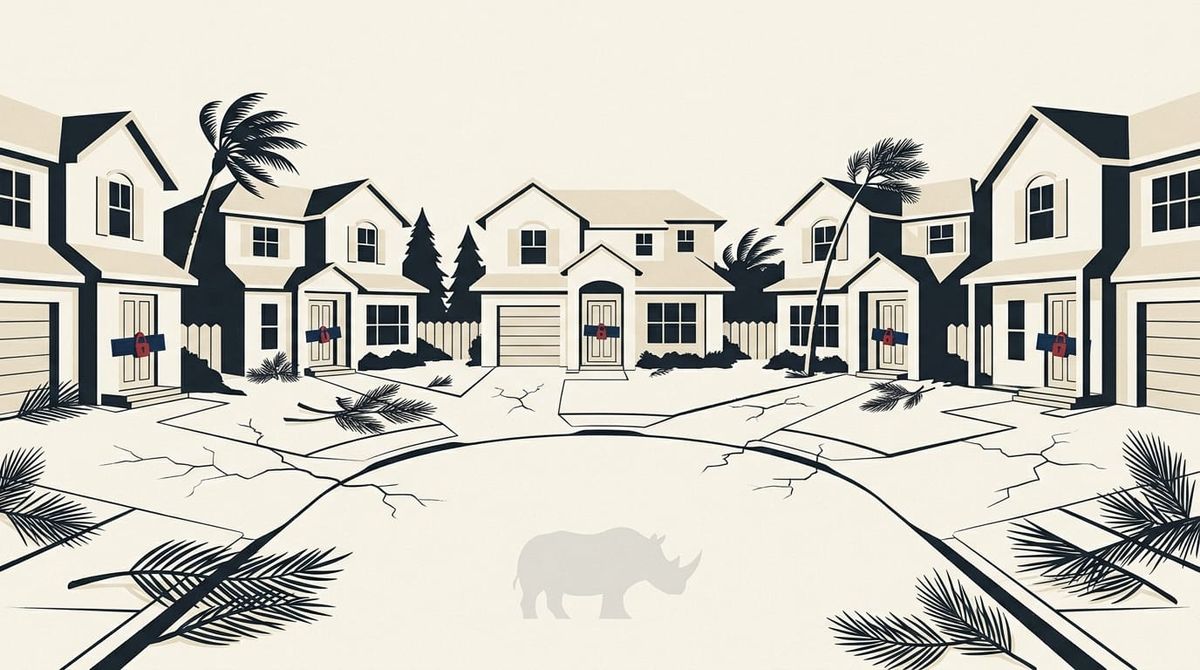
Insurers are walking away from more homes — and a house no one will insure is a house no bank will finance. We see about $228.9 billion in home value at risk each year as the problem spreads inland.
Home insurers are pulling out of more places. More than 1.9 million homeowners got non-renewal notices between 2018 and 2023, and seven of the ten biggest US insurers cut back in Florida alone, where premiums jumped 176% from 2015 to 2023. The problem is now spreading to North Carolina, Colorado, and Arizona. When a home can't be insured, a bank won't write a mortgage on it — and a home you can't finance sells at a steep discount, often 5–25% lower.
The market still treats this as a coastal story, so most inland prices haven't adjusted. We see roughly $228.9 billion in home value at risk each year, about 1.5% of the $14.8 trillion most exposed.
Zillow Group earns money when homes change hands, which stalls when buyers can't get coverage. Homebuilders D.R. Horton, Lennar, and PulteGroup build in fast-growing, fire- and storm-prone areas now losing insurers. Rocket Companies, a major mortgage lender, can't fund loans on homes it can't insure.
Why this matters. Home insurance is quietly disappearing in more places, and a home you can't insure is a home a bank won't lend against. That turns sellable houses into hard-to-sell ones, dragging down prices for whole neighborhoods. Lenders, homebuilders, and anyone holding mortgage debt should care because the chain that links insurance, financing, and home value is starting to snap inland, not just on the coast.
Blindside · US Macro Risk
Insurance Loss Breaks Home Sales
When insurers walk away, lenders can't lend and home values fall
Building
58
Blindside index
What drives it — drag to test
each slider starts at our cited estimate — drag to see the range
Share of at-risk homes that can't get insurance5%
Sourced — over 1.9 million dropped policies 2018–23; California's last-resort state plan grew 65% by 2023.
Value lost on an uninsurable or unmortgageable home25%
Sourced — First Street Foundation finds rising insurance costs cut home values 5–25% in the riskiest areas.
Extra value drag on nearby homes still insured+10%
Our judgment — distressed nearby sales drag down prices; no full study exists yet.
Time to impact
2–4 yearsBuilding
now3 yrs7+ yrs
When the financial hit begins to land, on our read.
How to read this. Drag any slider to test your own number — the chart and index update live. The likelihood and the locked facts stay put.
Home value at risk each year
$228.0bn1.54% of sector
Dark line = most likely · faint lines = low–high (8 in 10 outcomes land between) · shaded band = what outside analysts expect
Our estimate lands within what outside analysts expect ✓
Chance this is a permanent shift, not a blip
62%
Average of five independent reads (range 50–70%):
The track record65%
Coastal non-renewals already happened; inland spread matches the usual lag before disaster losses get repriced.
How it works70%
No insurance means no mortgage; no mortgage means the home sells at a steep discount. The chain is built in.
The skeptic's case50%
Federal flood program could grow, state backup plans absorb dropped homes, and lawsuits could force insurers back.
Lender and regulator signal68%
Lenders are flagging insurance availability as a financing risk, and a 2023 federal advisory shows regulators see it too.
What the market shows58%
Coastal prices fell, but most inland markets haven't adjusted yet. The spread is being underestimated.
Fixed — the sliders change the size of the hit, not the odds it's permanent.
Why this matters
Home insurance is quietly disappearing in more places, and a home you can't insure is a home a bank won't lend against. That turns sellable houses into hard-to-sell ones, dragging down prices for whole neighborhoods. Lenders, homebuilders, and anyone holding mortgage debt should care because the chain that links insurance, financing, and home value is starting to snap inland, not just on the coast.
Most exposed companies
Zillow Group ZG · D.R. Horton DHI · Lennar LEN · Rocket Companies RKT · PulteGroup PHM
🔒
The facts — locked
measured, not editable
1.9M+
More than 1.9 million homeowners got non-renewal notices between 2018 and 2023, mostly in Florida, California, and Louisiana.
California Department of Insurance / Senate Budget Committee (2024)
+65%
California's insurer of last resort saw enrollment rise 65% between 2020 and 2023.
California FAIR Plan Association Annual Report (2023)
7 of 10
Seven of the ten largest US home insurers cut back or stopped writing new policies in Florida between 2021 and 2024.
Florida Office of Insurance Regulation (2024)
~30%
Roughly 30% of US home sales could be hit by insurance stress within 10 years as it spreads inland from the coast.
NRDC / First Street Foundation Climate Insurance Report (2023)
+176%
Average home insurance premiums rose 176% in Florida from 2015 to 2023, far above the national pace.
Florida Office of Insurance Regulation / Insurance Information Institute (2023)
Attention is falling while the impact compounds. the blind spot is widening, not closing.
Our estimate puts home value at risk from this insurance breakdown at roughly $228.9 billion a year (most likely; range $162.1 billion to $317.3 billion), about 1.5% of the $14.8 trillion in homes most exposed to dropped coverage. That lines up with First Street Foundation's per-home value losses applied to homes that have lost policies. The blind spot is geography: markets that called this a Florida-and-California problem are now watching North Carolina, Colorado, and Arizona insurers shrink.