
The World Cup Visitor's Tax Is Real. The Continent Doesn't Collect It.
Cross a confederation border at the World Cup and you win 10 points less often, 46.1% against 56.0%. Then pull out the host nation and it falls apart: hosts take 70.3%, their continental neighbours just 53.3%. The border was never the tollbooth — the host's front door was.

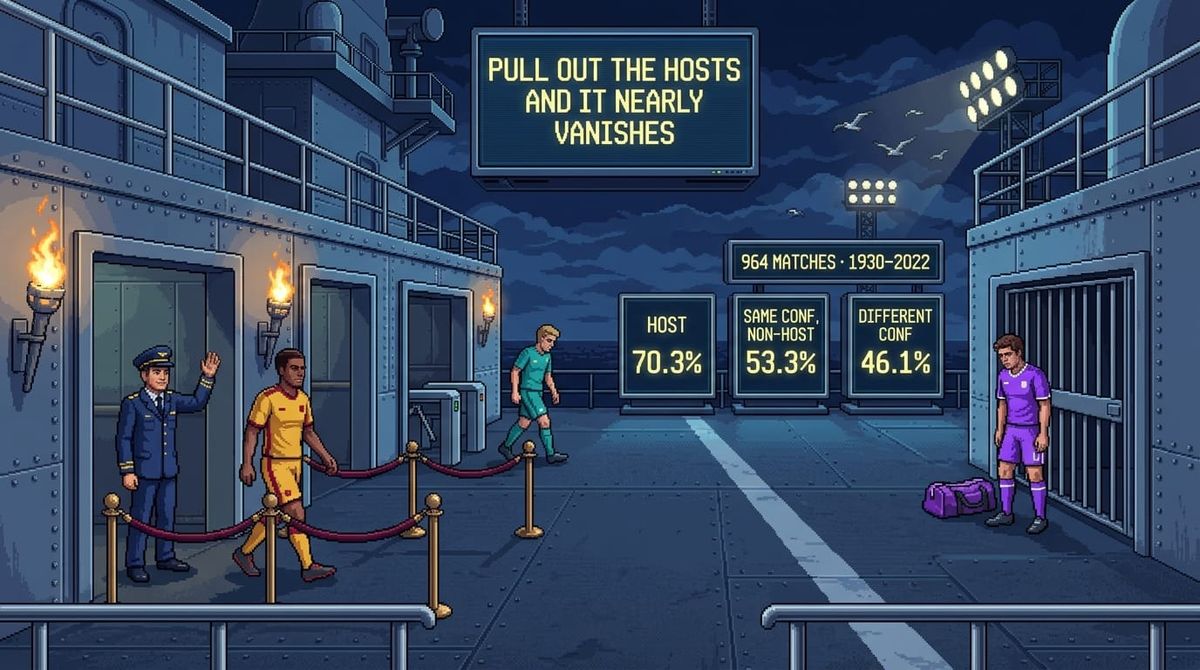
Host nations gain +17 points playing at home. Teams from the wrong continent pay the price. We measured the systematic Visitor's Tax by confederation across every World Cup.
C3 found that host nations beat their neutral-site rating by +17.3 points per game — one of the clearest and most repeatable edges in the sport. But it raised an obvious question: if the host profits from familiarity, does the same coin have a flip side? Do teams that travel farthest from home — to a different confederation, a different continent — systematically underperform? Across 964 World Cup matches spanning 22 editions, we measured exactly that.
The Visitor's Tax — What It Costs
C3 found host nations gain +17 points share. The flip side: do teams far from home pay a systematic penalty? We measured every team's performance at every World Cup by confederation, split across 22 editions and 964 matches.
The Tax Is Real — About 9.97 Points
Teams competing in a World Cup hosted by their own confederation win 56.0% of the time. Teams playing on foreign soil — in a different confederation's backyard — win just 46.0%. That 10.0-point gap is the Visitor's Tax: a measurable, systematic disadvantage paid by teams who make the longest conceptual journey to a World Cup. Both figures sit well clear of each other — same-confederation teams consistently between 52% and 60%, different-confederation visitors consistently between 43% and 49%.
Three Tiers of Home Benefit
The data reveals a clear hierarchy. At the top, the host nation itself: 70.3% — a staggering 18-point gap over neutral expectation. One step down: same-confederation non-host teams earn 53.3% — slightly above 50-50, but the benefit is modest and overlaps even odds. At the bottom: different-confederation visitors at 46.0%. The host's border matters enormously. The continent's border barely registers once you strip out the host nation itself.
Who Pays the Most?
The tax falls unevenly. CONCACAF teams suffer the most when travelling outside their confederation — a 12.6-point swing between playing at a CONCACAF-hosted tournament vs elsewhere. AFC teams aren't far behind (13.6 pp). Both confederations contain fewer historically elite teams, so the gap partly reflects quality regression when the favorable local draw disappears. UEFA and CONMEBOL — the two power blocs — show a more modest continental effect (5.3 pp and 5.7 pp respectively): their teams are good enough to compete anywhere, but still measurably better when the host continent is their own. CAF is the striking exception: essentially zero tax (-0.6 pp) — African teams have performed similarly whether the host is African or not.
Is the Tax Shrinking?
Comparing the modern era (2002–2022) to the historical (1930–1998), the tax has indeed compressed — from 11.8 pp to 7.6 pp. Globalization, professional league migration, and better travel logistics have all narrowed the edge that home-continent teams once enjoyed. But it hasn't vanished: even in the six most recent tournaments, same-confederation teams outperform visitors by nearly 8 points. The wall is lower; it still exists.
What This Means for 2026
With the 2026 World Cup hosted across North America — a CONCACAF tournament — every UEFA and CONMEBOL side faces paying the Visitor's Tax by the raw metric. But history counsels caution: the continental effect is modest outside the host nation itself. The +17-point bump belongs to the USA, Mexico and Canada in their own matches. Europe and South America will feel the atmosphere; they'll feel it less in the results. The biggest risk for high-ranked European sides isn't the tax itself — it's the quality of the expanded 48-team field, not the ZIP code.
Method. 964 World Cup matches, 1930–2022, covering 1,928 team-appearances. "Same confederation" = team's confederation matches the WC host's confederation, including the host nation. Host nation = team that played a non-neutral WC match (consistent with C3). Pre-match Elo ratings from the martj42 dataset (~49,000 results) cover all 22 editions and were used to confirm that the raw pattern is not explained by quality differences — host teams outperform their Elo expectation by 18.0 pp, same-confederation non-hosts by 1.7 pp, and different-confederation visitors by −2.8 pp. Israel assigned to AFC (their confederation at the 1970 WC); Iceland to UEFA (2018 only). — Fastmaster Intelligence.