
Score First, Win Three-Quarters of the Time. The World Cup Is Where That Breaks.
Score first and it's three-quarters over. Across 15,381 internationals since 1916 the opener wins 74.4% of the time — but at the World Cup it drops to 70%, the one stage where a lead is least safe.

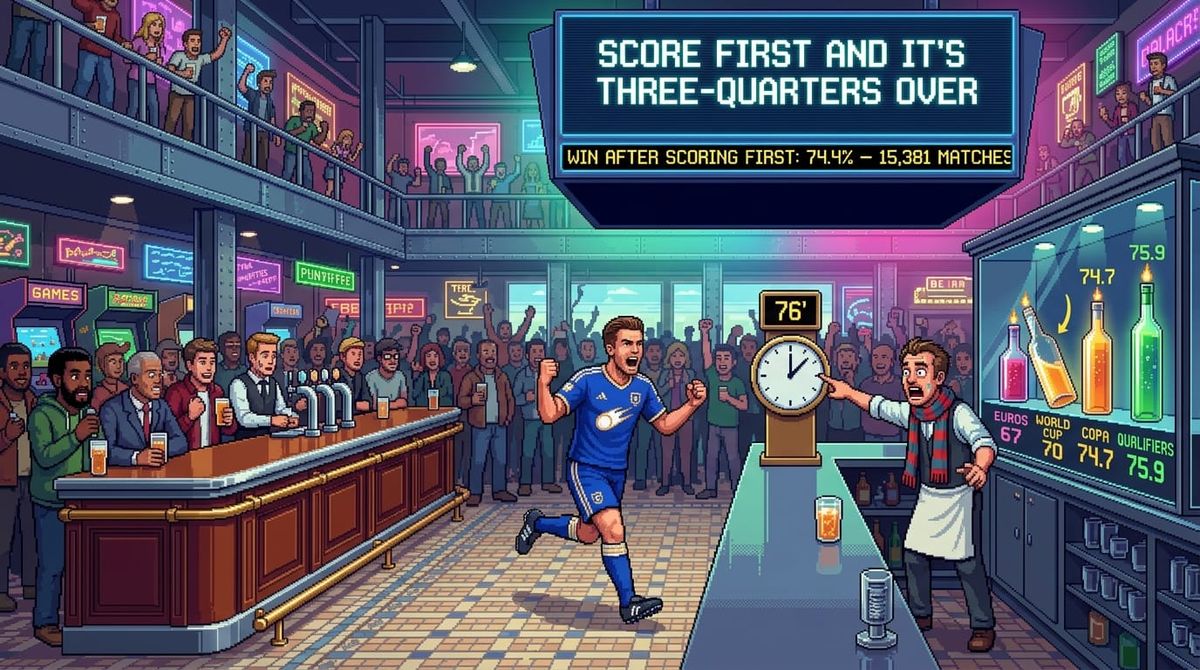
We tracked the opening goal in 15,381 international matches to find out just how decisive it really is — and where the rule breaks down.
The first goal in a football match isn't just a number on the scoreboard. It reshapes everything — the other team's tactics, the crowd's anxiety, the psychology of both dressing rooms. But just how much does it matter? We tracked the first goal in 15,381 international matches — every game where goalscorer data exists, going back to 1916 — and counted what happened next.
across 15,381 international matches, 1916–2025
Source: martj42 international football dataset (results + goalscorers, 1916–2025). First goal = lowest recorded minute in the goalscorer data for that match. Own-goal direction corrected: if a player puts the ball in their own net, the benefiting team (not the scorer's team) is credited with first blood. Counts only matches where both a goalscorer record and a result record exist. Tournaments outside the five shown (World Cup, Euros, Copa América, World Cup qualifiers, other competitive) had too few goal records to include separately.
Three quarters of the time: game over
Across all competitions, the team that scores first wins 74.4% of the time. They draw 15.1% and lose just 10.5%. The first goal is not merely an advantage — it is close to a settling of the matter. A trailing team has less than a one-in-four chance of avoiding defeat.
The timing of that goal amplifies everything. Score in the first 15 minutes and you win 72.6% of the time. Score after the 76th minute — already leading when the clock says the game is nearly done — and you win 88.5% of the time. Late first goals are less likely because matches rarely stay goalless that long, but when they come, they are almost always the last word.
The World Cup is different
Here the data gets more interesting. At the World Cup, the first-scorer wins just 70% of the time — notably below the overall rate. The European Championship is even lower at 67%. Compare that to World Cup qualifying matches, where the first-scorer wins 75.9% of the time — well above average.
The explanation is quality. In a qualifying match, the first goal often comes because the better team has asserted itself — and the gap between the teams is wide enough that a comeback never really threatened. In a World Cup final or semi-final, the standard difference between sides is much smaller. A trailing side at 0–1 at the World Cup will back themselves. The data says they are right to.
The countries that make it count
Some nations have turned first-blood into a near-guarantee. Germany win 85.1% of matches when they score first (281 matches). Argentina 84.7% (300). Netherlands 84.9%. These are sides that historically know how to sit on a lead — pressing for the second goal while denying the other team's rhythm. They don't let games back in.
At the other end, Malta win just 31.7% of matches when they score first — meaning the side that just scored on Malta has roughly a coin-flip chance of still winning. Teams at the weaker end of the table often concede first goals that are more freak events than reflections of the game's direction, and struggle to control the match afterward even when they got lucky first.
A very slow erosion
There is one trend worth watching. In the 1990s, the first-scorer won 76.8% of the time. In the 2020s, that is down to 72.6%. The gap is small — four percentage points over three decades — but it has moved consistently in one direction. Modern defences are better organised. Modern coaching emphasises playing out from the back, keeping shape, not capitulating mentally after a goal. Football is still heavily weighted toward the team that strikes first — but very slightly less than it used to be.
Method. Source: martj42 international football dataset (results.csv + goalscorers.csv, accessed 2026). First goal defined as the lowest recorded minute in the goalscorer data for that match. Where the first recorded goal was an own goal, first blood is credited to the scoring team's opponent (own-goal direction corrected). Counts only matches appearing in both datasets. Own-goal first: 332 of 15,381 matches. Friendly matches and AFCON are excluded from the competition breakdown — too few goalscorer records in those tiers to be representative. Nation leaderboard requires ≥30 qualifying matches. — Fastmaster Intelligence, May 2026.