
The Host Boost: What Playing at Home Is Actually Worth for the USMNT
The USMNT is the lowest-rated team in its group. On neutral ground it's going home. We applied the measured host boost — hosting is worth about 1.6 points to the USA's Group D.

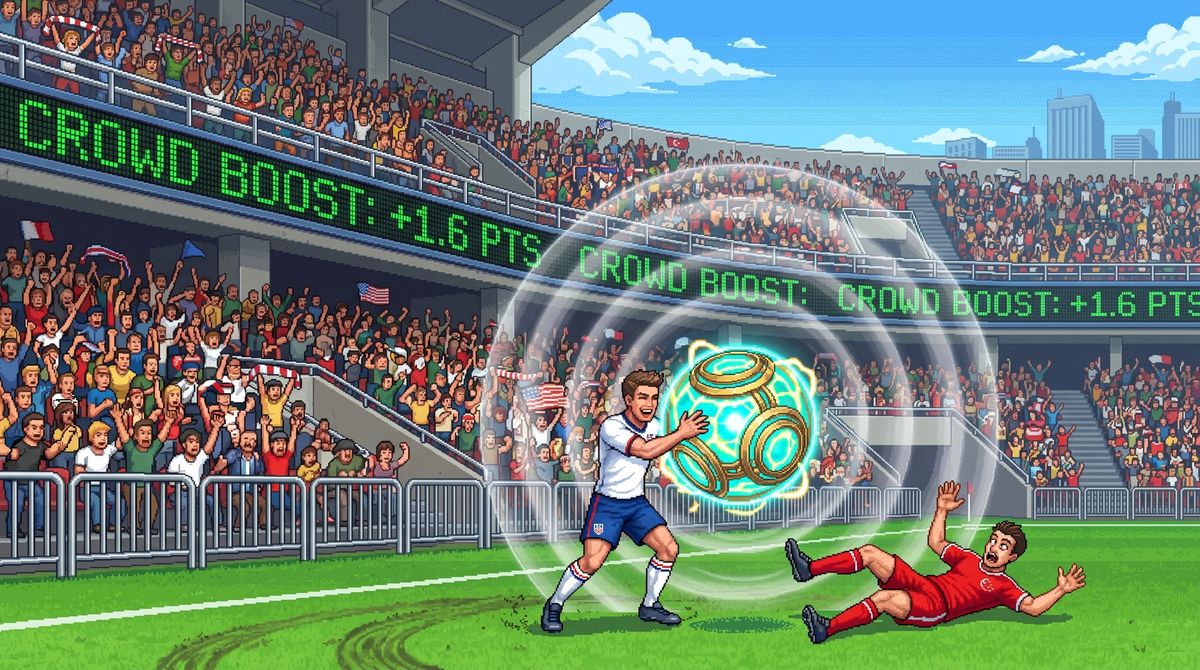
Three nations co-host the 2026 World Cup. The crowd is worth the same +1.5 to +1.6 points to each. What it does to their group — underdog lifeline, coin-flip key match, certainty where there was doubt — is completely different.
The 2026 World Cup has three co-hosts: Mexico, Canada, and the United States. Each arrives at their group from a different position — Mexico as its group's highest-rated side, Canada as second, the USA as the lowest. The crowd boost is the same for all three. What it does to each is completely different.
We didn't invent a home-field number. We took the one we'd already measured: across 22 World Cups since 1930, host nations beat their opponent-adjusted neutral rating by +17.3 points of result-share per game (95% CI +10.2 to +24.3) — one of the largest repeatable edges in the sport. We applied that boost to every group match for all three hosts.
United States: the underdog that gets a lifeline
The USA drew the group of death and finished the draw as the lowest-rated team in it — below Türkiye, below Australia, below Paraguay. On neutral turf, the USMNT projects to roughly 3.48 points — the profile of a third-place team going home. Hosting flips the arithmetic. The expected haul climbs to 5.03 points, a premium of +1.6 points. Against Türkiye alone — the group's top side at a neutral-site 21.5% win chance — the crowd lifts the USA to 35.4%.
Home-Field USA
The USMNT drew the hardest group on paper — and is the lowest-rated team in it. But they host. We took the measured host-nation boost — +17.3 points share a game across 22 World Cups — and applied it to each of the USA's three Group D matches.
Method. The host effect is the measured +17.3 result-share pts/game host-nation boost from FMI study C3 (95% CI +10.2 to +24.3; 964 World Cup matches, 1930–2022), added to the USA's opponent-adjusted neutral Elo expectation in each Group D match, then split into win/draw/loss and expected points. Result-share = win 1 / draw ½ / loss 0; xPts = result-share × 3. The slider scrubs the boost across its CI. Team Elos from FMI NT-Elo; host magnitude is measured, not assumed.
Canada: the Switzerland problem becomes a coin-flip
Canada enter Group B as the second-ranked side. Against Bosnia (70.5% neutral win) and Qatar (77.8%) the group points are near-banked either way — hosting moves them to near-certainty. The one match that matters is Switzerland. On neutral turf Canada are a 26.2% proposition against the group's top side. As host: 43.5%. The crowd converts a loss-expectation into a genuine contest. Across the group, hosting adds +1.5 points, from 6.21 to 7.67.
Home-Field CANADA
Canada enter Group B as the second-ranked side — strongly favoured over Bosnia and Qatar, behind Switzerland. On neutral ground they project comfortably through the group, except for that one match. The crowd changes the Switzerland calculation.
Method. The host effect is the measured +17.3 result-share pts/game host-nation boost from FMI study C3 (95% CI +10.2 to +24.3; 964 World Cup matches, 1930–2022), added to Canada's opponent-adjusted neutral Elo expectation in each Group B match, then split into win/draw/loss and expected points. Result-share = win 1 / draw ½ / loss 0; xPts = result-share × 3. The slider scrubs the boost across its CI. Team Elos from FMI NT-Elo; host magnitude is measured, not assumed.
Mexico: already the favourite — hosting removes the remaining doubt
Mexico enter Group A as the highest-rated side. On neutral turf their group projection is already 6.29 points — a comfortable passage. Hosting adds +1.6 more, reaching 7.85. Czech Republic (58.5% neutral win) and South Africa (73.4%) are formalities either way. South Korea is the match where it shows: from a competitive 41.4% on neutral turf to 63.2% at home — a clear Mexico advantage where before there was genuine uncertainty.
Home-Field MEXICO
Mexico enter Group A as its highest-rated side — the expected winners on neutral ground. We applied the measured host-nation boost to all three group matches. The crowd turns a comfortable projection into an emphatic one.
Method. The host effect is the measured +17.3 result-share pts/game host-nation boost from FMI study C3 (95% CI +10.2 to +24.3; 964 World Cup matches, 1930–2022), added to Mexico's opponent-adjusted neutral Elo expectation in each Group A match, then split into win/draw/loss and expected points. Result-share = win 1 / draw ½ / loss 0; xPts = result-share × 3. The slider scrubs the boost across its CI. Team Elos from FMI NT-Elo; host magnitude is measured, not assumed.
The band is wide — keep it honest
The host effect is real and clearly significant, but not precise. Carry the full confidence interval and the premium ranges from +0.9 to +2.2 points for each team — anywhere from a useful nudge to a transformation. And hosting guarantees nothing: Qatar lost all three at home in 2022, the worst host run on record. Use the slider in each embed to scrub the boost across its measured range.