New FAST Data: 46% of Free Streaming Viewers Take Action on Ads
The March 2026 Reach3 Insights FASTMaster Study reveals 46% of free streaming viewers take action after seeing an ad. Dive into our category-by-category breakdown of brand recall for giants like Coca-Cola, Toyota, and Walmart, and see why high-income households are heavily engaged.

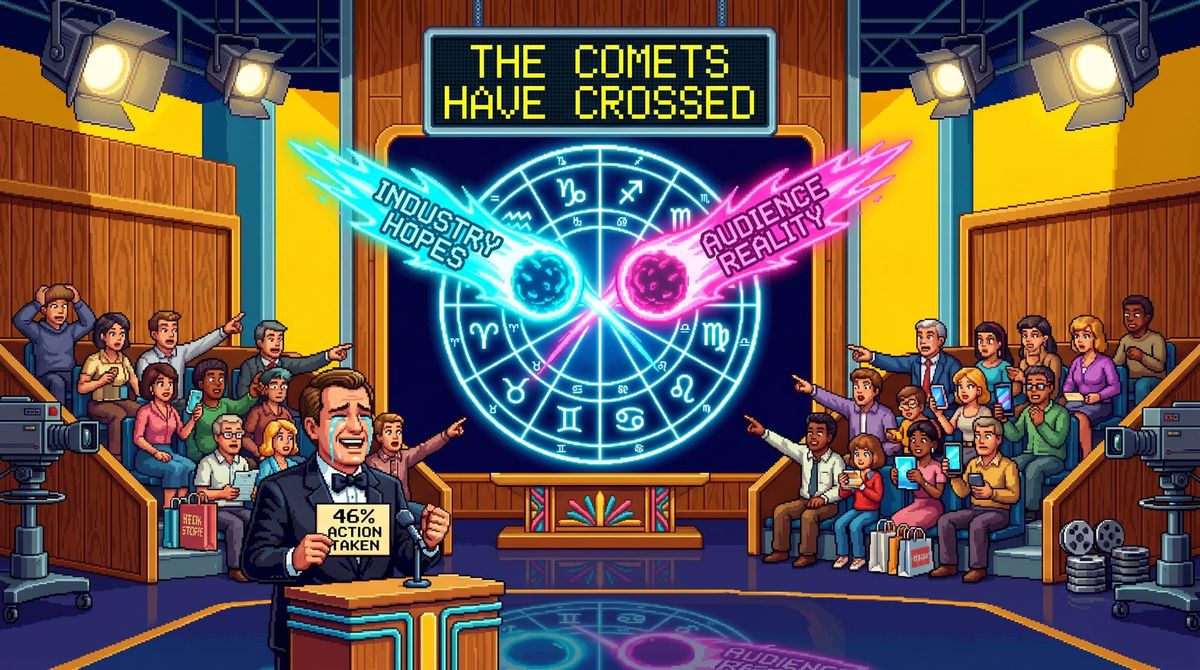
Nearly half the people watching free streaming say the ads worked on them — and for once the industry's wishful thinking and the audience's own answers point the same way. In the March 2026 wave of Reach3 Insights' FASTMaster Study — the Free Streaming Tracker — 46% of free streaming viewers said they had taken an action because of an ad they saw on a free streaming service: 19% bought something, 29% visited a website.
Reach3 Insights' FASTMaster Study* is a quarterly read on U.S. free streaming viewers, fielded in March 2026 across 3,077 streaming users including 2,002 active free streaming viewers. What follows is the category-effectiveness picture from that wave, profiled category by category. It is not a leaderboard. Each brand below stands alone as a single data point on its own category's effectiveness — no horse race, no podium.
Three medium-level figures frame everything after them. The first is that 46% net, with 19% buying and 29% visiting a website — the verdict the audience renders on itself. The second is the direction of travel: 40% say they are watching more free streaming than they were six months ago, against 11% who say less.
Reach3 Insights · FASTMaster Study · Wave 3
Nearly half act on a free streaming ad. A fifth buy.
Share of free streaming viewers who took each action after seeing an ad on a free streaming service. The actions overlap, so the parts don't sum to the net.
March 2026 · n=2,002 weighted free streaming viewers · self-reported
In fairness, that is self-reported behavioral change within the wave, not a trend line drawn against an earlier study — but the people leaning in outnumber the people leaving. The third is the pull of the brand on the channel itself: 62% say a network or studio brand makes them more likely to watch a channel, rising to 75% among 25-to-34-year-olds and 72% in households earning $150,000 or more. The name on the marquee still moves the feet through the door.
In food and beverage, Coca-Cola registered 44% ad recall on free streaming in the March 2026 wave. The recall profile skews male — 51% of men recall a recent Coca-Cola ad on free streaming against 38% of women — and skews younger, at 54% among both 18-to-24s and 25-to-34s and 52% among 35-to-44s, easing to 36% in the 55-to-64 band. It reaches 52% in households with children and 48% in households earning $150,000 or more.
Here is the part the planning orthodoxy keeps underrating: Coca-Cola advertises year-round rather than seasonally, so the 44% is not the sugar high of a single flight. It's sustained mindshare across the buying calendar.
In auto — the highest-CTV-spend category in the U.S. market — Toyota registered 46% ad recall on free streaming. The figure climbs to 56% in households earning $150,000 or more and 53% in households with children, and runs to 54% among men against 39% among women. By age it peaks at 54% in 18-to-24 and 52% in 35-to-44.
One cut should stop the OEM planner mid-spreadsheet: recall sits at 53% in traditional pay-TV households versus 37% among cord-cutters. The free streaming auto audience and the linear auto audience are not the same households. Buy them as though they were and you are paying to reach one twice and the other not at all.
In retail, Walmart registered 52% ad recall on free streaming. The profile skews young and family — 60% recall among 18-to-24s, 56% among 25-to-34s, 57% among 35-to-44s, and 58% in households with children — and reaches 55% in households earning $150,000 or more and 57% among men against 47% among women. Retail media networks are among the fastest-growing CTV ad-spend categories, and Walmart's expansion into connected-TV inventory is the kind of bet a 52% recall figure suggests is landing with the people it was aimed at.
In food delivery, DoorDash registered 43% ad recall on free streaming, and carries the highest under-25 recall rate in the tracker, at 53% among 18-to-24s, with 47% among 25-to-34s. It indexes strongly on higher-income and family households. Food delivery has been one of the fastest-scaling CTV ad verticals of the past three years, and a recall profile this young is precisely the audience that growth was built on.
One finding deserves an honest frame, because the obvious reading of it is the wrong one. Households earning $150,000 or more are 8.8% of the free streaming audience — a smaller share than the 12.5% they represent on traditional pay TV. Concede the point the skeptic wants to make: premium households do not dominate free streaming. They don't. But the ones who are here are disproportionately in play.
Reach3 Insights · FASTMaster Study · Wave 3
The $150K+ household: 8.8% of free streaming, and the readiest to act.
How the $150,000-plus household over-indexes against the total free streaming audience. It is 8.8% of that audience — versus 12.5% on pay TV — a small slice doing outsized work.
Took action on a free streaming ad
Watching more free streaming than six months ago
March 2026 · total n=2,002 weighted · $150K+ n=159 unweighted (175 weighted) · self-reported
Within that 8.8%, 62% have taken action on a free streaming ad against 46% of the total audience, and 49% say they are watching more than six months ago against 40% overall. The read isn't reach. It's that the premium households reachable here are reachable only here, because they have already moved their ad-free dollars into subscription streaming. Free streaming isn't where most premium attention lives. It's increasingly the only shelf where the rest of it is still for sale.
The full data and report is available to purchase. Contact Reach3 Insights for the report or to discuss the Wave 4 categories.
Methodology
Findings drawn from Reach3 Insights' FASTMaster Study (Wave 3), fielded March 2026 across 3,077 U.S. streaming users aged 18-64, including 2,002 active free streaming viewers. Brand recall reflects respondent-reported association with free streaming and is not verified against actual ad placement; figures are most useful for directional comparisons across waves and within categories. Action-taken metrics are self-reported, consistent with standard ad-effectiveness measurement methodology across major industry trackers.