
The Most-Played Rivalry Among the 20 Best Teams Isn't European. It's Mexico-USA.
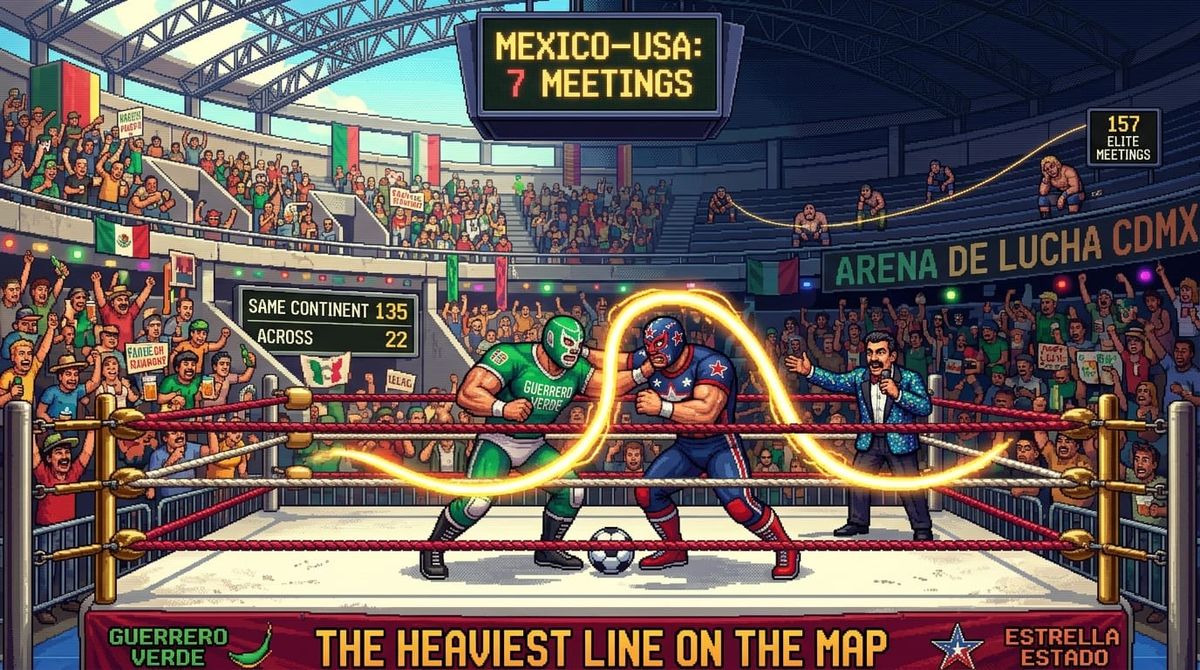
Ask a crowd to name the heaviest rivalry among the world's 20 best, and they'll reach for Europe. The map says Mexico-USA, seven meetings, more than any glamour tie on the board — and the continents barely touch beyond it.

Take every competitive A-international played between the twenty top-ranked national teams from May 2021 to May 2026 — 157 matches, spread across 72 distinct rivalries — and plot them as one network. Each nation is a point on the ring. Each rivalry is a line. The more often two sides have met, the heavier the line between them. No friendlies, no warm-ups: only the matches that counted.
The seating isn't alphabetical, and that is the whole trick. The teams are grouped around the circle by confederation — the eleven Europeans together, the four South Americans together, and so on — so the diagram stops being a tangle and starts being an argument about geography.
The continents barely touch
The Rivalry Network
Every competitive meeting between the world's 20 top-ranked national teams, May 2021–May 2026 — 157 matches across 72 rivalries, drawn as one map. The teams are seated around the ring by confederation, and the geography is the story: of the 22 times two continents met, 20 came at the World Cup. Switch to Across confederations to see how rarely the oceans get crossed — then click any nation for its head-to-head ledger.
Flip the control to Across confederations and the dense web almost disappears. Of the 157 elite meetings in the window, 135 were between two teams from the same continent. Only 22 crossed from one confederation to another — and 20 of those 22 happened at the World Cup itself. The remaining two were a Finalissima and a single Copa América guest fixture.
That is the structure of elite international football in one image. The continents qualify in their own sealed rooms — Europe against Europe, South America against South America — and the one stage built to break the walls down, the World Cup, is essentially the only place the oceans get crossed. It isn't a guess pulled from competition labels; it falls straight out of which governing body each side belongs to.
Click a nation
Every line carries a record. Click any team and the map re-colours to that nation's point of view — green where it leads the head-to-head, red where it trails — and the panel prints its full ledger against every elite side it has faced: played, won, drawn, lost, goals for and against.
The single most-played rivalry in the entire set is not a glamour tie in Europe. It's the CONCACAF clásico — Mexico–USA, seven meetings, more than any pairing the Champions League crowd would name first — the product of a two-team regional pool funnelling through the same finals and qualifiers again and again. The densest neighbourhood relative to its size is South America: Argentina–Colombia and Brazil–Colombia (six apiece), Argentina–Uruguay and Uruguay–Colombia (five), all riding the ten-nation round-robin where everyone plays everyone home and away.
Method, briefly. 157 unique meetings among the 20 top-ranked FIFA national teams (72 of 190 possible pairings), competitive A-internationals only (no friendlies), May 2021–May 2026. A match between two top-20 sides appears in both teams' logs and is counted once, removing any duplicates by pair and date. Confederation is each side's continental governing body — a fact, not a derived figure. Same or cross-confederation is decided by comparing the two nations' confederations, not by reading the competition name. Goals for and against are complete columns in the source match logs. Penalty shootouts counted as draws. We publish what the data can prove and flag what it can't. — Fastmaster Intelligence, Data Desk.