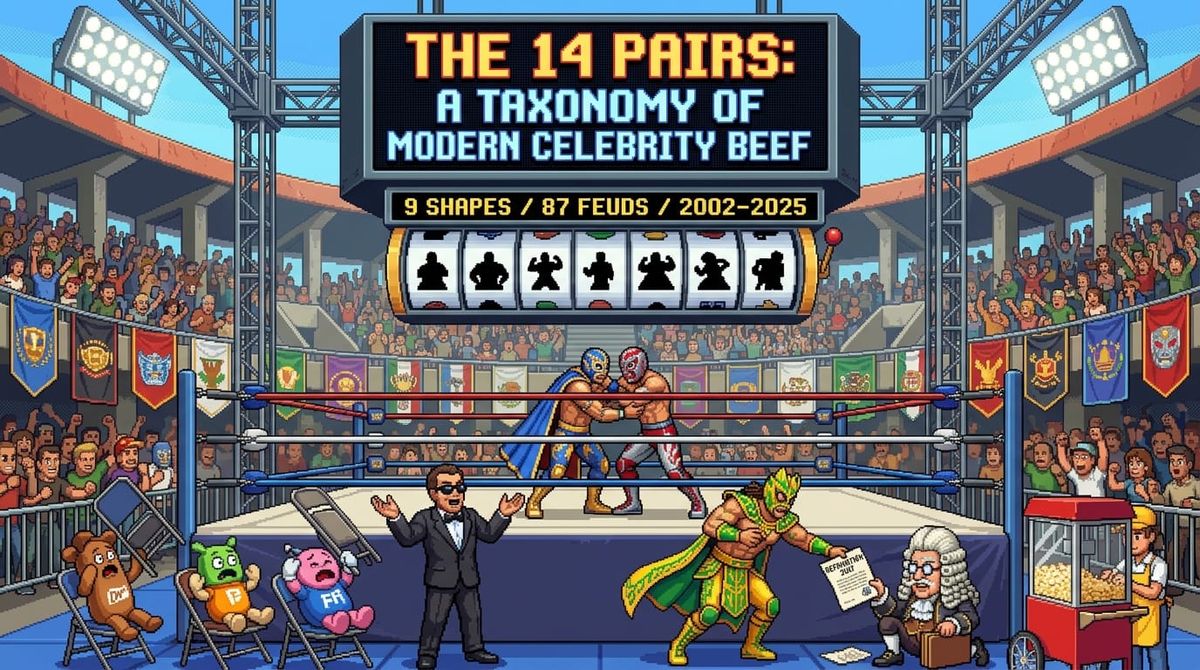
The 14 Pairs: A Taxonomy of Modern Celebrity Beef
Nine archetype shapes catalogued from 87 documented modern celebrity feuds 2002–2025. Why Kendrick × Drake and Pusha × Drake run different cycles even though they look superficially similar.
On May 4, 2024, Kendrick Lamar released "Not Like Us." Within a week it was Spotify's most-streamed song of the year-to-date. Within twelve months it had taken a Super Bowl LIX halftime slot, five Grammys (including Record and Song of the Year), and a January 2025 defamation lawsuit from Drake against Universal Music Group.
None of this was unusual.
Modern celebrity beefs follow shapes. There are roughly fourteen of them. Once you can name the shape a beef belongs to, recent feuds you thought were singular become legible as members of a class — and the class is what determines what happens to the brands in the cross-fire.
We catalogued the shapes by accident. Over three weeks we built a procedural simulator of cultural-asset markets — agent-based celebrities, era-split acquisition mechanics, endorsement contagion. To make the system generate beefs that didn't read as random insults, the engine needed a typology of what an actual beef looks like. We ended up with fourteen pair-archetypes, four shape-modes per pair, and a 779-event synthetic corpus that an audit clears at zero leaks across all 779 events.
What the taxonomy says about real beefs is the part that travels.
The four modes
Every beef runs in one of four modes. The mode is structural — it determines magnitude, duration, and how many tickers move.
Standard mode is what most beefs are: two people square off, a receipt drops, one wins, one absorbs. The market move sits in the ±10–35% range on directly-involved brands. Cardi B × Nicki Minaj (originating at the Harper's Bazaar NYFW party on September 7, 2018) is standard mode. Their sustained conflict touched Fashion Nova, Queen Radio sponsors, and 2 Chainz cosigns, but the underlying physics held.
Chaos mode is when reality bends in service of the beef. The artifact at the center develops its own arc. Kanye × Pete Davidson (February–March 2022, post-Kim Kardashian divorce filing) was chaos: a stop-motion music video depicting violence against Davidson; a Kid Cudi jewelry-confiscation cycle; an Instagram suspension that returned six weeks later; a daily TMZ news cycle in which each side moved the goalposts. Reality didn't break, but it stretched. Yeezy-adjacent assets traded in 3–6× the standard band during the eight-week peak.
Ultra-chaos is when institutions intervene. Drake × Kendrick is ultra-chaos. The cascade produced a Grammy clean-sweep, a Super Bowl, a defamation suit naming UMG, and a public-record paper trail (the Drake v UMG complaint, 81 pages, filed in U.S. District Court SDNY) that survives past the cycle's natural decay. Diddy × 50 Cent (December 2023 onward) is ultra-chaos: 50's acquisition of the rights to the "Fall of Diddy" documentary in December 2023 was a receipt-acquisition move; Sean Combs's federal indictment on September 16, 2024 was the institutional arrival. Drake × Pusha T (May 29, 2018, "The Story of Adidon") came close to ultra-chaos but resolved at chaos-tier — the leaked photo of Drake's son Adonis was the receipt, but no institutional cascade followed.
Brand-feud is the fourth mode and the structurally different one — the principals are companies, not people. The Wendy's-roasting-rivals template. Celebrities appear as joiners, not principals. Taylor Swift × Scooter Braun (June 2019 through October 2021) is a brand-feud at root: Big Machine vs. Universal Music Group vs. Republic Records vs. Taylor Nation as an operational entity. Swift was the public face, but the litigation was corporate-to-corporate, and the cascade resolved through a corporate workaround — the re-recording program, the first of which (Fearless (Taylor's Version)) charted at #1 in April 2021.
The mode determines the shape of the recovery curve. Standard beefs absorb in 90–120 days. Chaos beefs run 180–360 days. Ultra-chaos beefs persist past 540 days and may not resolve cleanly — the Drake v UMG litigation and the Sean Combs federal case both generated institutional paper trails that outlast the cycle's natural decay.
The fourteen pairs
The mode is universal — any beef can run in any mode. The pair-archetype is structural — it's determined by the types of principals involved and produces a specific, recognizable cascade that only emerges from that particular cross-product. Two beefs can run in the same mode and produce entirely different outcomes because the pair-archetypes are different. That distinction is where the predictive work happens.
Each pair is defined by two celebrity types whose conflict produces a recognizable cascade.
We won't enumerate all fourteen here. The methodology is the point: each pair has a signature beef dynamic — the recurring conflict mechanic that emerges only from the specific cross-product of those two archetypes. The signature dynamic is what distinguishes Pusha T × Drake from Kendrick × Drake even though both involve Drake and both turn on receipt-revelation.
Pusha T × Drake is a betrayal-and-receipts archetype. The defining moment is a documentary fact — a photo of a presumed-but-unconfirmed hidden son — that reveals private information. The cascade resolves through information disclosure. Drake confirmed Adonis on the Scorpion album one month later, and the catalog absorbed the hit by Q4 2018.
Kendrick × Drake is an authenticity-attack archetype. The defining moment is the recategorization of Drake himself. "Not Like Us" doesn't reveal a private fact; it reframes Drake's public posture as fraudulent. The cascade resolves through identity, not information. Drake's catalog has not absorbed Kendrick's hit twelve months out — Spotify playlisting data shows sustained outperformance on Kendrick-tagged contexts and sustained underperformance on Drake-tagged ones.
Same antagonist, two different archetypes, two different recovery curves. The shape predicted this.
The simulator maps each pair-archetype onto one of eight cascade outcomes — from both-pump (both sides' markets grow through the conflict) to permanent reset (one side's position is irrevocably altered). Each archetype fires a recognizable outcome pattern across every real-world instance of that pair. The engine below runs the fourteen archetypes against documented anchor feuds. Every bolded feud in the list below deep-links into the matching scenario.
Other pair-archetypes follow the same logic:
- Stan-proxy war (Cardi × Nicki; Selena Gomez × Hailey Bieber, February 2023 onward; Kanye × Pete) — the principals barely engage directly; the proxies do the work; the cascade moves on stan-army velocity rather than receipt quality.
- Snob war (Mariah Carey × Jennifer Lopez, "I don't know her," from a 2001 Mun2 interview onward) — the conflict is taste-based, not factual; the receipt is a credential, not a document; the cascade runs for decades at low intensity.
- Exposure/callout (James Charles × Tati Westbrook, May 10, 2019, "Bye Sister") — the receipt is a sustained-narrative video, 43 minutes long. What distinguishes exposure/callout from betrayal-and-receipts is what the cascade targets: Tati aimed at James Charles's brand partnerships, not his personal reputation. The market move was brand-driven before it was catalog-driven. Morphe terminated before most viewers had finished watching the video.
- Origin war (Lady Gaga × Madonna, 2011, "Born This Way" vs. "Express Yourself") — the receipt is a structural-comparison artifact; the cascade resolves on origination claim. Sibling to Theft Accusation, distinguished by whether the contested object is a specific item (theft) or the founding artifact itself (origin).
- Collab-gone-sour (Eminem × Mariah Carey, escalating from 2002's "Superman" through 2009's "The Warning") — the relationship started as a presumed romance, ended as a documented voicemail leak; the receipt was the relationship itself.
Cardi × Nicki is the canonical stan-proxy war not because the principals haven't engaged (they have), but because the cascade-defining events run through stan armies. The September 2018 party throw was the principals-engage moment; the multi-year aftermath was the proxies escalating on Twitter, Instagram, and streaming-platform comment sections. The brand response — Fashion Nova, OnlyFans cosigns, label-tier shifts at Young Money — tracked stan velocity more than principal moves.
The three tightness tests
The pair-archetype tells you the shape. A second test layer determines whether a beef will move markets at all — because not every beef that fits an archetype actually reaches the brands.
A beef is tight if it passes three tests:
- Action-object tightness. The brand whose stock moves must be the direct target or beneficiary of the antagonist's action. Not a category neighbor. Kendrick attacking Drake moves Drake's catalog directly. Kendrick attacking Drake does not move Travis Scott's catalog, even though Travis sits in Drake's collaborative orbit.
- Celeb motivation. The move has to come from canon. Kendrick attacking Drake fits Kendrick's archetype — a Pulitzer-laureate lyrical-purist with documented prior positions on Drake's authenticity going back to 2013's "Control" verse. 2 Chainz attacking Drake would not fit canon, and the market would price the attack as performative.
- Celeb–brand relationship. The celebrity must have documented exposure to the brand being moved. A celebrity attacking a brand they've never been associated with produces no measurable market move — there's no relationship through which the cascade can propagate.
The three tests are why some apparent beefs don't move markets. Doja Cat × her own fans (July 2023, the "I don't love y'all" cycle) failed Test 3 — Doja and her fans had no shared brand exposure that the conflict could touch. The cycle ran on Twitter for three weeks and produced no measurable streaming or merch impact. Megan Fox × Michael Bay (2009, the Wonder Woman / Hitler-on-set comments) failed Test 1 — Bay's directorial career absorbed the public conflict but Transformers box office did not, because the action-object was Bay personally, not the Transformers franchise as a tradeable asset.
The tightness tests are how the taxonomy distinguishes beefs that move markets from beefs that don't, regardless of audience size or media coverage. Audience size doesn't matter if the tightness fails.
Eight archetype shapes, eight real feuds. Test the framework before moving on — each session pulls a fresh eight from a pool of twenty.
What the taxonomy is for
For brands, the taxonomy is a fit-risk model. If your endorser sits in the same archetype as a beef principal, the cascade will eventually touch you. Aaron Rodgers × State Farm (2008–2021) survived standard-mode noise for thirteen years; it didn't survive the exposure/callout cascade triggered by his November 2021 vaccine comments because the cascade-archetype put State Farm in the impact radius. Tom Brady × FTX (June 2021 – November 2022) didn't survive the chaos cascade triggered by FTX's collapse because the celeb-brand relationship was already in cross-cluster territory; the cascade had nowhere to dissipate.
For media planning, the taxonomy is a duration estimator. Most beefs are over-priced for attention in their first week and under-priced in their fourth — the standard absorption curve doesn't kick in until day 30. Ultra-chaos beefs are persistently mispriced because the institutional cycle doesn't follow the news cycle.
For cultural strategy, the taxonomy is a pattern-recognizer. Most beefs look the same in week one — receipt dropped, sides forming, media cycle beginning. The archetype sorts them in week two. James Charles × Tati Westbrook was identifiable as an exposure/callout archetype within 24 hours of "Bye Sister" posting: sustained-narrative format, brands specifically named, cascade aimed at partnerships rather than personal reputation. That meant Morphe's exposure could be priced before Morphe's PR team had finished their first meeting. Standard-mode framing — over in 90 days, limited to catalog — would have produced the wrong call on duration and the wrong call on target. The archetype produced the right one.
The simulator itself is reproducible. Anyone with three weeks and a brand corpus could build a worse version of it. The asset is the taxonomy — the fourteen-pair canon, the four-mode architecture, the three tightness tests, the eleven-cluster celebrity typology that sits underneath all of it.
The pieces that follow apply this taxonomy to specific markets, specific endorsement failures, and specific acquisition outcomes. The taxonomy is the lens. The cases are what the lens is for.
🎮 Play this article in the game · Deck: Hype · Seed: Drake × Kendrick → dripdriphype.xyz/play?deck=hype&seed=feud_drake_kendrick&piece=W01