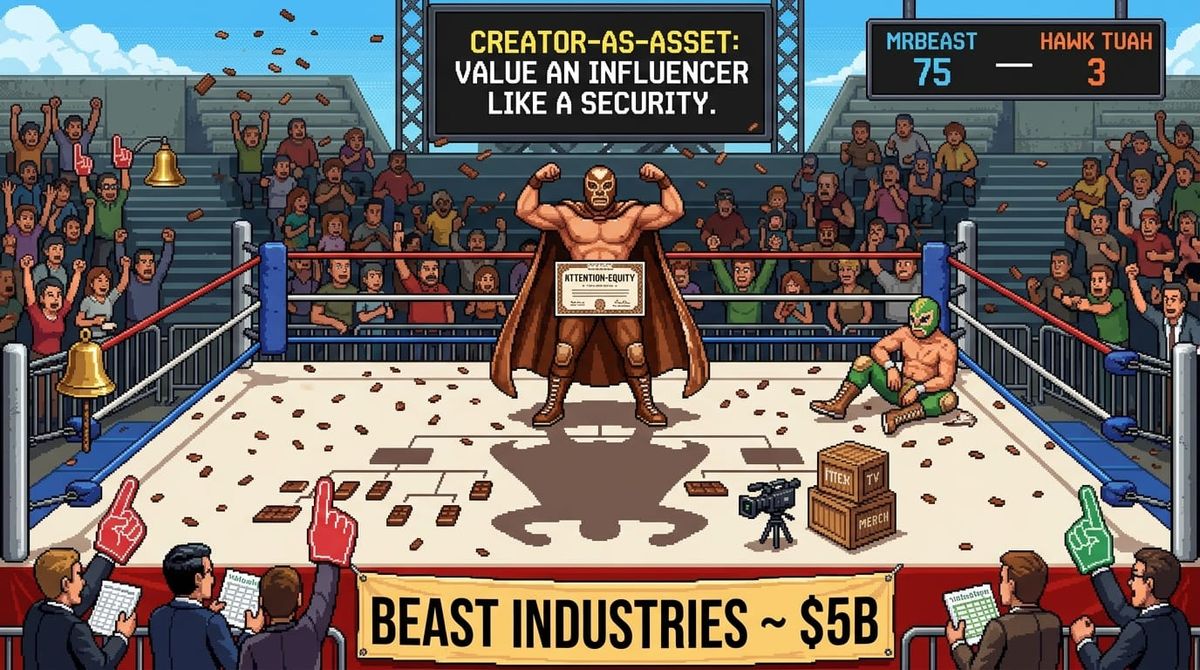
Creator-as-Asset: How to Value an Influencer Like a Security
MrBeast 75, Hawk Tuah 3. A four-component composite valuation index for creator-economy brands — built from hype, risk, backlog, mobility.

In January 2017, Jimmy Donaldson — known online as MrBeast — uploaded a video in which he counted to 100,000 over the course of approximately 40 hours. The video was profitable. It earned advertising revenue based on view count and ad rate. It was, in every conventional financial sense, a unit of YouTube inventory sold against a CPM.
In 2024, Jimmy Donaldson is something else. Feastables, the chocolate brand he launched in January 2022, reported approximately $250 million in revenue in its 2024 fiscal year. Beast Games, the reality-show competition format, sold to Amazon Prime in a March 2024 deal that included a reported $100 million production budget and a multi-season order. Beast Industries — the parent company under which Donaldson is consolidating his portfolio — was reported in late 2024 to be in fundraising conversations at valuations approaching $5 billion. Donaldson's individual personal-brand value, the underlying asset behind all of these products, has been variously estimated in the multibillion-dollar range, including in his own internally circulated financial models.
This is not a creator with merchandising. This is a holding company. The merchandise, the show, the chocolate, and the channel are derivatives of an underlying asset, and the underlying asset is the creator's attention-equity.
We catalogued the components of this asset class by accident. Over three weeks we built a procedural simulator of cultural-asset markets that needed to model what happens when a creator's economic value is no longer derived from CPM-times-view-count but from the price-setting capacity of the creator's attention itself. The simulator's framing — that the creator is the asset, that platforms are the exchanges they trade on, that drops are securities issued against the underlying — kept reproducing patterns observable across the MrBeast / Logan Paul / KSI / Emma Chamberlain cohort.
The framing travels.
What changed
Until roughly 2020, the dominant theory of creator value was advertising-derivative. A creator's earnings tracked CPM × view count × brand-deal frequency. Influencers were a marketing channel — middle-of-funnel awareness drivers priced by reach. The creator was a service provider; the brand was the principal.
Three changes broke that model.
First, creator-owned products started outperforming brand-deal income for top-tier creators. Logan Paul and KSI launched Prime Hydration in January 2022. The brand reported roughly $1.2 billion in retail sales for 2023 (with press-cycle valuation chatter in the multibillion-dollar range at peaks of the cycle). Both creators continue to make YouTube content. The YouTube content is now better understood as marketing for Prime than the other way around. Prime's underlying asset is Logan Paul + KSI as a paired attention-equity, not Prime's hydration formula.
Second, the financial press began applying asset-class vocabulary to creators. The 2022 Forbes coverage of MrBeast described Beast Industries explicitly in venture-finance terms — runway, unit economics, terminal-value modeling. Bloomberg, CNBC, and The Information started reporting on creator-led businesses with the vocabulary they apply to early-stage VC-backed companies. The vocabulary shift signals that institutional capital is now treating creators as the asset, not the channel.
Third, the exits started. Kylie Jenner sold a 51% stake in Kylie Cosmetics to Coty in November 2019 for $600 million, valuing the business at approximately $1.2 billion. Kim Kardashian sold 20% of KKW Beauty to Coty in June 2020 for $200 million, valuing that business at $1 billion. Emma Chamberlain raised approximately $7 million Series A for Chamberlain Coffee in 2022 and the brand has reportedly been valued at well over $150 million in subsequent rounds, with distribution across Whole Foods, Target, and Walmart. SKIMS — Kim Kardashian again, but in a brand category structurally distinct from KKW — raised at a $4 billion valuation in 2023. By the standard tests of an asset class — multi-stage outside capital, multiple-of-revenue applied as valuation, exits priced by enterprise-value rather than service-revenue — creators are now an asset class.
The four components of creator-asset value
The lens distinguishes four components that compose a creator's total value as an underlying asset.
Pick a preset profile and adjust the four sliders to see what the model values the creator at, alongside the named comparables it lands closest to. Every bolded creator below deep-links into this calculator at the matching profile.
Hype score is the multiplier on near-term offerings. Every product or drop tied to a creator gets priced relative to the creator's current attention-equity. When MrBeast's video uploads consistently break 100 million views in their first week (as multiple of his 2024 uploads did), every Feastables SKU on the shelf carries an implicit positive carry — the brand-equity halo translates into shelf-velocity. When Logan Paul gets entangled in a controversy — the CryptoZoo case — in which Logan Paul offered a $2.3 million community buyback in January 2024 and the lawsuit was dismissed in November 2025 — Prime Hydration's shelf-velocity carries an implicit negative carry. The hype score is observable in retail sell-through data with a lag of weeks. It is the closest thing the creator economy has to a stock price.
Cancellation tail risk is the binary terminal-failure feature that distinguishes creator assets from most other asset classes. A creator's hype score can be frozen near zero by a single high-impact incident — a documented misconduct, a confirmed crime, a sustained reputational collapse. The freeze is not a multiplier reduction; it is a phase change. Tana Mongeau's hype score in 2019 was elevated; by 2021, after a series of self-inflicted incidents, her core monetization channels had effectively closed. Colleen Ballinger's hype score in mid-2023 was high; by year-end, after the June 2023 ukulele-apology cycle, it was near zero. Cancellation is reversible — a meaningful minority of cancelled creators run "comeback" cascades that restore partial value (Logan Paul himself, post-2018, did this) — but a brand holding co-branded inventory at the moment of freeze experiences something close to a defaulted bond rather than a discounted stock.
Vintage-moon dynamics are the third component. A creator who becomes economically significant in year N has, in their backlog from year N-3 or earlier, a set of products and drops that retroactively appreciate. Early-era Casey Neistat New York Vlogs merch from 2015–2016 traded at significant premiums on resale platforms following his later commercial trajectory. Early-PewDiePie merchandise from the 2012–2013 era similarly appreciated as PewDiePie's gross channel value scaled. The pattern is consistent: when a creator's hype score climbs durably, their backlog appreciates disproportionately, regardless of the backlog product's intrinsic quality. Holders of early-era inventory effectively held call options on the creator's future trajectory and didn't know it at the time.
Cross-platform mobility is the fourth component. A creator who controls their audience can migrate it. The migration is itself a price-moving event — both the platform losing the creator and the platform gaining them experience measurable equity moves. The 2023–2024 wave of creator moves from Twitch to Kick (xQc's $100 million Kick deal in June 2023 being the largest publicized case; Adin Ross, Trainwreckstv following) made cross-platform migration a tradeable signal. A creator's mobility is itself part of their asset value. Locked-in creators with platform-specific dependencies trade at discounts to creators with platform-portable audiences. The audience the creator carries off-platform is the part of the asset that doesn't show up on any specific platform's balance sheet.
Eight rounds. For each creator's profile, predict the composite valuation index band.
What this implies for brands
Brands that still treat creators as a marketing channel are buying ad inventory at asset-class prices. A six-figure brand deal with an A-tier creator buys a brand deal's worth of attention — but the creator's underlying value is, by 2024, often a multiple of the deal value. Brands are renting access to an asset they could be co-investing in.
The newer pattern, increasingly visible since 2020, is structural co-investment. Coty's KKW Beauty deal in 2020 was a canonical creator-equity acquisition at scale ($200 million for 20%, on a $1 billion valuation), and Sue Nabi (Coty's CEO) described the structure publicly as a "partnership" rather than an endorsement. MrBeast's Feastables structure follows the same logic — Donaldson owns the brand outright, with co-investors and operational partners but not licensing fees to a brand owner.
The implication for traditional brands is a fit-or-acquire choice. A brand that wants long-term association with a creator's audience can either pay endorsement fees (renting a depreciating asset), or it can co-invest in the creator's underlying business (buying equity in an appreciating one). The former is the legacy model; the latter is what Coty did with Kardashian and Jenner, and what institutional capital is doing with Beast Industries.
What this implies for creators
Creators who understand themselves as service providers are pricing their work below market. A creator with five million subscribers who agrees to a $50,000 brand deal — without ownership of any derivative product — is treating the engagement as a fee-for-service transaction. The five-million-subscriber audience is the underlying asset; the engagement is a one-time rental of it. The creator collects the rental fee and the brand collects the option on the audience's future attention.
The reverse pattern — creator launches an owned product, brand becomes a distribution partner — has been visible since Kylie Cosmetics. The MrBeast / Prime / SKIMS / Chamberlain Coffee pattern is its institutionalization.
The structural implication for ambitious creators: hype score is a depleting resource if not converted to owned equity. A creator at peak hype who spends the peak on brand deals exits the peak with cash. A creator at peak hype who spends the peak on owned-product launches and cap-table accretion exits the peak with equity. The latter compounds; the former does not.
What this implies for the financial press
The financial press has been telling this story piecewise — a SKIMS valuation, a Feastables revenue number, a Prime valuation rumor — without naming the structural shift. The shift is from celebrity-endorsement (channel) to creator-equity (asset class). Once you can name the asset class, you can analyze it.
This is what the framework is for. The four components — hype score, cancellation tail risk, vintage-moon dynamics, cross-platform mobility — compose a value model for a creator-as-asset that maps onto traditional security analysis. Hype score functions like a near-term earnings multiplier. Cancellation risk functions like credit-default. Vintage-moon dynamics function like an option on backlog. Cross-platform mobility functions like a liquidity premium.
Jimmy Donaldson in 2017 was a service provider. Jimmy Donaldson in 2024 is an asset class. The difference is not that Donaldson got bigger. The difference is that the market learned how to price what he was.
🎮 Play this article in the game · Deck: Creator · Seed: Chamberlain Compounding → dripdriphype.xyz/play?deck=creator&seed=creator_chamberlain_compound&piece=W11