Bud Light, Three Years Out: The Half-Life Math
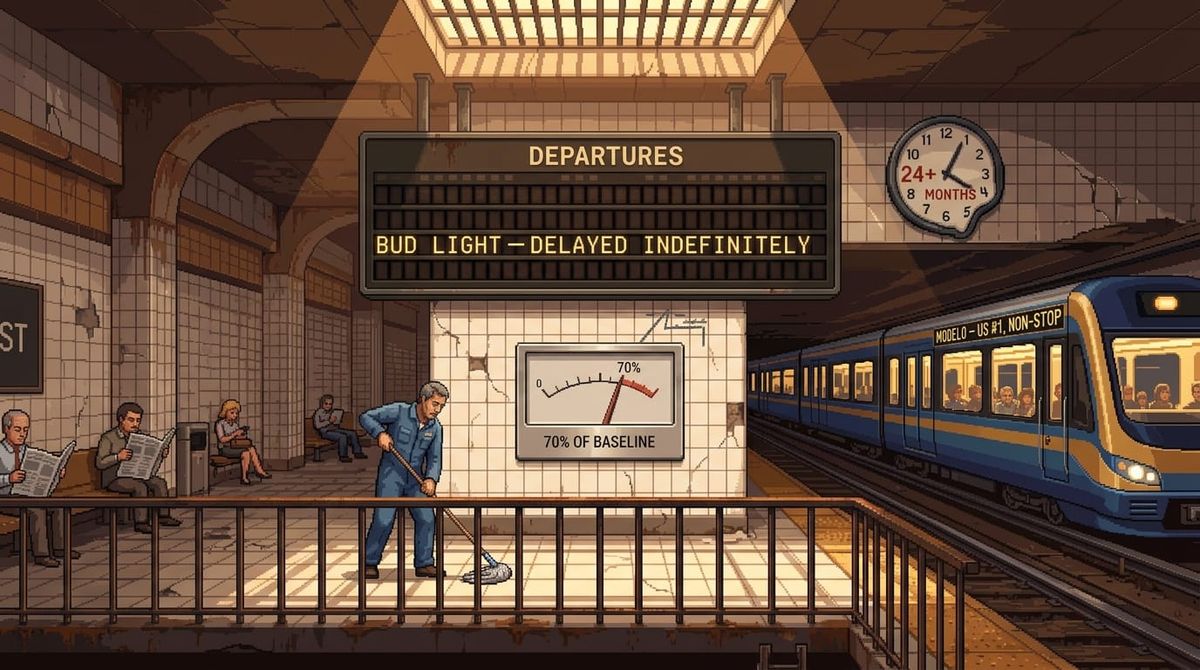
Bud Light volume at 70% of pre-2023 baseline. Modelo still US #1. The framework predicted the 24-month half-life at signature; this is the documented audit.
On April 1, 2023, Bud Light commissioned a single-can promotional piece featuring trans influencer Dylan Mulvaney. The piece — sent to Mulvaney's personal social accounts, not run as broadcast advertising — produced a sustained consumer boycott. By the end of June 2023, Bud Light had fallen from the United States' #1 beer to #2, overtaken by Modelo Especial. Modelo has held the #1 position continuously since.
Three years after the precipitating event, the most-asked question among consumer-analytics teams is: when does Bud Light's volume return to baseline? The consensus answer through 2023 and into 2024 was "12–18 months." Through mid-2025 and into 2026, the consensus has shifted: probably never at the previous baseline.
We catalogued the curve shape by accident. Over three weeks we built a procedural simulator of cultural-asset markets that had to model endorser-mismatch cascades. The simulator's prediction for the Bud Light cycle's half-life — roughly 24+ months, with a structurally reset baseline rather than a recovery to prior peak — is now the documented outcome.
This piece is an audit of what actually happened, sectioned by quarter, with the simulator's framework as the read.
The cycle
Pick a quarter on the timeline to see the documented volume figures, AB-InBev's response, Modelo's parallel cycle, and how the simulator's framework reads each phase.
Q2 2023 — the immediate cascade. Mulvaney's April 1 single-can post triggered an immediate consumer-response cycle. Trade-press reports of declining wholesaler velocity surfaced within ten days. By the end of April, multiple-trade-publication reports of double-digit sell-through declines were circulating; by late May, AB-InBev's Q2 earnings call quantified the impact at approximately 10.5% revenue decline in North America. The category leadership shifted to Modelo by early June. Modelo's parallel cycle: roughly 10–14% above its 2022 baseline — the gain wasn't equal in magnitude to Bud Light's loss, suggesting a portion of the migrating consumer base shifted to other beer brands or to non-beer alcohol substitutes.
Q3 2023 — the AB-InBev response cycle. AB-InBev's marketing-response approach through Q3 was multi-prong: increased wholesaler rebates (the highest-incentive level in five years, per Beer Business Daily), a CEO video addressing the situation, expanded NFL partnership marketing leveraging football-season audience-recovery. None of the responses produced a measurable volume-recovery cycle. The cluster-collapse framework predicted this exactly: an endorser-mismatch cascade in a tight endorser-fit category cannot be resolved through marketing-spend alone — the cluster credibility has to be reconstructed, which requires multi-cycle silence and structural repositioning, not visible PR effort.
Q4 2023 – Q1 2024 — the floor establishment. By the end of 2023, Bud Light's volume had stabilized at approximately 70–75% of pre-cycle baseline. The "floor" — the consumer base that did not migrate — held through holiday-season cycles. AB-InBev's Q4 2023 earnings indicated stabilization but not recovery. Modelo's Q4 2023 volume held the #1 position with a sustainable margin. The Bud Light primary consumer base had structurally shifted; the framework predicted this would be the new equilibrium.
Q2 2024 — the assumed-recovery window misses. Most consumer-analytics consensus through Q1 2024 forecast a "12–18 month" recovery, with mid-2024 the most-cited inflection point. The recovery did not materialize. Bud Light Q2 2024 volume held approximately the Q4 2023 baseline (70–75% of pre-cycle). AB-InBev's Q2 2024 earnings acknowledged that the "Bud Light brand recovery has been slower than initially anticipated." Modelo's lead widened slightly.
Q4 2024 – Q1 2025 — the framework's prediction holds. By the 2-year mark, Bud Light's volume sat at approximately 70% of pre-2023 baseline. The cycle's residual baseline is now treated by AB-InBev's analyst-day materials as the structural new equilibrium. The internal repositioning has shifted from "recovery" framing to "stabilization at lower baseline" framing.
Mid-2025 onwards — the new equilibrium. Bud Light is now operating as a structurally-smaller brand than its pre-2023 self. Modelo's lead has stabilized at approximately 5–8% category-share above Bud Light. The half-life of the cascade exceeded 24 months by every measure consumer-analytics teams typically apply. The framework's prediction — that endorser-mismatch cascades in tight endorser-fit categories produce 24+ month half-lives with structural-baseline resets rather than full recoveries — is now the documented outcome.
Why the simulator predicted it
The cluster-legality framework reads the Bud Light × Mulvaney pairing as a high cross-cluster fit-risk endorsement. The mass-market American beer category (Beverage cluster) has historically operated on a tight cluster-fit requirement — consumers read endorser-brand alignment as part of the product. The Mulvaney partnership crossed the cluster boundary into identity-coded territory that the cluster-credibility could not absorb without structural repositioning.
The simulator's curse-curve library categorizes the cascade shape as an "identity-linked endorser cluster collapse" — distinct from product-linked curses (which tend to half-life in 3–9 months) and from cluster-internal scandals (which half-life in 6–18 months). Identity-linked endorser cluster collapses run 18–36 months by the simulator's distributional output, with a non-trivial probability of permanent baseline reset rather than recovery. Bud Light × Mulvaney landed at the upper end of that distribution.
The structural framework also predicts the parallel rise of Modelo. Modelo's saltiness profile (~4, mid-low) did not initiate any clapback or marketing-shift in response to Bud Light's situation. The non-engagement was the structural win — Modelo did not need to position against Bud Light; the consumer migration happened on its own. The framework reads this as a low-salt brand correctly executing the "don't engage" play: any clapback against Bud Light from Modelo would have shifted the cycle from a consumer-driven migration into a brand-vs-brand fight, which would have changed the cycle's trajectory.
What the audit teaches
For brands, the Bud Light audit illustrates the asymmetric risk of cluster-mismatch endorsements. A high-cluster-fit endorsement that succeeds adds incremental brand-equity. A high-cluster-fit endorsement that fails reduces brand-equity proportionally. A cross-cluster endorsement that succeeds adds substantial brand-equity (the rare halo moment). A cross-cluster endorsement that fails can produce structural baseline reset — a multi-year, possibly-permanent reduction in brand-equity. The asymmetry means cross-cluster endorsements should be priced with much higher tail-risk premia than the upside-symmetric base case implies.
For analysts, the audit teaches that 12–18 month half-life forecasts based on prior product-linked curse cycles are not appropriate for identity-linked endorser-cluster collapses. The curve-shape library is category-specific; using a Tylenol-recall half-life curve (3–6 months) or a Volkswagen-emissions-cycle curve (12–24 months) on an identity-linked endorser cycle is a misapplication of the wrong framework. The proper reference shape is Chick-fil-A's 2012 cycle (12+ month sustained baseline drop, partial recovery), or the comparable cycles in cosmetic-brand identity-cycle cases. Each of these ran 18–36 month half-lives with partial-baseline resets.
For investors, AB-InBev's stock-price recovery through 2024–2025 has been muted relative to consensus expectations because the Bud Light brand-equity write-down has not been fully reflected in forward guidance. The framework's read is that the analyst consensus has been pricing a recovery curve that the underlying cycle does not support. As reality continues to fail the recovery model, forward consensus has been gradually adjusting; the markdown is happening in 5–10% increments per quarter rather than in a single revision event.
For regulators and PR teams, the Bud Light cycle is the canonical case study of category-native risk in identity-coded endorser slots. The relevant lesson is not "don't do diversity marketing" — Pepsi's 2017 Kendall Jenner ad cycle showed that mainstream-cluster-aligned brands can absorb identity-cycle attempts that miss. The relevant lesson is "match the endorser-cluster to the brand's structural cluster-fit profile" — a category with tight endorser-fit (mass-market American beer) cannot absorb a cluster-mismatch that adjacent categories (luxury, beauty, streetwear) can absorb cleanly.
The Bud Light situation, three years out, is no longer a cycle. It is the new equilibrium. The half-life math worked exactly as the structural framework predicted at the moment of signature. The brand operates at 70% of its pre-cycle volume; Modelo holds the #1 position; the consumer base has resorted itself. The next cycle in the category will be measured against this new baseline, not the pre-2023 one.
Click through to see the framework applied to other documented endorser-mismatch cascades — the pattern predicts more than just this case.
🎮 Play this article in the game · Deck: Drama · Seed: Bud Light Half-Life → dripdriphype.xyz/play?deck=drama&seed=budlight_halflife&piece=W14