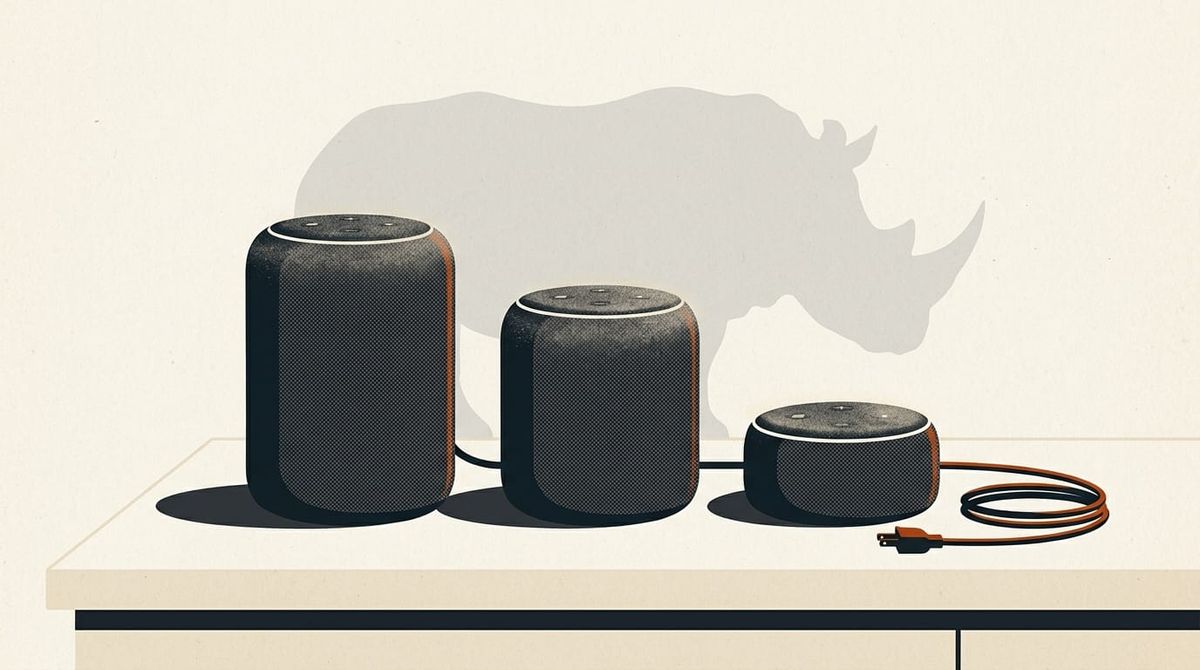
Smart speakers were meant to become shopping machines. Instead people set timers and play music. Shipments are falling and makers are retreating — yet the growth forecasts for voice shopping haven't moved.
The pitch was simple: put 100 million smart speakers in American homes and people would start shopping by voice. It never happened. Owners use them for timers, music and weather — not buying. Global speaker shipments fell 7% in 2023 after a 2% drop in 2022, and US ownership has plateaued near 30-35%. Amazon's voice unit lost about $5 billion in 2022, reported as heading toward roughly $10 billion, and Google cut 17 assistant features in 2024 while delaying its big Gemini upgrade to 2026.
The market still underprices this. Research firms keep printing 24.5% yearly growth on the $15.0 billion US voice-shopping market, even as the companies building it quietly retreat. Their own spending tells the truer story.
Amazon (AMZN) carries the biggest bet, with billions sunk into its voice unit. Alphabet (GOOGL) is openly sidelining its assistant for chatbots. Sonos (SONO) sells into a shrinking $6.3 billion US speaker hardware market. Apple (AAPL) staked its HomePod on the same fading promise.
Why this matters. Companies bet that smart speakers would become shopping machines, but people only use them for timers, music and weather. Anyone counting on voice-shopping growth — device makers, advertisers, and stores building voice features — faces revenue that may never arrive. Lenders and investors backing the rosy forecasts are exposed to a gap between hope and reality.
Blindside · Podcasting & Audio
The Talking Speaker That Never Shopped
Voice shopping was promised; people only set timers and play music
Building
81
Blindside index
What drives it — drag to test
each slider starts at our cited estimate — drag to see the range
Promised voice-shopping growth that never shows up10%
Sourced — global speaker shipments fell 7% in 2023 after 2% in 2022; US ownership stuck near 30-35%.
Speakers used for chores, not buying50%
Our judgment — most speaker use stays at timers, music and weather, never turning into purchases.
Makers pulling back on voice (Amazon, Google)+10%
Sourced — Amazon's voice unit lost about $5bn in 2022; Google cut 17 assistant features in 2024.
Time to impact
2–5 yearsBuilding
now3 yrs7+ yrs
When the financial hit begins to land, on our read.
How to read this. Drag any slider to test your own number — the chart and index update live. The likelihood and the locked facts stay put.
Yearly sales that never arrive
$897m5.98% of sector
Dark line = most likely · faint lines = low–high (8 in 10 outcomes land between) · shaded band = what outside analysts expect
Our estimate lands within what outside analysts expect ✓
Chance this is a permanent shift, not a blip
66%
Average of five independent reads (range 52–74%):
The track record70%
Gadget categories that stall on ownership and lose maker investment — 3D TV, virtual reality, Google Glass — rarely bounce back.
How it works74%
Shipments are dropping, both big assistants are being sidelined for chatbots, and voice never grew past timers and music.
The skeptic's case52%
Smarter assistants like Alexa+ and Gemini could revive voice shopping; 100 million speakers is real reach.
What forecasters say60%
Research firms still print 24.5% yearly growth — the consensus has not lowered its hopes, and that is the mistake.
What the spending shows72%
Amazon's billions in losses and Google's cuts reveal the makers no longer believe their own original promise.
Fixed — the sliders change the size of the hit, not the odds it's permanent.
Why this matters
Companies bet that smart speakers would become shopping machines, but people only use them for timers, music and weather. Anyone counting on voice-shopping growth — device makers, advertisers, and stores building voice features — faces revenue that may never arrive. Lenders and investors backing the rosy forecasts are exposed to a gap between hope and reality.
Most exposed companies
Amazon AMZN · Alphabet (Google) GOOGL · Sonos SONO · Apple AAPL
🔒
The facts — locked
measured, not editable
$15.0bn
$15.0 billion in US voice-shopping revenue in 2024
Grand View Research
~100m
About 100 million Americans own a smart speaker (roughly 35% of people aged 12 and up)
Edison / industry, Dec 2024
−7%
Global smart-speaker shipments fell 7% in 2023 (down 2% in 2022)
TechInsights / Canalys
~$5bn
Amazon's voice unit lost about $5 billion in 2022 (reported as heading toward roughly $10 billion)
Fortune / WSJ
17 skills
Google cut 17 assistant features in 2024
Pocket-lint / Google blog
to 2026
Google's plan to replace its old assistant with Gemini slipped to 2026
9to5Google / PPC Land
$6.3bn
$6.3 billion US smart-speaker hardware market in 2024
Fortune Business Insights
Attention is falling while the impact compounds. the blind spot is widening, not closing.
Global smart-speaker shipments have shrunk two years running (down 2% in 2022, down 7% in 2023), Amazon's voice unit has piled up losses reported as heading toward $10 billion, and Google cut 17 assistant features in 2024 — yet US voice-shopping revenue of $15.0 billion is still modelled at high growth. We put the chance of a lasting stall at 66%, with a most-likely yearly hit of $897 million (range $640 million to $1.2 billion, about 6.0% of the $15.0 billion base).