The Industry Missed Curse Culture. Gen Alpha Didn't.
A 6-year-old reports a cursed Labubu at after school the way you'd report rain. 481.6 million Netflix streams, two Oscars, and WrestleMania's third-best merch seller confirm it. Gen Alpha voted for demons, hauntings, and curses — across five categories. The industry hasn't caught up.
I picked up my 6-year-old from after school recently and partway through telling me about his day he mentioned there was a cursed Labubu at the program — it had moved by itself in front of all the girls, and he felt bad for whoever owned it. He said this the way you'd say it rained. No quotation marks around "cursed," no skepticism — complete acceptance of the premise, then on to whatever happened next.
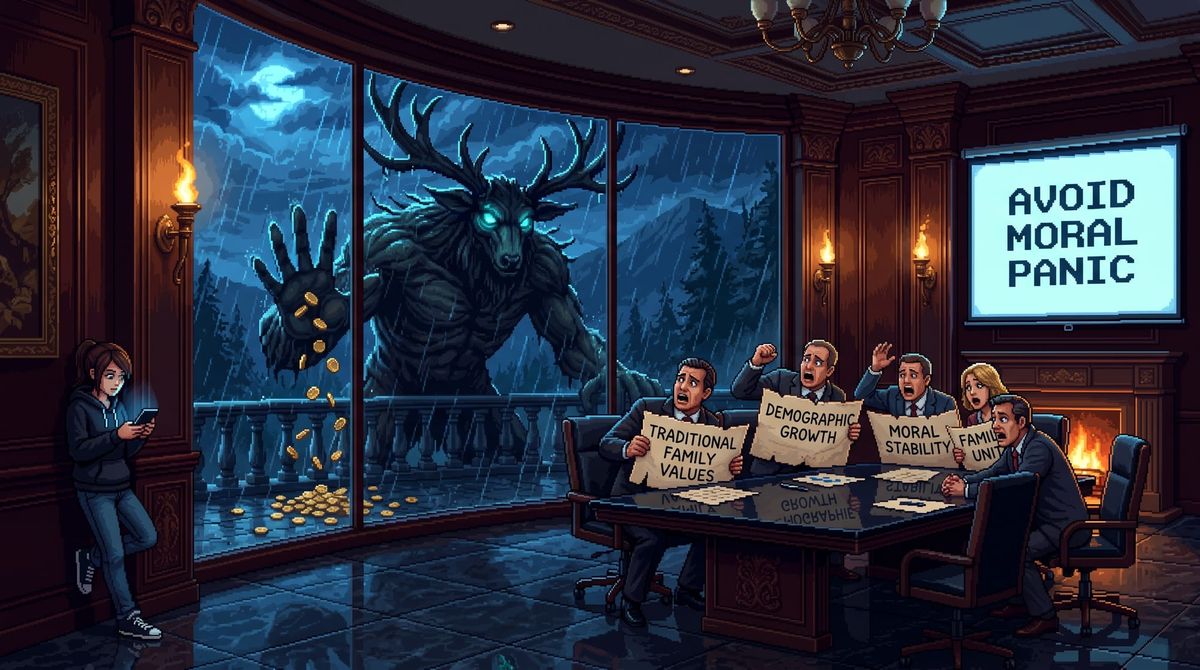
Curse culture is the defining Gen Alpha aesthetic, and the visual-media industry has almost entirely failed to build for it. The prevailing assumption — that demonic, haunted, and cursed imagery in children's media triggers moral panic — hasn't held since at least 2001. What it triggers now is nine-figure audience numbers, WrestleMania merch restocks, and the most-watched film in Netflix's history across five categories. Almost no one is building for it.
At WrestleMania 42 last month, a face-painted, jar-of-teeth-toting WWE character named Danhausen finished third in in-stadium merchandise sales for the entire weekend — behind only CM Punk and Cody Rhodes, both of whom main-evented the show (WrestlingNews.co, April 2026). His top item was a t-shirt that says, simply, Cursed!
In Roblox, a survival-horror title called 99 Nights in the Forest peaked at 14.2 million concurrent players, a number most AAA studios will never see. The premise: rescue four missing children from a deer-like creature and a forest cult while your fear meter rises toward hallucination (PC Gamer).
On Netflix, KPop Demon Hunters drew 236 million views in its first 10 weeks and 481.6 million in the second half of 2025 alone, won two Oscars, and put the fictional group HUNTR/X's single "Golden" at #1 on the Billboard Hot 100 — the first female group to top that chart since Destiny's Child in 2001 (Hollywood Reporter; Netflix Tudum; Billboard).
Three different mediums, three different demographics, one common element: demons, hauntings, curses. Sold to children. With essentially no controversy.
I'd call it three moves that run together, and they're showing up everywhere Gen Alpha looks.
The Three Moves
Domesticate. Labubu — the Pop Mart blind-box collectible that triggered a viral panic last summer when TikTokers claimed it was modeled on the Mesopotamian demon Pazuzu — was actually designed by Hong Kong artist Kasing Lung as a mischievous Nordic-elf forest creature. Snopes debunked the Pazuzu connection (Snopes), but the more telling fact is that the rumor increased the dolls' cultural cachet rather than diminishing it.
Danhausen describes himself as "Conan O'Brien possessed by a demon" (Fangoria). Nezuko, Demon Slayer's most-merchandised character, is a demon recast as protective little sister. The horror vocabulary stays. The threat gets stripped out.
Commercialize. The curse is the product. Danhausen's Cursed! t-shirt outsold most of the WWE locker room at WrestleMania weekend. "Possibly haunted" Labubu listings continue to fetch premiums on resale platforms (Elle India). A Japanese survey found that 40% of Gen Alpha respondents named Demon Slayer their favorite anime — the highest of any title — despite its TV-MA rating in the U.S. (CBR).
Participate. Kids aren't just watching curse culture. They're casting curses. Danhausen's whole gimmick is hexing opponents live on Raw and SmackDown; the schoolyard adaptation is self-evident. Labubu owners post their own ritual burnings, salt circles, and sage smudges to TikTok (Deccan Chronicle).
Demon Slayer fans practice "breathing forms" at each other. In 99 Nights in the Forest, players manage a fear meter that produces hallucinations until they relight the campfire (99 Nights in the Forest Wiki).
Danhausen Wasn't Engineered for This. He Preceded It.
It would be easy to read Danhausen as a character WWE engineered for the Gen Alpha moment. He isn't. Donovan Danhausen made his professional wrestling debut in 2013; the face-painted "very nice, very evil" gimmick crystallized on the independent circuit in 2017–2018, born from a Halloween show where he painted his face after the ghouls in John Carpenter's They Live (It's the Real Wrestling). He signed with Ring of Honor in 2019, AEW in 2022, was the highest-selling wrestler on ProWrestlingTees that year — outselling CM Punk and MJF (Cageside Seats, January 2023) — and didn't reach WWE until Elimination Chamber 2026.
In other words: Danhausen is a charming throwback to wrestling's carnival roots — Papa Shango putting curses on the Ultimate Warrior in 1992, the Undertaker's three-decade mortician gimmick, Kane's pyrotechnic-demon debut at Bad Blood '97 (which Danhausen himself cites as the moment he wanted to become a wrestler). The lineage runs through Gorgeous George and the sideshow. WWE didn't invent the curse aesthetic for children. They signed the guy who'd been performing it on the indies for nearly a decade, at exactly the moment the audience walked over to meet him.
Two weeks ago at a restaurant in Yonkers, I heard an 8-year-old at the next table telling his family about Danhausen — the curses, the jar of teeth, the hexes on opponents. My son picked it up before I did. "He knows about Danhausen," he said, like that settled something. I hadn't heard WWE discussed in a restaurant in years — last time it was grown men arguing about championship belts.
That's the bigger story. The aesthetics were always available. The audience changed.
Why Now, Part One: The Demons Drained Out
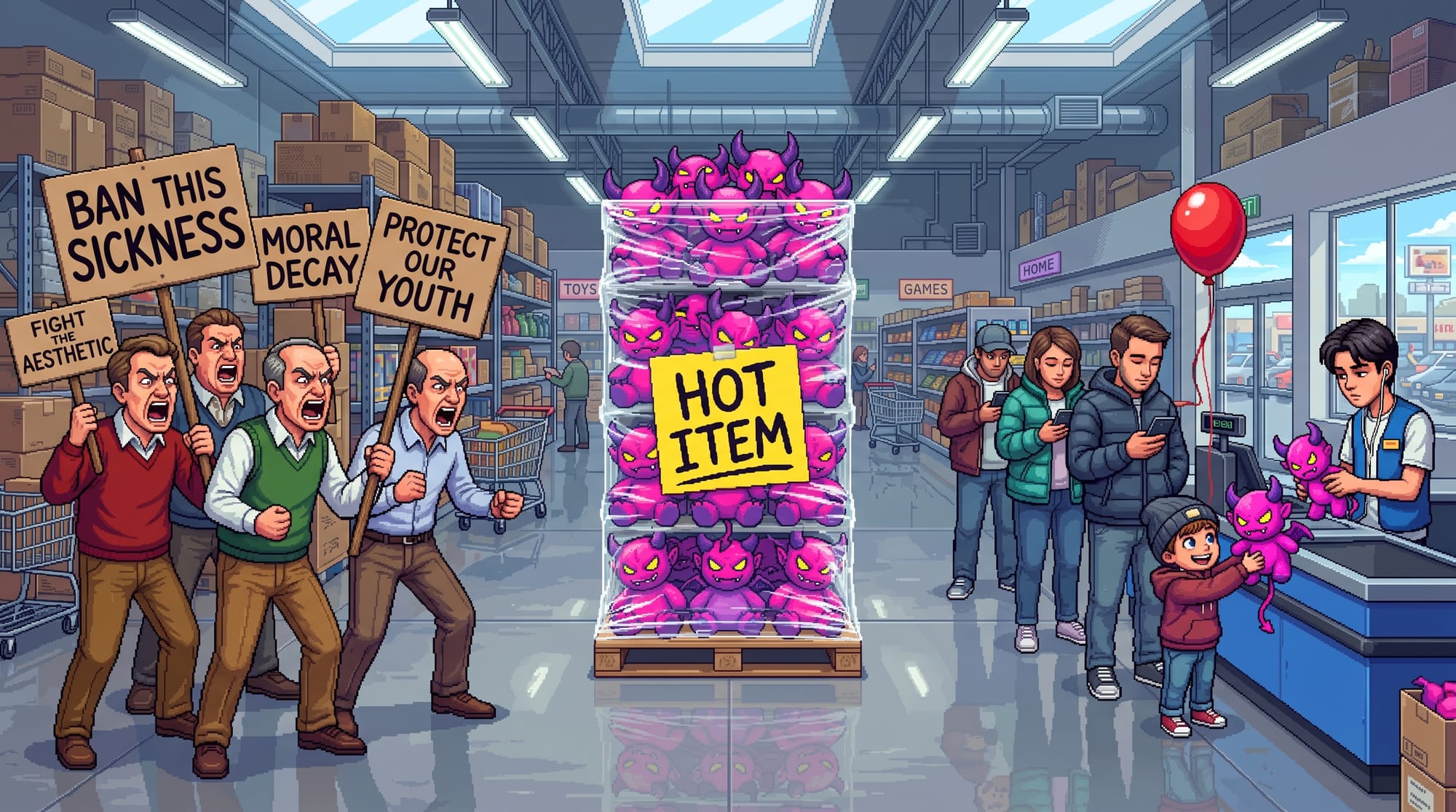
Three decades ago, the same imagery triggered nationwide panic. When id Software released Doom in 1993 — a game in which a space marine fights through hordes of invading demons to save humanity — it was condemned by religious organizations as actively demonic. Not as a horror property about demons, but as a vehicle for satanic influence (Kill Screen; SEVENCUT).
The argument was, on inspection, strange: Doom is a game in which you kill demons. By any literal reading of the plot, it's one of the most aggressively pro-humanity games ever shipped. The pentagrams on the walls were treated as load-bearing; the actual story was treated as decoration. The same logic powered the panics over Dungeons & Dragons, Pokémon, Harry Potter, and Mötley Crüe — the symbols themselves were the threat, regardless of context.
Three decades later, demons headline a children's musical and the response is 481.6 million Netflix views and two Oscar wins. The aesthetic charge that used to live in those symbols has migrated to a much smaller and more isolated audience.
Pew Research finds the religiously unaffiliated have grown from 16% of U.S. adults in 2007 to 29% in 2023–24, now the largest single religious cohort in America (Pew Research Center). Most of that growth isn't atheists — it's "nothing in particular," people who quietly drifted from "yeah, I'm Catholic, I guess" to "I don't really do that." Stealth secularism. Their kids are Gen Alpha. If you're unbothered by Pazuzu, a Pazuzu plushie is just a plushie.
Even alarmed-side commentary acknowledges what's happening. Writing in Christianity Today, Isabel Ong identified "our modern-day penchant for making monsters and demons safe — or cute or attractive or morally ambiguous — and how this might be creating a sense of spiritual ambivalence" (Christian Parenting). That's curse culture, articulated from the worried side. A handful of Christian commentators raised concerns about KPop Demon Hunters; the response was muted in a way that would have been unimaginable when Doom shipped — the audience that found those arguments persuasive got smaller.
Why Now, Part Two: The Visual Baseline Shifted
Stealth secularism is 60% of the story. The other 40% is brainrot.
The Italian brainrot bestiary — AI-generated hybrid creatures with pseudo-Italian names that went viral on TikTok in early 2025 — trained Gen Alpha that the default visual register is cursed (Know Your Meme). Tralalero Tralala is a three-legged shark wearing blue Nikes. Bombardiro Crocodilo is a crocodile-headed WWII bomber. Glitched, chimeric, uncanny, deliberately wrong.
For a kid raised on that feed, Labubu doesn't read as creepy. It reads as a guy. Danhausen's face paint isn't unsettling; it's normal grammar. The Deer in 99 Nights is a brainrot character that happens to chase you.
Previous generations had cursed media as exceptions — Goosebumps was a genre, set apart from regular kids' content. For Gen Alpha, cursed is the ambient texture of childhood. The three moves — domesticate, commercialize, participate — work because the substrate is already there.
Subtle Fails. Curse-Native IP Doesn't.
So what should the visual-media industry do about this?
First, understand what won't happen: curse culture is not burning out. Trends burn out when their audience ages out or their aesthetic gets exhausted. Curse culture spans cute (Labubu), goofy (Danhausen), serious-action (Demon Slayer, KPDH), and survival-horror (99 Nights) — it isn't sitting on a single aesthetic. And it isn't sitting on a single cohort that'll age out, because the underlying drivers aren't reversing on any timeline that matters to a media exec.
Individual properties will burn out. Labubu the object will get oversaturated; Pop Mart is already rotating toward the rest of The Monsters line. 99 Nights will get dethroned in Roblox next quarter.
Danhausen will eventually be replaced by the next cursed gimmick. The properties are disposable. The register is not.
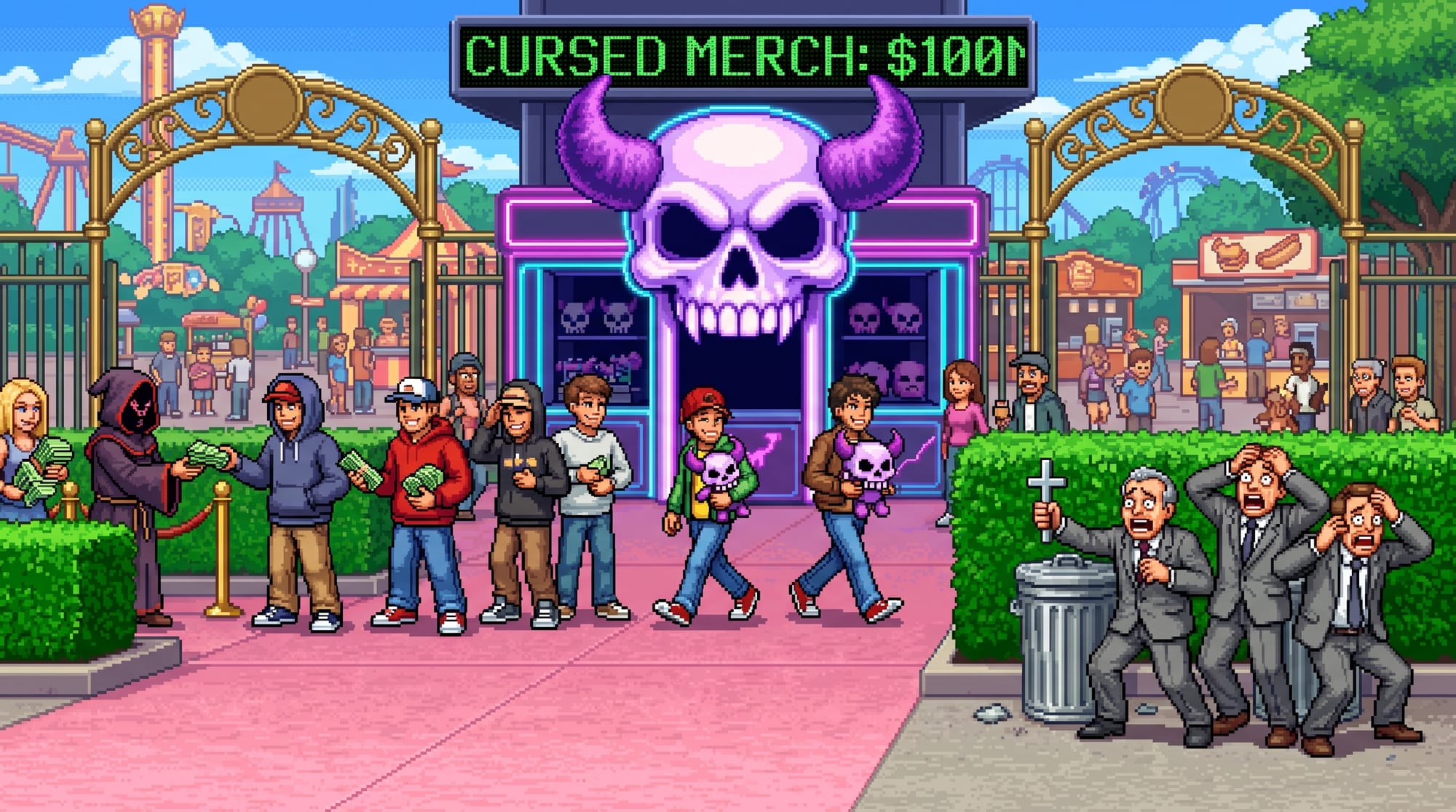
Second, understand what won't work: subtle. Subtle is the move when you're nervous about an audience that doesn't want the thing. Gen Alpha demonstrably wants the thing.
They're voting with 14 million concurrent players and 481.6 million Netflix streams. Subtle is what Disney and Nickelodeon have been running for the past decade — the slightly-weird side character, the Halloween-themed episode, the marginally darker villain design — and it's part of why their kids' linear share keeps eroding. Subtle is the half-measure of an industry that doesn't believe the audience research.
The actual playbook:
Build the curse into the premise, not the trim.
Pop Mart didn't add a creepy character to a normal collectible line; the line is monsters. Danhausen isn't a heel turn on a normal wrestler; the gimmick is the curse. The execs winning this build curse-native IP from scratch.
Domesticate without defanging.
This is the hardest part, and what most legacy studios get wrong. KPDH's demons are scary and hot and funny. Labubu is cute and slightly off.
The register requires keeping the tension live, not resolving it into safety. A Labubu that was just cute would be a Care Bear. A Care Bear is not curse culture.
Build the participation layer.
The reason 99 Nights is at 14 million CCU isn't the horror; it's that kids can play the horror with their friends. Curse-coded IP without a participatory hook — toy ritual, schoolyard catchphrase, TikTok dance, in-game mechanic — leaves most of its value on the table.
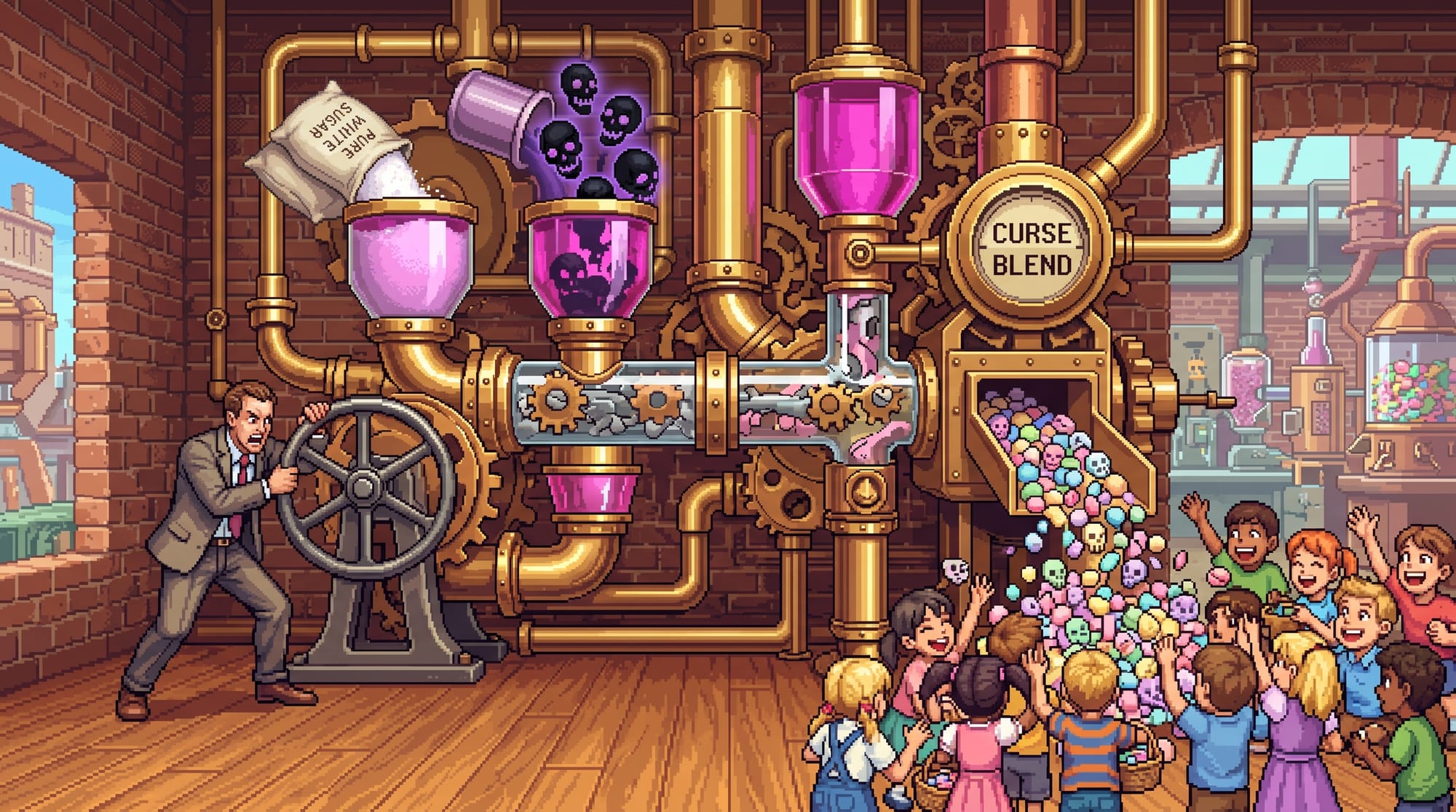
I built my son a candy store simulator with cursed item blending as a core mechanic — not because I planned for it to be the star feature, but because it was. That's the part he shows every kid who plays it. Not the candy, not the store management — the cursed stuff. Try it.
Work the ratings system, because Gen Alpha already has.
Demon Slayer is technically TV-MA in the U.S., and Gen Alpha kids watch it anyway. Producers building curse-coded kids' IP have to operate in a parental-controls landscape where the underlying audience has already moved past the gates. The smart move is PG-rated curse aesthetics with TV-MA visual literacy. KPop Demon Hunters is the textbook execution.
One real risk worth flagging: moral panic could still come back, from a different vector than the 1990s evangelical right. AI-generated brainrot is already drawing concern about cognitive effects — "brain rot" was Oxford's Word of the Year for 2024 specifically because of worry about kids' attention spans. The Italian brainrot audio's documented blasphemy and Gaza references are starting to generate parent-side pushback (Capital). If curse culture gets bundled with brainrot in a future panic cycle, the whole register gets dragged into the discourse — not enough to kill it commercially, but enough to make brand-safety teams nervous for a quarter or two.
The companies winning curse culture — WWE, Pop Mart, Sony Pictures Animation via Netflix, the Roblox studios behind Doors, Dandy's World, Forsaken, and 99 Nights — didn't tiptoe. WWE didn't workshop Danhausen for two years in focus groups; they signed a guy who'd been doing it on the indies since 2017. Pop Mart didn't soft-launch Labubu, and Sony didn't market KPDH as "a movie that happens to feature demons." They built the thing and let the audience decide — to the tune of nine and ten figures.
Curse culture is not coming. It is here, with audience numbers in the tens and hundreds of millions. Build for it now, or spend the next five years explaining to your board why Gen Alpha chose someone else.