
Seat-as-Asset: The Status Experiences Sub-Economy
F1 Paddock Club at 10× face, Sukiyabashi Jiro reservations at $4,500 above the meal, Soho House founders-tier with 5-year waitlists. The sub-economy of seats.

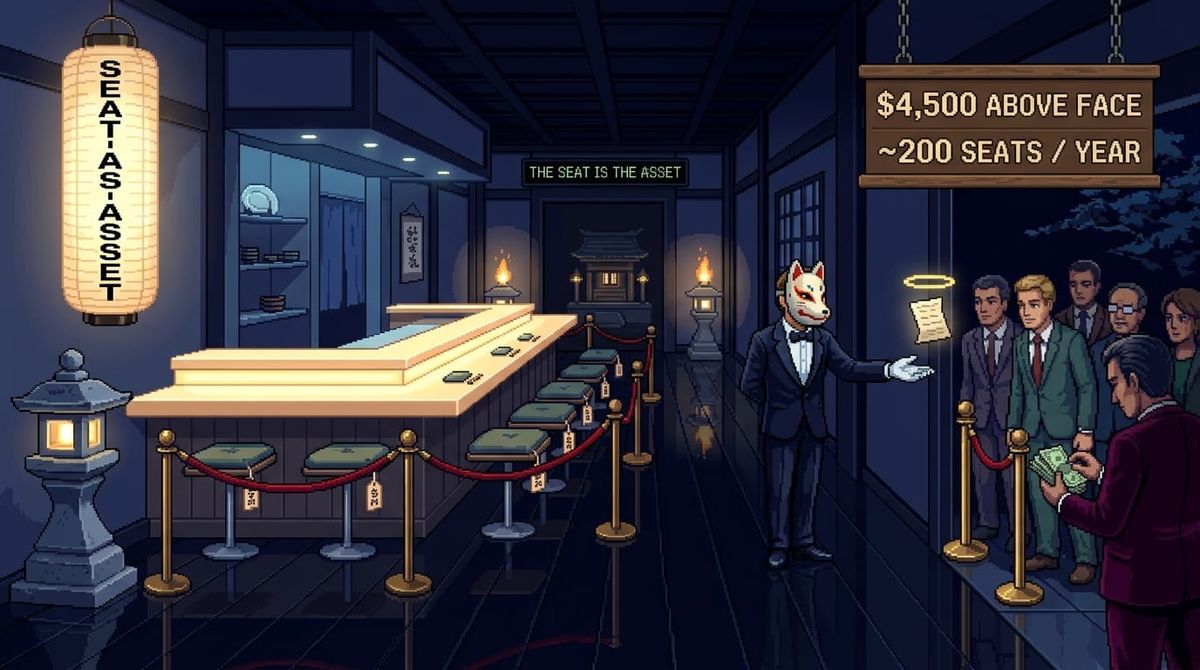
A two-seat omakase reservation at Sukiyabashi Jiro Honten in Ginza, on a Tuesday at 8pm, does not trade on Resy. The reservation does not exist on Resy. Sukiyabashi accepts reservations only through hotel concierge desks at a small set of approved Tokyo properties, and rejects most of those. Total seat capacity at the original Honten location is 10 per night, served in two sittings. Total annual seats issued to non-Japanese diners across all sittings: approximately 200, across roughly 80 service days. A confirmed reservation, transferred through a back-channel, traded in 2024 for approximately $4,500 above the face price of the meal — which itself is approximately $400. The seat is not a meal. The seat is the asset.
This is the Status Experiences sub-economy. Not Tickets (which trade for mass-market events at scale). Not Hookups (transactional intimate access). A distinct category whose unit of trade is a seat, an invitation, or a member-tier slot — always finite, often time-anchored, technically non-transferable but practically gray-market liquid.
We catalogued the market by accident. Over three weeks we built a procedural simulator of cultural-asset markets and discovered Status Experiences is structurally distinct from every other cultural-asset category we'd modeled. The mechanics — social-proof multipliers, plus-one transfer rights, annual-renewal lapse cycles, blackball-tier cancellation, multi-year wait-list accrual — don't appear cleanly in any adjacent category. The market operates at a smaller volume than Tickets but at meaningfully higher per-seat pricing, and it has been operating in roughly its current form since the late 1990s.
What's actually trading
Pick a sub-niche to see the documented seat-prices, gray-market premiums, and waitlist economics.
Motorsport hospitality. F1 Paddock Club wristbands are the canonical case. Face value at Monaco GP weekend (the premium tier): approximately €5,500 per person. Gray-market resale during the 2024 cycle reached 3–10× face — single wristbands trading at €15,000–50,000 depending on the team-hosting tier. The wristbands are technically non-transferable; the gray market operates through second-party hospitality brokers who buy block allotments and resell with attached "concierge services" to legitimize the transfer.
Private aviation fractional shares. NetJets fractional shares trade as quasi-financial instruments. A 1/16th share (50 flight hours per year) traded in 2024 at roughly $750,000 + ~$25,000/month in management fees. Secondary market exists for fractional resales; the cycle's price-discovery operates on a 12–24 month rebalancing window. The asset class is the closest thing in Status Experiences to a true financial instrument — depreciation schedules, asset valuations, and re-sale liquidity all follow institutional-tier conventions.
Yacht charter / floating-week-rentals. Mediterranean yacht-charter weeks for the 2024 summer season at the premium tier (60+ meter, full crew, prime week) traded at $400k–$1.5M per week depending on yacht and week. Brokers (Camper & Nicholsons, Burgess, Northrop & Johnson) operate as the gray-market clearinghouse; the underlying yacht-ownership economics depend on the charter market subsidizing roughly 60–80% of operating costs for non-resident-flagged vessels.
Members clubs. Soho House founders-tier memberships have approximately five-year wait-lists for the London / NYC properties at top tier. Annual fees at the Every House global tier sit at approximately £2,800 (2024); founders-tier add-ons can push annual costs to £6,000+. The membership is not technically transferable; in practice, founder-status memberships transfer through corporate-account workarounds, and the social premium of "being a founder member at a specific house" is observable in third-party social-status pricing.
Other members-club tiers: NeueHouse, Zero Bond (NYC), Casa Cipriani (multiple), San Vicente Bungalows (LA), each operating on similar dynamics — long wait-lists, capped membership, annual-renewal lapse mechanism (don't renew, lose the seat to the waitlist).
Omakase / peak-restaurant. Sukiyabashi Jiro Honten (Tokyo, 10 seats × ~80 service days = ~800 seats/year for foreign diners). Eleven Madison Park (NYC, ~80 seats × 5 nights). Atomix (NYC, ~50 seats × 5 nights). For the highest-tier omakase the reservation is the trade — Resy-broker apps (Appointment Trader and similar) operate as the gray-market layer at premium-tier omakase, charging $200–2,500+ above face for confirmed bookings.
Festival / event VIP tiers. Coachella Weekend-1 VIP wristbands traded at 3–4× face during the 2024 cycle. Cannes Film Festival badge tiers (the color-coded tier system from White → Pink-with-Pastille → Blue → Yellow) determine access to specific film screenings; the unofficial badge-exchange market in Cannes during the festival window is one of the most-documented gray-markets in the European film industry.
Sports-tier season-ticket personal-seat-licenses (PSLs) for premium NFL teams (Dallas Cowboys, Las Vegas Raiders, San Francisco 49ers) trade at $40k–$500k+ for the highest-tier seats. PSLs are the closest North American sports analog to the global Status Experiences model — finite issuance, technically non-transferable, gray-market liquid.
The five mechanics
The category's distinguishing structural features:
Social-proof multiplier. Owning multiple high-status seats compounds the per-seat value of each one. A consumer who holds Soho House Founders + F1 Paddock Club Monaco + Coachella VIP simultaneously has a status profile that lifts the resale value of each individual seat through the implicit "they're real" signal. The mechanic is observable in concierge-broker pricing: identical Soho House founders-tier transfers attached to a verified high-status buyer trade ~15–25% above ones attached to anonymous transfers.
Plus-one transfer rights. Many seats include a plus-one — the right to bring or send a guest. The plus-one itself trades separately from the primary seat. Gray-market resellers frequently flip the plus-one slot rather than the primary seat, because the primary seat-holder retains their access while monetizing the unused plus-one. F1 Paddock Club, Met Gala invitations (the rare instances they trade), Cannes-tier badges, and Soho House guest passes all operate on this two-component trade structure.
Annual-renewal lapse. Memberships tick down. If a Soho House member doesn't renew by the annual deadline, the seat reverts to the waitlist and the member loses their tier. This creates calendar-pressure analogous to Tickets time-decay but at a different rhythm — monthly to annual rather than show-date-bound.
Blackball-tier cancellation. Unlike most other categories where cancellation is consumer-driven or platform-driven, Status Experiences cancellation can be club-administered. A Soho House member who violates the membership code loses access to all global properties; the cancellation is not reversible through subsequent good behavior. The blackball mechanic is the strongest negative-status-event in the category and operates as a discrete cliff rather than a curve.
Multi-year wait-list accrual. Seats accumulate option-value during wait-list periods. A Soho House founders-tier wait-list slot that's been on the list for four years carries different option-value than a fresh sign-up — the wait-list position itself becomes an asset, transferred in some cases through corporate or family-account workarounds.
Eight rounds. For each scarce-seat or experience, classify the trade premium tier from the documented gray-market data.
What this means
For collectors of status assets, the framework's structural insight is that the bag composition is the asset, not any individual seat. Building a Status Experiences portfolio is structurally different from accumulating individual collectibles — the social-proof multiplier means a coherent portfolio of moderately-prestige seats can outperform an incoherent portfolio of higher-prestige individual seats.
For operators (clubs, restaurants, festival organizers), the framework explains why explicit non-transferability rules increase secondary-market premiums rather than suppressing them. A truly-transferable status seat would trade at face plus modest premium. A technically-non-transferable seat that gray-markets liquid trades at face plus 200–800% premium because the non-transferability is part of what's being purchased. The operator's enforcement posture (lax / moderate / strict) determines the gray-market premium structure but never eliminates it.
For analysts watching the broader luxury market, Status Experiences is the canary for the broader category's cycle health. When status-seat gray-market premiums compress (as they did briefly in 2009 and 2020), it signals the broader luxury cycle is cooling. When they expand sharply (as in 2022–2023 across multiple categories), it signals the broader luxury cycle is heating. The seat market leads the goods market by approximately 6–12 months in both directions.
For regulators and tax authorities, the Status Experiences sub-economy is one of the least-regulated cultural-asset markets in modern operation. Gray-market broker fees, plus-one transfer payments, and corporate-account membership transfers operate substantially outside of formal financial-system tracking. The category's volume is meaningful enough that European Union and US tax authorities have opened informal inquiries in 2024–2025 into broker-tier reporting requirements, but no formal enforcement framework has been established.
The reservation at Sukiyabashi Jiro on a Tuesday at 8pm is a seat. The seat is the asset. The omakase itself is the experience. The two are related, but they trade independently — and the seat is the more interesting half of the transaction.
🎮 Play this article in the game · Deck: Finance · Seed: Status Seat Trading → dripdriphype.xyz/play?deck=finance&seed=status_seat&piece=W15