
Heat × Cool: How Cities Reprice the Same Brand
A Supreme Box Logo at $148 in NYC and $360 in Tokyo. Same hoodie. Two-axis pricing across eight cultural-asset categories and a city-by-city matrix.

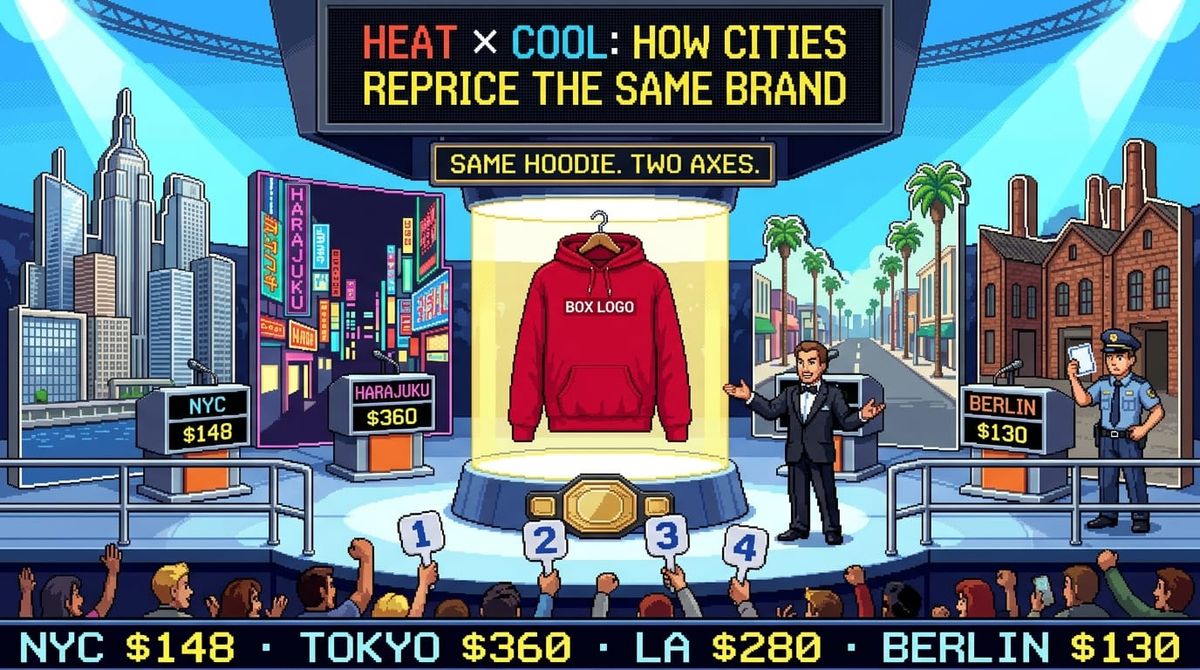
A Supreme Box Logo Hoodie at the New York City flagship store retails for $148. The same hoodie, in identical colorway, on the Tokyo Harajuku resale grid trades at $240–$360. The same hoodie in Los Angeles secondary trades at $200–$280. The same hoodie in Berlin secondary trades at $130–$180 — frequently below NYC retail.
The differences are not currency. Not import duty. Not transportation cost. Not even differing tax regimes. The hoodie is an identical physical artifact across all four locations. What differs is which dimension of cultural value each city is paying for.
Cultural-asset markets do not price along a single axis. They price along two — and most cities resolve the same artifact to a different point on those axes.
We catalogued the pattern by accident. Over three weeks we built a procedural simulator of cultural-asset markets that needed to model what happens to identical inventory across geographies during cascade windows. The simulator's dual-axis pricing model — Heat (mainstream demand: volume, virality, awareness) × Cool (subcultural credibility: authenticity, scarcity, resistance to mainstream adoption) — kept reproducing the observable arbitrage gradients across luxury, streetwear, sneakers, trading cards, vintage media, and recorded music. Same object. Four prices. One per city archetype.
The findings travel.
Heat is not Cool
Heat is the dimension consumer-marketing has been measuring since at least the 1960s. Awareness, sentiment, share of voice, recall, viral coefficient. It is mainstream. It rewards reach. It compounds in cities where status flows from being seen with the object.
Cool is the dimension subcultures measure but rarely formalize. Authenticity (does the object pre-date its commercialization?), scarcity (is the supply genuinely constrained?), credibility (does the object signal the wearer's positioning against the mainstream?). It compounds in cities where status flows from being seen with the object before it became something to be seen with.
A force can move them in opposite directions on the same object. A corporate acquisition of a heritage streetwear brand spikes Heat (press, awareness, retail expansion) while cratering Cool (the brand has joined the mainstream it was supposed to resist). A scandal involving a brand's celebrity ambassador spikes Heat (everyone is talking about it) and can crater Cool (the cultural permission the brand carried has been compromised). The two axes are not correlated. The same artifact can compound on one while bleeding on the other.
Which axis a buyer is willing to pay for depends on where they live.
Four city archetypes
Cities sort, with surprising consistency, into four reactive archetypes. The classification holds across categories — a city that pays for Cool in streetwear pays for Cool in vinyl and watches and trading cards too.
Subculture cities — Tokyo, Berlin, Brooklyn-as-distinct-from-Manhattan, Antwerp, parts of Seoul — pay for Cool. The sellout discount is real here: an object that has become legibly mainstream loses value as fast as an object that has become legibly authentic gains it. Tokyo's Harajuku grid is the canonical subculture city for streetwear: Stüssy graphic tees command roughly 30–50% premium to comparable US pricing through Komeda, Beams, and the broader Harajuku consignment ecosystem. Berlin runs the inverse on aspirational merch — German Vogue's "Berlin discount" is real and persistent. The same Yeezy that resells at premium in LA trades roughly 10–20% below comparable cities in Berlin. The cities are running the same axis; they're just placing the artifact differently on it.
Aspirational cities — Los Angeles, Dubai, Miami, parts of Singapore, expanding Lagos — pay for Heat. The announcement spike is real here: an object that has become legibly mainstream is the point. Hermès Birkin pricing tells this story across the global gradient: a Birkin at London's Sloane Street boutique trades meaningfully above NYC retail; the same bag in Dubai (via re-import gray market) trades higher still; in Tokyo, where the waitlist culture is documented but more discreet, the secondary discount narrows. Aspirational cities reward visible Heat. Subculture cities reward sustained Cool. The same artifact reads as a different asset in each.
Finance / media cities — London, San Francisco, Hong Kong, Frankfurt, parts of Singapore — front-run cascades. They aren't necessarily paying the highest price; they're paying the first. When an acquisition rumor breaks, when a feud cascade activates, when a curse cycle begins to land — finance cities reprice before the aspirational cities have noticed and before the subculture cities have decided how to feel. The arbitrage opportunity from finance-city front-running to aspirational-city post-confirmation is one of the most consistent patterns in cultural-asset secondary markets. A streetwear brand acquired by a publicly-traded conglomerate sees London resale trader-activity inside 48 hours; the LA aspirational-cycle response takes 3–6 weeks; the Tokyo subculture-cycle response takes 3–9 months and frequently reads in the opposite direction.
Tourist-trap cities — Las Vegas, Times Square specifically (rather than NYC generally), Bali's resort coast, Dubai's mall-tier districts, parts of Bangkok — absorb dead inventory. A brand in a Taxidermist outcome (per the era-split framework — a licensed-out heritage brand operating primarily as a licensing vehicle) finds its remaining unit sales here. The buyer is not pricing Heat or Cool. The buyer is pricing convenience and presumed legitimacy. Pierre Cardin sells in Las Vegas. Authentic Brands Group's post-acquisition product line sells in tourist-trap districts in volumes that the subculture and aspirational cities won't absorb. The dead-brand category has a structural floor here that it doesn't have anywhere else.
Pick a category and a city pair to see the documented Heat × Cool spread, dominant archetype per city, and the arbitrage direction. Every bolded artifact below deep-links into the matrix at the matching combination.
The arbitrage that doesn't disappear
Globalization was supposed to flatten these spreads. Resale platforms, international shipping, cross-border payments, and arbitrage bots have all dramatically reduced the operational friction of geographic price discovery. The spreads narrowed in the 2010s for items where the only differentiator was distribution friction — fast-fashion brands, mass-market electronics, even mid-tier sneakers.
For cultural-asset categories, the spreads did not narrow. They sometimes widened.
Vintage Pokémon Base Set First Edition cards demonstrate this clearly. The English-language cards (printed January 1999) and Japanese-language cards (printed October 1996) are nominally equivalent at the categorical level. The Japanese cards consistently trade at multiples of comparable English-condition cards on the Asian collector market. The differential persists across PSA-graded conditions, across Heritage and Goldin auction houses, across decade-spanning observations. It is not arbitrage-able away because the differential is cultural, not operational. The Japanese collector market values Cool (the originating market, the founder-era artifact) that the English market is increasingly pricing as Heat (the mainstream-recognized investment asset).
Sneaker secondary markets show the same pattern. Authentic-tier resale pricing for Air Jordan 1 colorways runs ~15–25% higher in Tokyo than NYC for the same model in identical condition. The premium is stable; it has been documented across StockX and GOAT pricing data for years. Tokyo is paying for Cool. NYC is paying for Heat. The model is the same. The geographies are pricing different assets.
Hermès Birkin pricing has the same pattern. The bag, the materials, the maker, the production location — all identical. The bag in London (Sloane Street boutique) trades to a different secondary tier than the bag in Tokyo (Ginza boutique). The London buyer is pricing the Birkin's status function (Heat). The Tokyo buyer is pricing the Birkin's connection to a specific French heritage and the patient waitlist culture that earned it (Cool). The same handbag is two assets in the two cities.
Eight rounds. For each artifact + city-pair, pick the city paying the premium.
What the framework is for
For collectors and resale operators, the city × cluster matrix is a structural arbitrage map. The spreads exist because the underlying valuation axes are different — not because there's information friction between markets. A Birkin sourced through Tokyo's waitlist and resold in Dubai will not produce a Heat-arbitrage opportunity for long, but a Birkin sourced through London's Sloane Street and resold in Tokyo Ginza's secondary market consistently produces a Cool-arbitrage spread that survives multiple cycles. The arbitrage requires routing by axis, not by city.
For brands strategizing geographic expansion, the matrix is a positioning framework. A brand built on Cool (Stüssy, Comme des Garçons, early Off-White, original Supreme) requires subculture-city anchoring to maintain category permission. A brand built on Heat (Crocs, Stanley Quencher cycle, aspirational-mass-luxury) requires aspirational-city presence to compound. A brand attempting to occupy both (post-acquisition Off-White, post-VF Supreme) faces the structural problem that the two axes are in tension and the geography that pays for one will discount the other.
For analysts, the matrix is a forecasting lens. When a brand's geographic distribution shifts (a Cool-anchored brand opens flagships in Las Vegas; an aspirational-anchored brand pulls back from Dubai), the structural axis-allocation is shifting — and the secondary market reprices accordingly before the primary market's strategic statements have explained why.
A Supreme Box Logo Hoodie in NYC and the same hoodie in Tokyo are not the same asset. The market has been pricing them as separate assets for fifteen years. The two-axis framework is what makes the consistency legible.
🎮 Play this article in the game · Deck: Finance · Seed: City Arbitrage → dripdriphype.xyz/play?deck=finance&seed=city_arbitrage&piece=W05