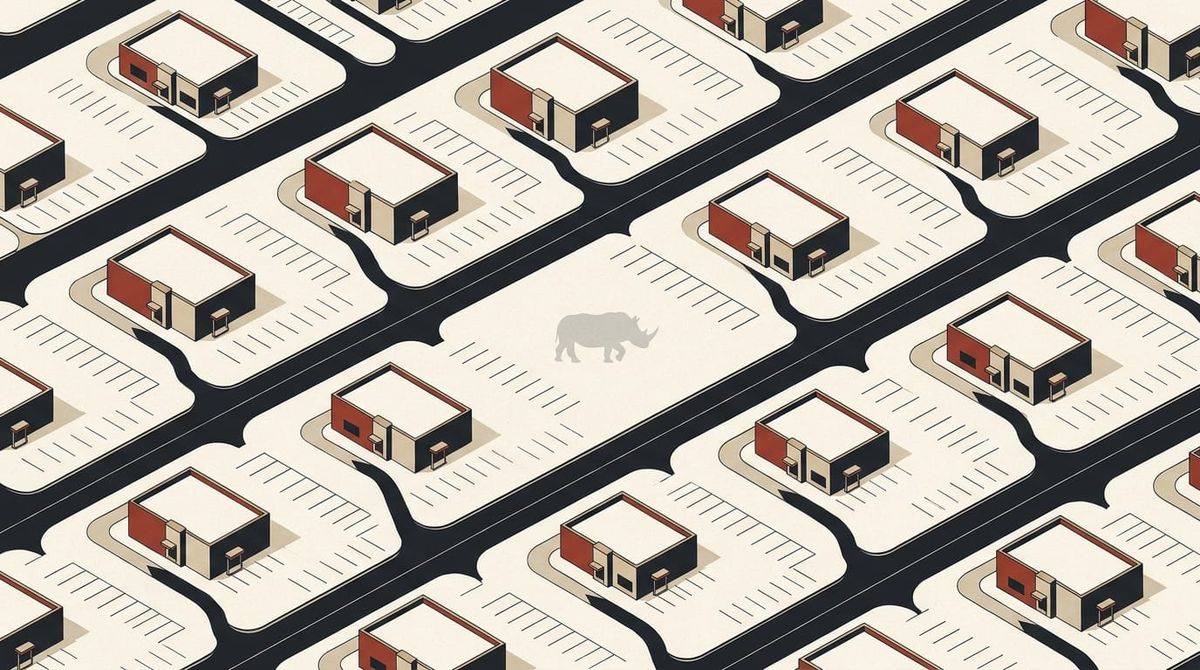
US fast-food chains opened stores three times faster than the population grew in 2025. Each restaurant now fights for fewer customers, and our model sees $5.9bn in sales a year quietly lost to overbuilding.
America's fast-food chains keep cutting ribbons on new stores, but the supply of customers has not kept up. Store counts rose 1.4% in 2025 while the population grew only 0.5%. There are now 531 people per restaurant, down from 568 in 2019, and our model sees the potential customers per store falling another 9.2% by 2030. Same-store visits already dropped 3.1% to 4.1% in early 2025.
The market still reads steady store growth as health. It misses that much of that growth now steals sales from a chain's own older locations and lands on weaker sites that may need write-downs. We estimate $5.9bn in lost sales a year on a $385bn base.
McDonald's (MCD) and Subway are the most built-out, at 4.1 and 4.8 stores per 100,000 people — Subway already closed 729 US stores in 2025. Restaurant Brands International (QSR), Yum! Brands (YUM), Wendy's (WEN) and Jack in the Box (JACK) all run dense, mature US burger and chicken networks with little open ground left to grow into.
Why this matters. American fast-food chains are opening stores three times faster than the population is growing, so each restaurant now fights over fewer customers. New stores increasingly just steal sales from a chain's own older locations, and weak sites become candidates for write-downs. Lenders financing new builds, franchisees signing leases, and investors holding chain stock all face a slow squeeze on sales per store that the headline growth numbers hide.
Blindside · Fast Food / QSR
America Ran Out of Corners
Chains keep opening; the customers per store keep shrinking
Building
64
Blindside index
What drives it — drag to test
each slider starts at our cited estimate — drag to see the range
Sales in crowded, fully-built markets52%
Our judgment — older California and New York plus built-out suburbs are now flat or shrinking (Technomic).
Sales lost as new stores steal from old2.4%
Sourced — store count up 1.4% while population grew 0.5%; fast-food visits fell 3.1% to 4.1% in early 2025.
Write-downs on weak new locations+14%
Our judgment — customers per store drop 9.2% by 2030 as growth lands on lower-volume sites.
Time to impact
2–6 yearsBuilding
now3 yrs7+ yrs
When the financial hit begins to land, on our read.
How to read this. Drag any slider to test your own number — the chart and index update live. The likelihood and the locked facts stay put.
Yearly sales lost to overbuilding
$5.9bn1.53% of sector
Dark line = most likely · faint lines = low–high (8 in 10 outcomes land between) · shaded band = what outside analysts expect
Our estimate lands within what outside analysts expect ✓
Chance this is a permanent shift, not a blip
71%
Average of five independent reads (range 55–80%):
The track record74%
Store-based retail formats historically hit a ceiling once they get too dense; fast food is already past its 2019 level.
How it works80%
New openings cluster in the Sun Belt and in coffee and chicken; old burger markets are flat or shrinking already.
The skeptic's case55%
Smaller stores, delivery-only kitchens and remodels could stretch the runway; Chick-fil-A's low density shows some open space remains.
What forecasters say70%
Biggest 500 chains still add about 3,600 stores a year — the pace is slowing, not reversing, for the giants.
What operators do78%
70% of McDonald's franchisees now run five or more stores; money backs proven operators, not brand-new sites.
Fixed — the sliders change the size of the hit, not the odds it's permanent.
Why this matters
American fast-food chains are opening stores three times faster than the population is growing, so each restaurant now fights over fewer customers. New stores increasingly just steal sales from a chain's own older locations, and weak sites become candidates for write-downs. Lenders financing new builds, franchisees signing leases, and investors holding chain stock all face a slow squeeze on sales per store that the headline growth numbers hide.
Most exposed companies
McDonald's MCD · Restaurant Brands International QSR · Yum! Brands YUM · Wendy's WEN · Jack in the Box JACK
🔒
The facts — locked
measured, not editable
+1.4%
US chain stores grew 1.4% in 2025 while the population grew only 0.5%
Technomic Top 500 (RB Online)
531
531 people per US restaurant now, down from 568 in 2019
SignalFlare AI (BLS/Census)
−9.2%
Projected 9.2% fewer potential customers per restaurant by 2030 (stores up 17.3%, population up 6.5%)
SignalFlare AI
−3.1 to −4.1%
Fast-food visits to the same stores fell 3.1% to 4.1% in early 2025
SignalFlare AI / industry
−729
Subway closed a net 729 US stores in 2025, and 3,000 since 2021
Restaurant Dive
4.1
McDonald's runs 4.1 stores per 100,000 people; Subway runs 4.8
StatsPanda
0.9%
Chick-fil-A runs just 0.9 stores per 100,000 people — the only real open space left is small
StatsPanda
US fast-food store counts have grown faster than the population every year since 2019, cutting the potential customers per restaurant by a modelled 9.2% through 2030 and driving an estimated $5.9bn in yearly lost sales to self-competition and weak sites (low case $4.0bn, high case $8.2bn) out of a $385bn sector. Same-store visits running 3.1% to 4.1% lower in early 2025 show the squeeze is already in the numbers; we put the chance this is permanent at 71%.