How Cultural Contagion Spreads
Stanley, Balenciaga, Bud Light, Hawk Tuah, Labubu — eleven contagion shapes that some categories permit and others structurally cannot.
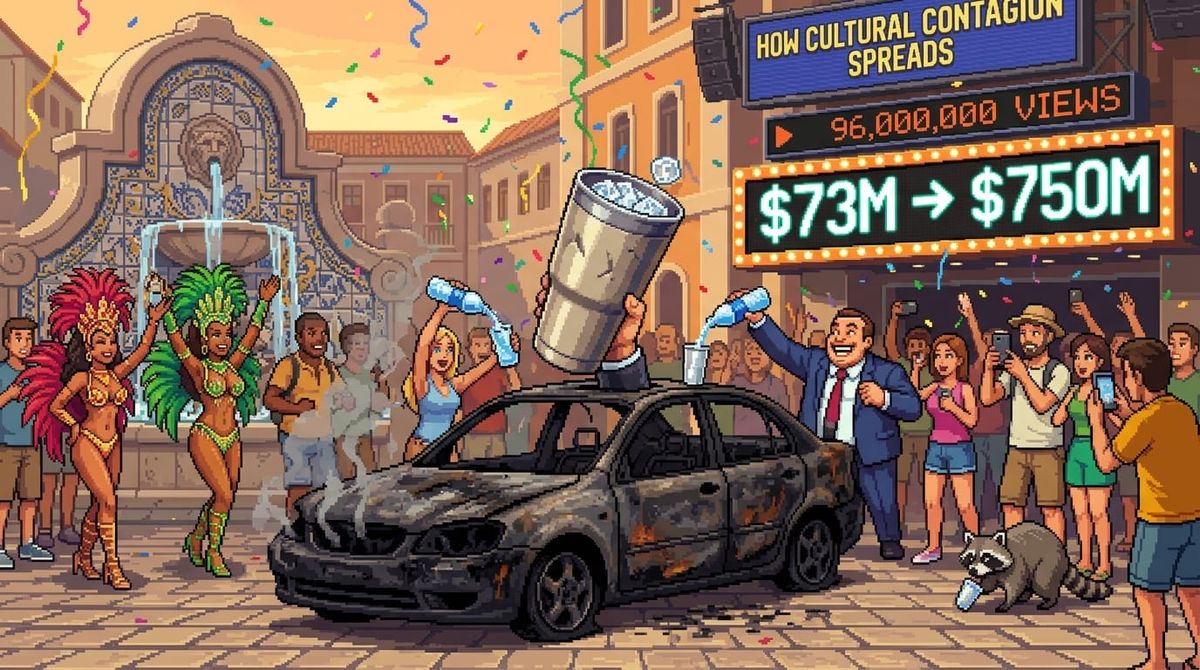
In November 2023, a woman in Tennessee posted a video of her car after a fire. The car was destroyed. Inside the cupholder was a Stanley Quencher tumbler, half-melted on the outside, ice still rattling around inside. She demonstrated this by pouring water into it. The video reached 96 million views on TikTok within a week. Stanley's then-president, Terence Reilly, replied publicly and sent her a new car along with replacement tumblers.
This sequence — the burning car, the surviving cup, the CEO's response, the brand's subsequent six months of unrelenting consumer attention — is what we mean by cultural contagion. It is not what we mean by "viral marketing," which implies the brand authored the moment. Stanley did not author this moment. A stranger's accident did.
But the moment was not random. The video reached 96 million views because the Stanley Quencher had already become culturally available to be captured by it. Six months earlier — when Stanley was still a 110-year-old camping brand — the same video would have gotten 100,000 views, generated no executive response, and changed nothing about the company's trajectory. The Quencher's $750 million revenue year in 2023 (up from $73 million in 2019) had to exist first. Something in the category had to have already shifted.
Cultural contagion has rules. We catalogued them by accident.
Over three weeks we built a procedural simulator of cultural-asset markets. The simulator had to model the moments when a brand gets captured by a cultural cycle — when reality, briefly, bends around it. To make the simulator's chaos events read as plausible, we had to articulate which categories permit which contagion shapes. The answer turned out to be more constrained than we expected: contagion is category-bound, and a category that doesn't permit a contagion shape cannot be infected by one no matter how much attention is directed at it.
This is the rule the rest of this piece is about.
Categories define their own contagion shapes
Every product category has a possibility-space for what can happen to it inside a cultural moment. The possibility-space is set by the category's structure — what counts as scarce in it, what counts as transgressive in it, what counts as accessible-but-aspirational in it, what counts as legible status in it. Cultural contagion in a category travels along the shapes that category permits.
The Stanley Quencher cycle happened because Drinkware, as a category, was missing a status marker until roughly 2022, and the Quencher invented one. Drinkware had previously been a utility category. The 40-ounce Quencher's combination of mid-tier pricing ($35–45), limited-color drops with Target exclusives, and visible carrying-around-ness (a tumbler that travels) turned it into the category's first widely-shared status object. Once Drinkware had a status object, it had a contagion shape: limited drops, color-of-the-season hype, Target line-ups, fistfights captured on phone cameras. The Costco-parking-lot Stanley fights of January 2024 — three documented incidents in the first ten days alone — are what status-object contagion looks like when its category previously had no such cycle.
The same shape could not have happened to Education, no matter what an EdTech brand did. There is no status-object cycle in Education's possibility-space. There is no "limited drop." There is no Target line. There is no version of the contagion that the category supports.
This is the central observation: contagion shape is determined by category, not by attention budget. Brands that spend at the level of $50 million annually trying to manufacture moments in categories that don't permit those moments produce, year after year, no moments. Brands that spend nothing in categories whose possibility-space supports the right shape produce, occasionally, billion-dollar phenomena.
Four shapes, four cases
The four cultural-contagion cycles of the past three years that produced the most documented economic impact each correspond to a different category-native shape. Each one is unrepeatable in the others' categories.
Pick a contagion shape and a real anchor to see the side-by-side — simulator's procedural chaos-mode cascade × the matched real-world cycle. Every bolded case in the four-shape walk below deep-links into this preview at the matching scenario.
Balenciaga (Luxury, transgression-shape). In November 2022, Balenciaga published a holiday campaign featuring children holding teddy bears in BDSM harnesses. The campaign produced, within four weeks, a Kering market-cap drawdown of approximately $7–8 billion, an executive apology, the firing of the campaign's photographer, multiple consumer-led product-burning campaigns, and a class-action lawsuit. Luxury's possibility-space supports this shape. Transgression-as-marketing is part of Luxury's genre — it has been, in different registers, since at least the late-1990s Tom Ford era of Gucci. The category permits deliberate provocation, and it permits the curse that follows when the provocation lands wrong. Other Kering brands (Bottega Veneta, Saint Laurent) absorbed measurable contagion from the same cascade. A QSR brand running the same campaign would not have produced the same shape; the category does not permit the same kind of transgression.
Bud Light (Beverage, endorser-mismatch shape). In April 2023, Bud Light commissioned a single-can promotional piece featuring trans influencer Dylan Mulvaney. The piece — distributed to Mulvaney's social channels, not run as broadcast advertising — produced a sustained consumer boycott. Bud Light fell from the United States' #1 beer to #2 within twelve weeks (overtaken by Modelo Especial, which has held the position since). Anheuser-Busch InBev's 2023 North American revenue declined approximately 10.5% in Q2. Two years out, Bud Light's volume sat at approximately 70% of its pre-2023 baseline by mid-2025. The Beverage category — especially mass-market American beer — has a tight endorser-fit requirement. The category's consumers read endorser-brand alignment as part of the product. A mismatch on identity-coded dimensions produces a curse cascade with a long half-life. Other categories would not have produced the same magnitude of consequence for the same endorser choice. The Beverage category did.
Hawk Tuah (Creator-as-asset, speedrun shape). In June 2024, an unrelated woman gave a one-line interview on a Nashville street that produced a six-second clip. By December 2024 — six months later — that clip had been parlayed into a podcast, a merchandise line, a brand partnership portfolio, and a celebrity-tied memecoin (HAWK) that launched, ran to a $490 million market cap within roughly fifteen minutes, and collapsed 95% on the same day amid widespread allegations of insider trading. The SEC opened an inquiry by January 2025. The shape — interview clip → personal brand → monetization stack → memecoin → rug — is the creator-as-asset speedrun, a contagion shape only the Creator Economy category supports. The category permits velocity: attention can be converted to monetization in days rather than years, and monetization can be converted to terminal exit (the memecoin rug, the brand-deal cliff, the platform pivot) in hours. A Toys-category Hawk Tuah is structurally impossible. A Luxury-category Hawk Tuah is unimaginable. The Creator Economy alone has the velocity to run the shape.
Labubu (Toys, scarcity-engineering shape). Pop Mart's blind-box plush figure Labubu, designed by Hong Kong artist Kasing Lung and licensed in 2019, became the dominant collectibles cycle of 2024–2025. By Q1 2025 Pop Mart's Labubu line had contributed an estimated $400 million in annual revenue. The cycle's structure — blind boxes, regional exclusives, celebrity endorsements (BLACKPINK's Lisa carrying one became the precipitating moment in April 2024), counterfeit waves, and resale markups of 5–20× over retail — is the Toys category's native contagion shape. Trading Cards, Sneakers, and Collectibles run the same shape with different artifacts. None of the categories' adjacent categories support it. Drinkware, even at its 2023–2024 peak, did not run the blind-box shape. Toys did. Toys does.
Match the shape to the category. Six rounds per session, fresh from a pool of eleven contagion shapes.
What this means for brands
For brands deciding where to spend, the rule has a corollary: contagion is not buyable. You cannot purchase a Stanley moment into a category that doesn't permit one. You cannot purchase a Balenciaga-style transgression cycle in QSR, even if the campaign is perfectly transgressive — QSR's possibility-space doesn't include the response shape. You cannot purchase a Hawk Tuah speedrun in pharma, regardless of what your influencer budget is — pharma's possibility-space is structurally rate-limited.
For brands deciding where to position, the rule has a sharper one: the category you are in determines the contagion that can happen to you, including the contagion you don't want. Balenciaga's curse cascade was a feature of Luxury's possibility-space, not a Balenciaga-specific flaw. Bud Light's cascade was a feature of Beverage's endorser-fit sensitivity. The implication is that some categories carry curse-risk as a structural feature, and the only way to opt out is to be in a different category.
For analysts watching consumer markets, the rule is a forecasting tool. When a contagion shape appears, ask which category natively supports it — and which adjacent categories don't. The shape will repeat within the category (the next Stanley will be a different drinkware product); it will not transfer to categories that don't support it. The 2024 Stanley adjacent brands that tried to manufacture the same shape — Owala, Hydro Jug, the wave of TikTok-merchant tumbler brands — succeeded within Drinkware because the category was already primed. They did not succeed by entering adjacent categories with the same playbook.
For categories that don't currently permit a major contagion shape, the rule is a kind of structural insurance. Education, Pharma, Legal Services, and B2B SaaS sit largely outside the possibility-space of the cycles that have defined consumer attention for the last three years. They are, by category structure, immune to the Stanley shape — which means they are also immune to the Balenciaga shape. There is no contagion to capture them. There is also no contagion to consume them.
This is not the same as saying these categories are safe. They are not. They have their own category-native risks — most of them slower, less visible, and less photogenic than what happens to a Drinkware brand in a Costco parking lot. But they are, mostly, available to be neither blessed nor cursed by the cycles that captured Stanley and Balenciaga and Bud Light and Hawk Tuah.
The Stanley Quencher in the burned car had to exist as a category-native object first. The video that captured it didn't make the cycle; the cycle made the video reachable. Once a category's possibility-space includes a contagion shape, every brand in that category is exposed to it — for the upside and the downside, in whichever order the next moment hits.
The shapes are stable. The brands that ride them rotate. The categories that permit them are determined years in advance, by structural features of the market that have nothing to do with the brands themselves.
🎮 Play this article in the game · Deck: Hype · Seed: Stanley Status Cycle → dripdriphype.xyz/play?deck=hype&seed=contagion_stanley_status&piece=W06