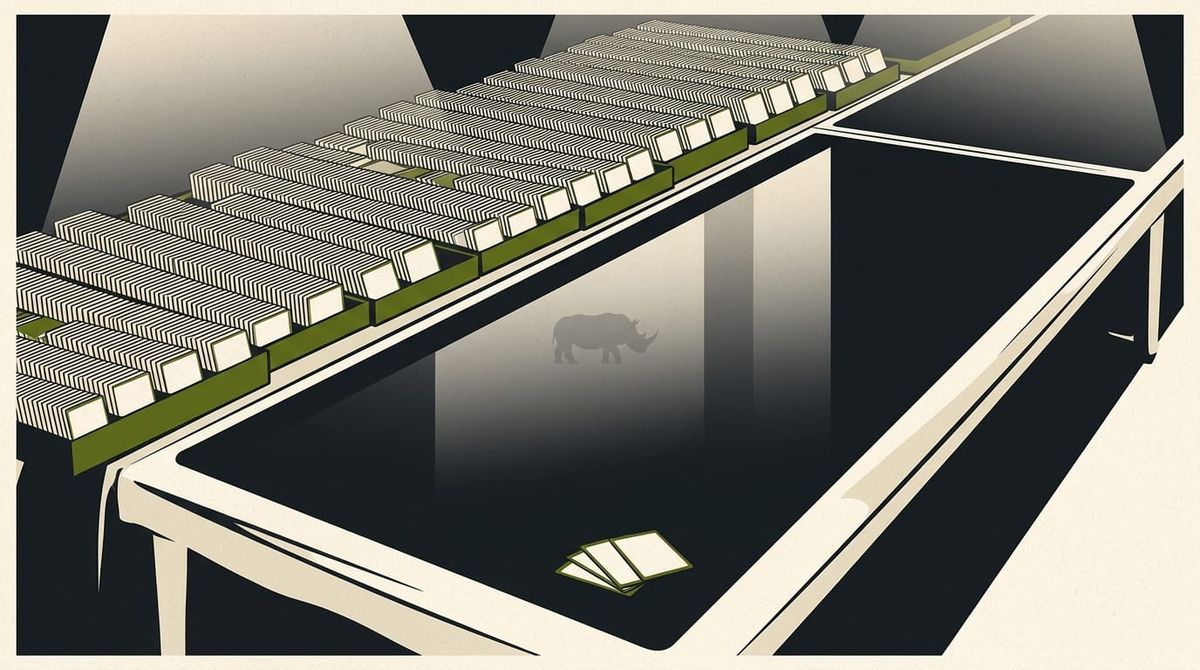
Sports cards grew into a $13bn market on buyers who admit they're in it to flip. If 40% of new buyers leave instead of becoming collectors, $2.2bn a year is at risk — and the 1990s card glut shows how fast it can vanish.
Sports cards became a $13bn market, and much of that growth came from new buyers who openly say they buy to resell for profit, not to keep. Gen Z is 40% of new US buyers, and they are the group most likely to flip. The danger: if those resellers can't sell at a profit, they leave — and the 1990s card glut, when billions of cards stayed worthless for decades, shows how fast that can happen. We estimate $2.2bn in yearly sales at risk, about 16.8% of the market.
The market underprices this because record grading volumes — 26.6 million cards in 2025, up 26% — look like proof of health, when they may just be flippers chasing quick gains.
Funko (FNKO) lives and dies by collectible booms and would feel a mood shift first. eBay (EBAY) earns fees on every card resale, so fewer flippers means fewer trades. GameStop (GME) has leaned into card sales in its stores, exposing it directly if the flip crowd walks.
Why this matters. Sports cards grew into a $13bn market on the backs of new buyers who admit they bought to resell, not to keep. If those flippers leave instead of becoming lifelong collectors, demand could fall by about $2.2bn a year. Anyone who lent against, owns, or runs a card business — from Fanatics' grading line to local shops — is betting the boom buyers convert.
Blindside · Toys & Collectibles
Sports Cards' Buyers Want Out
A boom built on resellers who may never become collectors
Building
78
Blindside index
What drives it — drag to test
each slider starts at our cited estimate — drag to see the range
Share of buyers who buy to flip, not keep40%
Sourced — Gen Z is 40% of new US buyers and the group most likely to buy purely to resell (Fresh Card Insights, CivicScience).
Share of flippers who quit if they can't sell35%
Our judgment — no fixed number; in the 1990s card glut, speculative buying fell roughly 70-90% and prices stayed flat for decades.
Our judgment — grading hit 26.6M cards in 2025 and Fanatics paid over ten times prior license deals; a buyer collapse repays neither.
Time to impact
3–6 yearsBuilding
now3 yrs7+ yrs
When the financial hit begins to land, on our read.
How to read this. Drag any slider to test your own number — the chart and index update live. The likelihood and the locked facts stay put.
Yearly card sales at risk
$2.2bn16.80% of sector
Dark line = most likely · faint lines = low–high (8 in 10 outcomes land between) · shaded band = what outside analysts expect
Our estimate lands within what outside analysts expect ✓
Chance this is a permanent shift, not a blip
45%
Average of five independent reads (range 32–55%):
The track record50%
Booms built on speculation usually crash (1990s cards, Beanie Babies); but this time young buyers really are showing up.
How it works55%
New buyers admit they're in it to resell; 429-million-card print runs recreate the glut. Turning flippers into keepers is unproven.
The skeptic's case35%
Young buyers really are arriving. The market may split: rare graded cards rise, common cards go worthless, but the high end survives.
The optimist's case32%
Fanatics paid $10.4bn after full study; live-selling apps like Whatnot and Loupe are bringing in genuinely new, younger, loyal buyers.
The wary investor55%
A 15-20 year deal priced off an inflated 2021-25 boom is risky if flippers age out. 'Too big to fail' is a late-cycle warning.
Fixed — the sliders change the size of the hit, not the odds it's permanent.
Why this matters
Sports cards grew into a $13bn market on the backs of new buyers who admit they bought to resell, not to keep. If those flippers leave instead of becoming lifelong collectors, demand could fall by about $2.2bn a year. Anyone who lent against, owns, or runs a card business — from Fanatics' grading line to local shops — is betting the boom buyers convert.
MLBPA's Fanatics deal vs any prior card contract; 15-20yr exclusives
Tony Clark, MLBPA / ESPN
26.6M
cards graded in 2025 (+26% YoY; PSA = 71% share)
GemRate / Sports Illustrated 2025
40%
of new US card buyers are Gen Z — the cohort most likely to buy to resell
Fresh Card Insights / CivicScience
65%
of collectors are 18-35 — a base concentrated in flip-era entrants
Fresh Card Insights
429M
NBA cards in 2025-26 Fanatics/Topps flagship; 1.26M copies of each base card
Athlon / hobby production data 2026
1990s
junk-wax precedent: billions printed, values stayed near-zero for decades
20SomethingFinance / hobby history
Attention stays flat and low while the impact builds. the gap stays open.
Our middle estimate puts $2.2bn in yearly sports-card sales at risk (range $1.6bn-$2.9bn, about 16.8% of the $13bn market), because the 40% of new US buyers who arrived as resellers may never become durable collectors. Fanatics' $10.4bn valuation and 15-20 year exclusive deals can survive a split market where rare cards hold value; a 429-million-card flagship print run, sold to a generation that still remembers the 1990s glut, cannot.