About a third of Lego's sales ride on Disney and Warner Bros. brands. When those deals renew in 2026–28, the owners can demand more — putting $183m of yearly profit, around 7% of Lego's base, quietly in play.
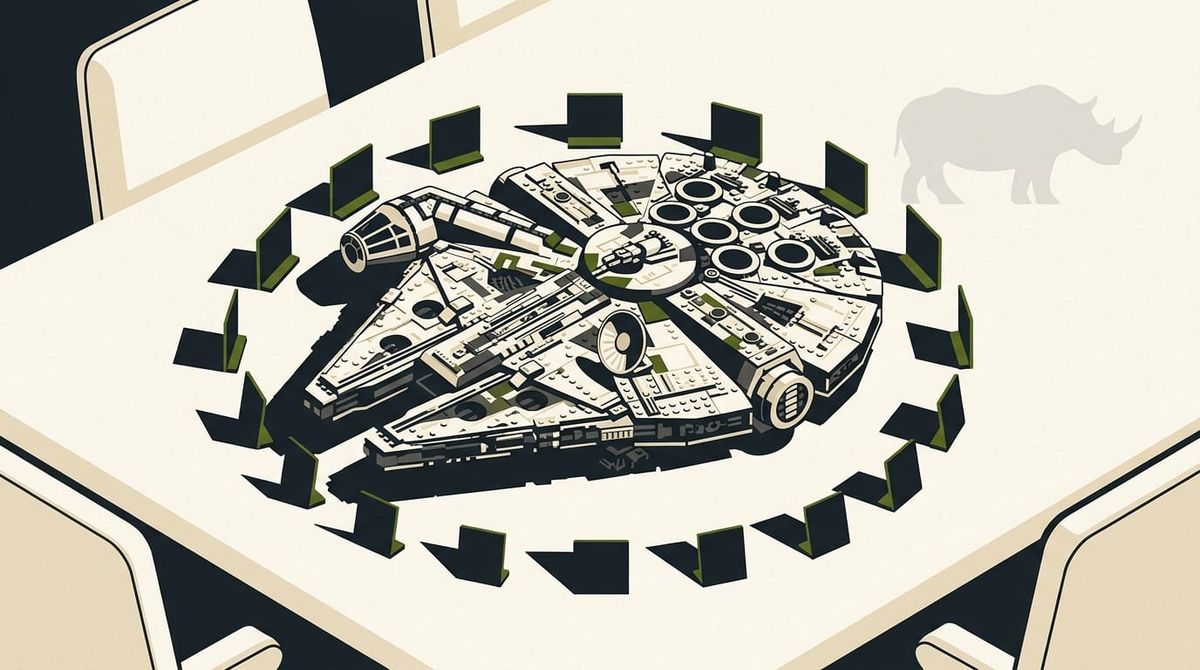
Roughly a third of Lego's revenue comes from sets built on outside brands like Star Wars and Harry Potter. Those brands belong to Disney and Warner Bros., who already take 10–20% of the wholesale price as a fee. When Lego's deals come up for renewal between 2026 and 2028, those owners can push for a bigger cut — and Lego, having proven how many of these sets it can sell, has limited room to say no.
The market underprices this because it treats brand fees as a fixed cost that never changes. In reality it is rent, and a few owners hold the leverage. Our middle estimate is $183m of yearly profit at risk, about 7% of Lego's $2.6bn base, on its most profitable year ever.
The Walt Disney Company and Warner Bros. Discovery are on the winning side, owning the brands and the bargaining power. Rival toymakers Mattel and Hasbro face the same math — they too rent hit brands and would absorb richer terms whenever their own deals reset.
Why this matters. When Lego's deals with Disney and Warner Bros. come up for renewal between 2026 and 2028, those owners can demand a bigger slice of every Star Wars and Harry Potter set sold. The market treats Lego's brand fees as a fixed cost that never moves, when they are really rent that rising owners can lift. Investors in the brand owners benefit; anyone counting on Lego's record profits holding steady is exposed to a slow, quiet squeeze.
Blindside · Toys & Collectibles
Disney and Warner Squeeze Lego
movie-brand owners raise their cut when Lego's deals come up for renewal
Building
71
Blindside index
What drives it — drag to test
each slider starts at our cited estimate — drag to see the range
Share of Lego profit riding on movie-brand sets33%
Sourced — sets built on outside brands are about one-third of Lego's sales, used here as a profit stand-in.
Profit lost on those sets as royalties rise18%
Our judgment — premium brands charge 10–20% of wholesale; a few points more plus limited price pass-through eats the margin at 2026–28 renewals.
Few brand owners hold most of the bargaining power+10%
Our judgment — Disney owns Star Wars and Marvel, Warner owns Harry Potter, so a handful of owners can demand more across the board.
Time to impact
2–5 yearsBuilding
now3 yrs7+ yrs
When the financial hit begins to land, on our read.
How to read this. Drag any slider to test your own number — the chart and index update live. The likelihood and the locked facts stay put.
Yearly profit at risk from richer royalties
$183m7.03% of sector
Dark line = most likely · faint lines = low–high (8 in 10 outcomes land between) · shaded band = what outside analysts expect
Our estimate lands within what outside analysts expect ✓
Chance this is a permanent shift, not a blip
46%
Average of five independent reads (range 35–55%):
The track record50%
Brand owners with hit properties routinely raise their cut at renewal once a partner clearly depends on them.
How it works55%
A third of profit rides on a few brands at 10–20% royalties; Disney and Warner renew across 2026–28.
The skeptic's case40%
Lego is the prize partner; owners need its execution, and Lego can raise prices or lean on its own brands.
What the market shows35%
Lego just posted its most profitable year ever, absorbing brand costs from strength rather than weakness.
What watchers expect52%
A private, low-debt company can swallow a quiet fee rise, so the drag stays hidden and underpriced.
Fixed — the sliders change the size of the hit, not the odds it's permanent.
Why this matters
When Lego's deals with Disney and Warner Bros. come up for renewal between 2026 and 2028, those owners can demand a bigger slice of every Star Wars and Harry Potter set sold. The market treats Lego's brand fees as a fixed cost that never moves, when they are really rent that rising owners can lift. Investors in the brand owners benefit; anyone counting on Lego's record profits holding steady is exposed to a slow, quiet squeeze.
Most exposed companies
The Walt Disney Company DIS · Warner Bros. Discovery WBD · Mattel MAT · Hasbro HAS
🔒
The facts — locked
measured, not editable
$13.02bn
Lego 2025 revenue (DKK 83.5bn, +12%); net profit $2.6bn (+21%)
LEGO Group FY2025
~1/3
of Lego revenue comes from entertainment-licensed sets (Star Wars, etc.)
CNBC 2024
10-20%
royalty rate on premium IP (Disney) as % of wholesale
toy-licensing royalty data 2025
5-15%
typical toy-licensing royalty range for established brands
UpCounsel / licensing data
~20%
price premium licensed Lego sets carry over unlicensed — the consumer IP tax
BrickNerd analysis
$263M
Lego royalty expense (2012 reference) — the scale of the IP tax line
MTLR / Lego historicals
Star Wars + HP
the two biggest 2024 licenses — Disney + Warner Bros hold the leverage
LEGO Group / Kidscreen
Attention is climbing. the market is starting to price this in — the early window is closing.
Our middle estimate puts $183m of yearly Lego net profit at risk (range $130m–$248m; 7.0% of the $2.6bn base) as a concentrated 2026–28 renewal cycle — anchored by Disney and Warner Bros. charging 10–20% of wholesale on their brands — forces a renegotiation the market still books as a fixed cost. Lego's record 2025 profit is real; so is the exposure of a roughly one-third licensed-revenue base to owners who know exactly how much shelf space they command.