Twenty Ways to Lose Half Your Money
From gene therapy to Litecoin, the loudest pitches among the 21 themes FASTMaster tracks took the deepest cuts in early 2026 — proof a good story is no floor.

The Tape
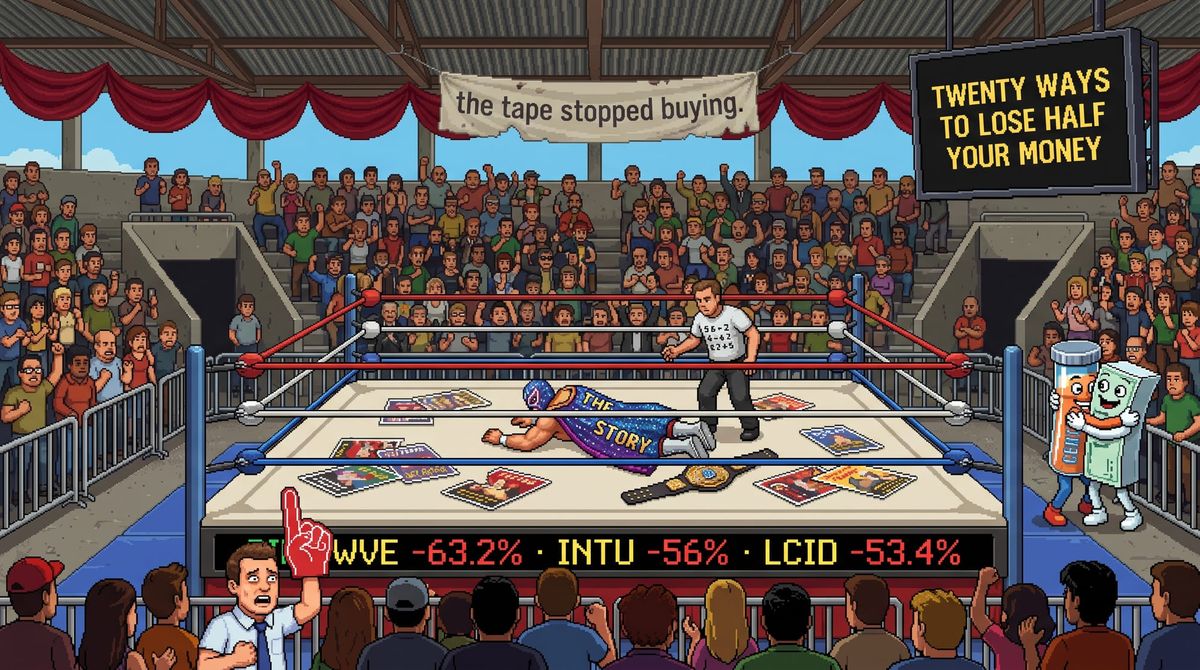
This was the six months the market stopped grading on a story and started grading on a business — and most of these names didn't have one yet. The deepest cut on our board belongs to Wave Life Sciences, the RNA-medicine developer that beat its own Q1 estimates, kept a $13 price target from its bank, and still lost 63.2% of its value over the first half of 2026. When an earnings beat and a Buy rating buy you nothing, the lesson isn't about one drug — it's that across the 21 themes FASTMaster tracks, the year's punishment fell hardest on bets where the pitch had outrun the proof.
The Burn List
The slide-deck biotechs
Early-stage biotech is the purest form of paying for a sentence, and in H1 the sentences stopped clearing. Wave Life Sciences, which engineers RNA-based medicines, did everything the script asks — it surprised to the upside on earnings and held its analyst target — and finished down 63.2%, the worst single name on our board. The bank stayed bullish. The market stopped reading along.
Enveric Biosciences, which develops psychedelic-derived drugs minus the hallucination, spent the half pitching investors a presentation deck and lost 58.3% doing it. Its peer Cybin, a clinical-stage developer in the same space, was less bruised only by degree, down 48.1%. Selling neuroplasticity without the trip is a clever line. A clever line is not a Phase 3 readout, and the buyers belatedly noticed the difference.
The blue-chip that bled like a meme
Here is the half's genuine surprise. Intuit, the cash machine behind TurboTax and QuickBooks, fell 56.0% — a steeper drop than most of the speculative names below it. In fairness, a software giant getting cut harder than a meme stock takes some doing. It managed it by raising fresh debt into an AI pivot while a shareholder-claims investigation circled, which is how the market reframed a margin story as a spending one. The wider Tech theme fell a far gentler 16.9%; Intuit found a way to do four times worse on its own.
The betting boom that bet on itself
The growth story in sports betting met its own odds. Gambling.com Group, an affiliate marketer that funnels punters to the sportsbooks, lost 54.3% as the industry it feeds began trimming headcount. The leader did no better: Flutter, the FanDuel parent and the biggest US book, shed executives, hundreds of jobs, and 49.3% of its value. A boom that announces layoffs at the top of the table isn't a boom anymore — it's a cost-control exercise, and the tape priced it as one.
The meme deflation
The meme trade ran on belief, and belief got expensive. Lucid Motors, the luxury-EV maker, shipped hands-free driving on its Gravity SUV and still dropped 53.4% — proof that you can deliver the feature and still not outrun the cash burn underneath it. Trump Media, the social-platform operator, needed no such catalyst at all, sliding 43.4% on nothing in particular. The Meme Stocks theme fell 24.0% overall; these two more than doubled the damage, which is what happens when the only fundamental was enthusiasm and the enthusiasm left.
The robots that shipped losses faster than hardware
Robotics keeps selling the future and invoicing the present. Knightscope, which leases security robots, fell 51.0% with the autonomy narrative doing none of the lifting. Serve Robotics, which builds sidewalk delivery bots, was less battered at 41.1% — less battered, hardly unbruised. Both are still valued for what they'll someday earn, and in H1 the market asked, not unreasonably, to see a deployment count instead of a demo reel.
The crypto crater
The selloff here was democratic — it didn't care about your tier. Cardano, a top-ten blockchain token, dropped 26% around its Van Rossem hardfork en route to a 45.0% half-year loss; Avalanche, another large-cap chain, matched it tick for tick at 45.0% even as a treasury-strategy vehicle rang the Nasdaq bell in its name. Solana (-42.9%) and Ethereum (-41.9%) fell alongside them, tokenized-stock plumbing and zero-knowledge roadmaps notwithstanding. Even the steadiest, Litecoin, the veteran payments coin, lost 41.0% — the least-bad of a bad bunch. The Crypto theme fell 36.2%; these five managed to fall harder than their own wreckage.
The premiums that stopped commanding one
Some of these names didn't have a missing business — they had a vanishing edge. Tencent Music, China's leading streaming platform, lost 48.4% after its own parent walked away from the exclusive copyrights that were the whole moat; the premium left with the exclusivity. Roblox, the kids' game platform, touted real-world fandom and in-game purchases right as Las Vegas parents sued over child safety, and the engagement story couldn't out-shout the courtroom — down 46.5%. Lululemon, the premium activewear brand, crashed to its lowest level since 2018 and handed Michael Burry's short the win, off 43.7% as the label kept de-rating. A premium is a thing the market agrees to pay extra for. In the first half of 2026, it stopped agreeing.
The contracts that didn't add up to a company
Two names landed exactly the headline their bulls wanted and fell anyway. Arqit Quantum, which sells quantum-safe encryption, booked a defense-collaboration win and reported results, and the market shrugged it down 44.6% — far worse than the Quantum theme's 14.8% slide. Centrus Energy, a US uranium enricher and a marquee name in the reactor-revival trade, fell 40.3% as a weakening earnings outlook made the dip impossible to buy; its theme lost just 11.1%, so this was Centrus's own problem, not the sector's. A contract and a press release are not yet revenue, and the gap between them was the trade.
The Lesson
Walk the whole list and the same tell sits at the front of every name: at the start of the year, each one was sold on a sentence the buyer was supposed to finish. The biotech's buy rating, the psychedelic's deck, the robot's demo, the crypto chain's roadmap, the encryption firm's defense logo, the brand's premium — all of them asked the market to price a future and trust that the business would arrive on schedule. For a while that trust was free. In the first half of 2026 it stopped being free, and the names with the loudest stories and the thinnest proof paid the steepest interest. The tell wasn't the sector or the size — Intuit was a profitable blue-chip and fell harder than a Trump-branded social network. The tell was the gap between what these companies claimed and what they could yet show. Mind the gap. By the year's first half, the gap was the whole trade.